Ikechukwu Onuoma Esq


Online Dispute Resolution (ODR) refers to the use of Alternative Dispute Resolution (ADR) mechanisms over the internet. ODR methods can be used to deal with both offline- and online-related disputes.
The idea of using ADR mechanisms “online”, as opposed to “offline”, appears to have arisen in the 1990s. During that decade, some of the most noticeable ODR services were provided by: (1) the Virtual Magistrate Project; (2) the Online Ombuds Office (OOO) ; and (3) the Online Mediation Project. These projects were originally developed under the auspices of various institutions, including the American Arbitration Association (AAA) and the National Center for Automated Information Research (NCAIR). Within a short period of time, dispute resolution professionals realized that there were possibilities for considerable expansion of this burgeoning field. In 1997, Professors Ethan Katsh and Janet Rifkin founded the National Center for Technology and Dispute Resolution, which “supports and sustains the development of information technology applications, institutional resources, and theoretical and applied knowledge for better understanding and managing conflict”. Four years later, the first book in the field of ODR was written.
In principle, ODR mechanisms are expected, among other things, to “facilitate access to justice”, and should therefore be able to tackle some of the problems concerning the use of offline dispute resolution mechanisms. This is also true when we think of the fact that meditation is frequently accessed by busy clients in the commercial world. It is believed that ODR could “resolve disputes quickly and more efficiently” than the traditional methods but, to our knowledge, no research has been reliably and skillfully conducted to back up this assumption. ADR scholars have put forward various proposals aiming at developing an ODR system, and during the last 10 years an important number of ODR services have been developed. Within the vast array of ODR mechanisms, negotiation, mediation and arbitration appear to be the most commonly practiced. Focus is placed here on Mediaton.
E-Mediation can be defined as a system-based—as opposed to a face-to-face-based—mechanism in which an impartial third party called “the mediator” facilitates the negotiation process between two or more people. It is true that in just a few years the picture has changed dramatically. Each year close to a million disputes are resolved online and over a hundred online dispute resolution providers offer their services worldwide. From a technology gadget, ODR has become a major phenomenon in dispute settlement. At first sight, the online environment would not seem conducive to successful mediation. Offline, the human element and the personal authority of the mediator whom the parties trust are keys to the success of the process. Surprisingly, a survey conducted among both online mediation practitioners and mediators without any online experience showed the latter to be sceptical while the former were convinced of the benefits of the process and witnessed high settlement rates online. The main reasons for the positive assessment of online mediation lie in the advantages gained from asynchronous communication that allows time to reflect before reacting to a proposal from the other side or from the mediator. Other benefits are significant savings in cost and time, and convenience. In ‘Frontiers of Law: The Internet and Cyberspace: Cyber-Mediation: Computer-Mediated Communications Medium Massaging the Message’ (2002) 32 New Mexico Law Review 27 at 42–43 and passim; On the basis of this survey, online mediation could well develop and deliver beyond initial expectations, provided potential users abandon their perception of this method as unsuited to electronic means of communication. Of course it is true that some mediations are better suited for ODR.
In any event, is likely that non-binding methods of dispute resolution will continue to be prevalent in ODR—a reflection of what the French legal philosopher Mireille Delmas-Marty calls ‘véritable triomphe du mou, du flou, du doux’ (blandly, ‘the true victory of soft law’).
Ikechukwu Onuoma Esq,Managing Partner, Obra Legal
“Order Justice Omolaye-Ajileye’s Electronic Evidence Books Now” — Essential Guides On Evidence Act, Case Law And Digital Proof
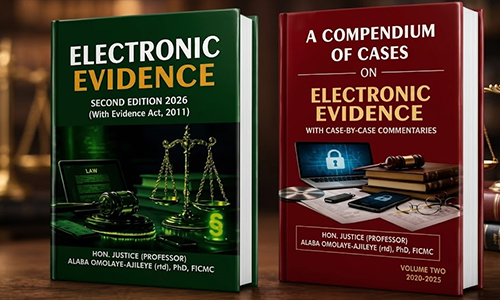
[A MUST HAVE] Evidence Act Demystified With Recent And Contemporary Cases And Materials

Available now for NGN 40,000 at ASC Publications, 10, Boyle Street, Onikan, Lagos. Beside High Court, TBS. Email publications@ayindesanni.com or WhatsApp +2347056667384. Purchase Link: https://paystack.com/buy/evidence-act-complete-annotation
______________________________________________________________________ “Enhance Legal Practice With Authoritative Reports” — Alexander Payne Offers Comprehensive Law Reports, Spanning Over A Century Of Nigerian Jurisprudence Interested buyers are encouraged to place their orders and enquiries via:
0704 444 4777, 0704 444 4999, 0818 199 9888
Website: www.alexandernigeria.com
Interested buyers are encouraged to place their orders and enquiries via:
0704 444 4777, 0704 444 4999, 0818 199 9888
Website: www.alexandernigeria.com
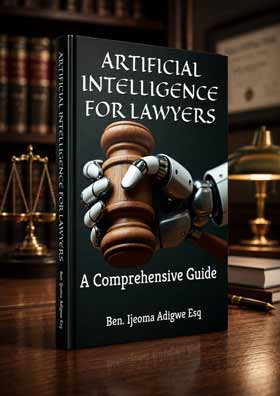 The book also examines Nigeria's legal ecosystem, focusing on the LPELR and NBA AI Guidelines. As a bonus, every purchase comes with a FREE eBook titled: How to Use the AI Features in LegalPedia and LawPavilion.
Ohio Books Ltd praises the publication, stating:
"....this is the only Nigerian book I know of on the topic."
How to Order:
📞 Call, Text, or WhatsApp: 08034917063 | 07055285878
📧 Email: benadigwe1@gmail.com
🌎 Website: www.benadigwe.com
Ebook Version: Access it directly online at https://selar.com/prv626
Authored by Ben Ijeoma Adigwe Esq., ACIarb (UK), LL.M, Dip. in Artificial Intelligence, Director at the Delta State Ministry of Justice, Asaba, Nigeria.
______________________________________________________________________
The book also examines Nigeria's legal ecosystem, focusing on the LPELR and NBA AI Guidelines. As a bonus, every purchase comes with a FREE eBook titled: How to Use the AI Features in LegalPedia and LawPavilion.
Ohio Books Ltd praises the publication, stating:
"....this is the only Nigerian book I know of on the topic."
How to Order:
📞 Call, Text, or WhatsApp: 08034917063 | 07055285878
📧 Email: benadigwe1@gmail.com
🌎 Website: www.benadigwe.com
Ebook Version: Access it directly online at https://selar.com/prv626
Authored by Ben Ijeoma Adigwe Esq., ACIarb (UK), LL.M, Dip. in Artificial Intelligence, Director at the Delta State Ministry of Justice, Asaba, Nigeria.
______________________________________________________________________