The geopolitics of power, domination, colonization and control that has seductively engulfed the AFDB and has been trying to reap off and rape off the corporate governance structure of the AFDB is no longer a new development to Africans and the world at large.

According to Article 29 of the Agreement establishing the AFDB, it is trite that: “all the powers of the bank shall be vested in the Board of Governors…” Consequently, the powers of the Board of Governors of the bank has been guaranteed but must be exercised within the confines of the powers of the bank as provided for in the Agreement.
Now, the pertinent question to ask is whether the resolution of the Board of Governors to authorize an independent review of the report of the Board of Directors through an independent investigator is legal?
Determining whether the Board of Governors has the power to act or review the report of the Board of Directors or, alternatively, is in breach of any Agreement, Rules, Regulations, Terms of Reference or Resolution, is principally a matter of construing the above mentioned AFDB legal instruments, especially the contents of the legal instrument guiding the relationship between the AFDB and its President, Board of Directors and Board of Governors, and then deciding whether on the facts, the Board of Governors resolution for review of the Board of Director’s report through an independent review process is in breach of any imposed prescriptions of the AFDB.
The spirit and letters of the AFDB Compendium of Texts Relating to the Conduct of Elected Officers of the African Development Bank and the African Development Fund (AFDF) is very clear and unambiguous. A cursory look at the content of this compendium will x-ray the fact that the compendium comprises of the Code of Conduct for Executive Directors of the AFDB and AFDF, the Revised Terms of Reference of the Ethics Committee of the Board of Directors of the AFDB and AFDF; and the Resolution adopted by the Board of Governors of the African Development Bank on 14th May, 2008, regarding the application of the Code of Conduct for Executive Directors of the AFDB and AFDF to the President of the bank group.
In the light of the above premises and having a further and specific look on the Board of Governors Resolution N B/BG/2008/11, adopted at the first sitting of the Forty-third annual general meeting of the AFDB, on the 14th May, 2008, it is crystal clear that the Code of Conduct for Executive Directors of the AFDB and AFDF is applicable to the President of the Bank, as provided for in Article 1 of the Resolution.
Article 2 of the same Resolution provides for the procedures for lodging a complaint/allegation before the Ethics Committee of the Bank against the President of the Bank for any violation of the provisions of the Code of Conduct. In a similar vein, upon submission of such complaint to the Ethics Committee, Article 3 of the same Resolution provides for procedures for examining such allegations/complaints. Article 3 provides as follows:
“The Ethics Committee shall conduct a preliminary examination of the complaint or allegation to determine whether it is based on apparently solid justifications with a view to submitting it to the Chairperson of the Bureau of the Board of Governors under the following conditions:
If the preliminary examination of the complaint or allegation shows that it is frivolous or not based on any objective and solid facts, it shall be dismissed.
If the preliminary examination of the complaint or allegation reveals facts that are capable of establishing violations of the Code of Conduct, the complaint or allegation shall be submitted to the Chairperson of the Bureau of the Board of Governors for further examination”.
Considering the 1st subparagraph of Article 3 of the Resolution, the Ethics Committee having examined the allegations/complaint against the President, dismissed same for being frivolous and not based on any objective and solid facts. However, Article 3 has been watered down by Article 4 of the same Resolution. Article 4 vests on the Board of Governors the competence to finally determine whether or not there exists a reasonable basis for pursuing a complaint or an allegation in relation to any violation by the President. Article 4 provides as follows:
“Notwithstanding the provisions of Article 3 of this Resolution, the Chairperson of the Bureau of the Board of Governors, in consultation with other members of the said Bureau, shall have sole competence to finally determine whether or not there exists a reasonable basis for pursuing a complaint or an allegation in relation to the violation by the President of any provision of the Code of Conduct.
In taking his/her decision, the Chairperson of the Bureau of the Board of Governors may require the Ethics Committee and the person that made the complaint or allegation or any Department of the Bank, to provide additional information and clarifications, where necessary.
The Chairperson of the Bureau of the Board of Governors may, in appropriate cases, require the Ethics Committee to conduct more in-depth investigations”.
From all intent and purposes, Article 4 did not in any way empower the Board of Governors to use an independent investigator to review the report of the Board of Directors. If the services of an independent investigator is needed, the Resolution would have provided for such as expressly provided for in section 3(18) of the Revised Terms of Reference of the Ethics Committee of the Board of Directors. Section 3(18) of the Terms of Reference provides with respect to review of allegations of violation of the Code of Conduct or any real or potential conflict of interest against a “Board official” as follows:
“The committee may conduct its investigations with the assistance of the Ethics Advisor(s) and/or an independent investigator”.
Resolution N B/BG/2008/11, only empowered the Chairperson of the Bureau of Board of Governors, in consultation with others members of the said Bureau to finally determine whether or not there exists a reasonable basis for pursuing a complaint or an allegation in relation to the Code of Conduct, and in appropriate cases, the Chairperson of the Bureau of the Board of Governors may require the Ethics Committee to conduct more in depth investigations. Nowhere was the Board of Governors empowered to use independent person or investigator to review the report of the Board of Directors or conduct further in-depth investigations. The latin maxim- Delegatus non potest delegare is apposite. A person to whom a power, trust or authority is given to act on behalf or for the benefit of another cannot delegate it unless he is authorized to do so. This is because the delegation involves a matter of personal trust between the grantor and the delegate. Consequent upon the above premises, it is evident that the agreement of the Bureau of Board of Governors to invite an independent investigator or person to review the Board of Directors report is ultra vires and an abuse of public power and authority.
In Westminster v. London & North Western Railway Coy (1905) A.C. 436 at 430, Lord Macnaghten enthused as follows: “A public body invested with statutory power must take care not to exceed or abuse its powers. It must keep within the limits of the authority committed to it. It must act reasonably”.
Elsewhere in Nigeria, the Court of Appeal, in re-echoing the decisions of the English Court in the cases of Essex County Council v. Essex Incorporated Church Union (1963) A.C. 808, at P. 828, and Guardian of Salford Union V. Dewhurst (1926) A.C.619, held as follows in the case of Eboreime V. Arumeme (1977) LPELR – 12812 (CA), “……Persons who are appointed members of public boards or bodies whose activities and modus operandi are defined or regulated by statutes ought to always remember that however they feel about any issue that comes before them by virtue of such an appointment, they are bound to act strictly in accordance with the letters of the statutes…. Anything short of this is an abuse of public power and authority and such an abuse does nobody any good”. Per Nnaemeka-Agu, J.C.A., (as he then was).
PERMUTATIONS OF THE BOARD OF THE GOVERNORS OF AFDB
Another pertinent question begging for answers is why the AFDB Board of Governors permutated and staggered with their original decision illegally after finally endorsing the report of the Board of Governors in accordance with the laid down procedures. Is it possible they misinterpreted the relevant provisions of the AFDB legal instruments or is it because of the colonial knee on the neck of the AFDB that is putting so much fear and pressure on them? The truth is that a corporate decision has been taken in accordance with the laid down procedures of the bank. Later somersaulting and bowing to colonial pressure in order to maneuver the laid down rules and procedures of the bank is unlawful. Even in normal corporate governance structure, once a particular business decision is reserved for a particular organ of the company to take, another organ of the company cannot override such powers. Below authorities elucidate more on the above stated principle.
In the case of Automatic Self-Cleansing Filter Syndicate Co. Ltd v. Cuninghame (1906) 2 Ch 34, the Court held thus:
“…That even a resolution of a numerical majority at a general meeting of the company cannot impose its will upon the directors when the articles have confided to them the control of the company’s affairs. The directors are not servants to obey directions given by shareholders as individuals; they are persons who may by the regulations be entrusted with the control of the business, and if so entrusted they can be dispossessed from that control only by the statutory majority which can alter the articles. Directors are not, I think, bound to comply with the directions even of all the corporators acting as individuals. Of course the corporators have it in their power by proper resolutions, which would generally be special, to remove directors who do not act as they desire…..”
Similarly, in the case of John Shaw & Sons (Salford) Ltd v. Shaw (1935) 2 KB 113, the Court of Appeal, per Greer L.J, further held thus:
“….I am therefore of opinion that the learned judge was right in refusing to dismiss the action on the plea that it was commenced without the authority of the plaintiff company. I think the judge was also right in refusing to give effect to the resolution of the meeting of the shareholders requiring the chairman to instruct the company’s solicitors not to proceed further with the action. A company is an entity distinct alike from its shareholders and its directors. Some of its powers may, according to its articles, be exercised by directors, certain other powers may be reserved for the shareholders in general meeting. If powers of management are vested in the directors, they and they alone can exercise these powers. The only way in which the general body of the shareholders can control the exercise of powers vested by the articles in the directors is by altering their articles, or if opportunity arises under the articles, by refusing to re-elect the directors of whose actions they disapprove. They cannot themselves usurp the powers which by the articles are vested in the directors any more than the directors can usurp the powers vested by the articles in the general body of the shareholders…”
Furthermore, the law is trite that a company owns its business; the fact that one person controls the company and every aspect of its business does not make that business the controller’s; it is still the company’s. The fact that one person holds all, or substantially all, of the shares in a company does not without more, make the company’s business that person’s business in the eyes of the law. Cases of Salomon V. A. Salomon & Co. Ltd (1897) AC 22 (House of Lords) and Gramophone and Typewriter Co. Ltd V. Stanley (1908) 2 KB 89 (Court of Appeal) are apposite.
Isaiah Berlin, a Latvian-born British social and political theorist, philosopher and historian of ideas, stated thus: “I wish my life and decisions to depend upon myself, not on external forces of whatever kind. I wish to be the instrument of my own, not other men’s act of will. I wish to be the subject not an object….i wish to be somebody not nobody, a doer-deciding, not being decided for, self-directed and not acted upon by external nature or by other men as if I were a thing, or an animal, or a slave incapable of playing a human role, that is, of conceiving goals and policies of my own and realizing them”.
Finally, like George Floyd, the colonial knee on the neck of the AFDB is tortious to AFDB. AFDB should be allowed it to thrive. AFDB management should be allowed to burn its fingers and learn its lessons.
May God bless and heal Africa. Kasiemobi Oranugo, Esq.,08065613658
 The book also examines Nigeria's legal ecosystem, focusing on the LPELR and NBA AI Guidelines. As a bonus, every purchase comes with a FREE eBook titled: How to Use the AI Features in LegalPedia and LawPavilion.
Ohio Books Ltd praises the publication, stating:
"....this is the only Nigerian book I know of on the topic."
How to Order:
📞 Call, Text, or WhatsApp: 08034917063 | 07055285878
📧 Email: benadigwe1@gmail.com
🌎 Website: www.benadigwe.com
Ebook Version: Access it directly online at https://selar.com/prv626
Authored by Ben Ijeoma Adigwe Esq., ACIarb (UK), LL.M, Dip. in Artificial Intelligence, Director at the Delta State Ministry of Justice, Asaba, Nigeria.
_______________________________________________________________________
The book also examines Nigeria's legal ecosystem, focusing on the LPELR and NBA AI Guidelines. As a bonus, every purchase comes with a FREE eBook titled: How to Use the AI Features in LegalPedia and LawPavilion.
Ohio Books Ltd praises the publication, stating:
"....this is the only Nigerian book I know of on the topic."
How to Order:
📞 Call, Text, or WhatsApp: 08034917063 | 07055285878
📧 Email: benadigwe1@gmail.com
🌎 Website: www.benadigwe.com
Ebook Version: Access it directly online at https://selar.com/prv626
Authored by Ben Ijeoma Adigwe Esq., ACIarb (UK), LL.M, Dip. in Artificial Intelligence, Director at the Delta State Ministry of Justice, Asaba, Nigeria.
_______________________________________________________________________
“Order Justice Omolaye-Ajileye’s Electronic Evidence Books Now” — Essential Guides On Evidence Act, Case Law And Digital Proof
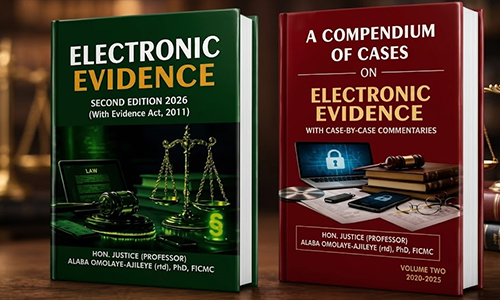
 Interested buyers are encouraged to place their orders and enquiries via:
0704 444 4777, 0704 444 4999, 0818 199 9888
Website: www.alexandernigeria.com
Interested buyers are encouraged to place their orders and enquiries via:
0704 444 4777, 0704 444 4999, 0818 199 9888
Website: www.alexandernigeria.com