By Nnenna Ogbenna Esq., (LLB, BL, LLM)


Introduction
The World Health Organization (WHO) first declared Covid-19 a world health emergency in January 2020. As the coronavirus pandemic spreads across the globe, the term “virus” has gotten much airplay. Viruses are the most common biological entities on Earth. Viruses rely on the cells of other organisms to survive and reproduce. They cannot function outside a host organism, which is because they cannot store energy themselves. They can therefore be called microscopic parasites. Without deep diving into what is and isn’t a virus, a decent definition of a virus is that a Virus is a microscopic parasite, generally much smaller than bacteria, that lacks the capacity to thrive and reproduce outside of a host body.1
The corona virus belongs to a large family of viruses that are known to cause illness ranging from the common cold to more severe diseases such as Middle East Respiratory Syndrome (MERS) and Severe Acute Respiratory Syndrome (SARS).2 The coronavirus disease (Covid-19), which originated in China, has spread to several countries and territories, Nigeria inclusive. Many economies around the globe have witnessed reduced economic activities in the first half of the year. The global supply chain has been disrupted and, companies, small businesses, and industrial facilities have been shut down in affected countries in a bid to contain the spread of the coronavirus disease which has further led to lockdowns and travel restrictions across countries.
With domestic and international restrictions on movement hampering trade and travel, most businesses had to alter their operations or completely stop. Productivity became challenging, so was meeting up with estimated targets for businesses and companies.
Impact of Covid-19 on employment nationally and internationally
The pandemic has seen small businesses crashing and the unemployment rate increasing. Businesses and individuals have been observing social distancing due to the pandemic; meeting obligations have been extremely hard. The IMF released its forecast on April 14, 2020, labelling these times as the “Great Lockdown”. The IMF concluded that the global economy would experience its “worst recession since the Great Depression, surpassing that seen during the global financial crisis a decade ago. In addition, the IMF estimated that the global economy could decline by 3.0% in 2020, before growing by 5.8% in 2021; global trade is projected to fall in 2020 by 11.0% and oil prices are projected to fall by 42%.3 This forecast assumes that the pandemic fades in the second half of 2020 and that containment measures can be reversed quickly.4
Companies and businesses have informed some of their staff to proceed on leave without pay until further notice, some went further to implement a salary cut, and some relieved some staff of their jobs.
In 2017 (pre-Covid 19), the National Bureau of Statistics (NBS) reported that Nigeria’s unemployment rate rose to 23.1% and underemployment rose to 16.6%, with over 20 million Nigerians unemployed.5 This figure is likely to increase significantly with the impending job losses as a result of the pandemic.
Before Covid-19 spread worldwide – global unemployment already stood at around 190 million. These numbers have multiplied in a matter of weeks. By the ILO’s analysis, the impact of the Covid-19 pandemic far exceeds that of the 2008-2009 financial crisis. They expect that COVID-19 will wipe out 7% of working hours globally in the second quarter of 2020 – equivalent to 195 million full-time workers.
In Nigeria, it is no secret that unemployment has been a major issue yet to be adequately tackled. SMEs are responsible for most of Nigeria’s employment. They account for 96% of businesses and 84% of jobs (compared to 53% in the US, 60% in South Africa and 65% in Europe). For the last five years, they have contributed to around half of Nigeria’s GDP. Most of these small businesses in Nigeria are ill-equipped to handle a crisis of this scale, and the focus has now been switched to survival. The sectors most impacted by Covid-19 include leisure, real estate, transportation, aviation, tourism, and construction. This is because the current restrictions in place limits their ability to generate revenue.5
- Leisure
The pandemic also affected leisure activities. Gyms and aerobics classes, restaurants, recreational parks, bars, clubs, cinemas, weddings, burial ceremonies, parties, and leisure activities and small businesses that involve large crowds.
- Real estate
The real estate industry is not left out. While houses are still being sold, it is however at an all-time low. For land transactions, registration or searches would normally take maximum of two to three working days to process a search carried out in Abuja Geographic Information Systems (AGIS), now, due to the current restrictions and the fact that only level 14 officers and above can resume work, such searches may take two to three weeks.
- Transportation
Transportation is an essential service. Moving passengers, goods and services should be a top priority for any government. However, due to Covid-19, getting passengers became an issue because of the lockdown. Also, interstate road travels were suspended. All that mattered was the meeting of essential needs of steady supply of food, medical supplies, and emergency goods with minimal delays or restrictions during this period.
- Aviation
Airlines have been grounded for over two months following the spread of the Covid-19 pandemic and have made next to zero revenue, yet they continue to incur costs of maintenance of their aircrafts. The International Air Transport Association (IATA) estimates a loss of 3.5 million passengers in the Nigerian Aviation industry, due to restrictions necessary to curb the pandemic, resulting in over $760 million in lost revenue.6
- Tourism
Tourist spots are known for generating extra revenue for the government. However, the lockdown and the pandemic affected tourism both in and outside Nigeria. People were advised not to gather in groups of over 20, and tourist spots usually attract crowds. Even hotels were closed down.
- Construction
Construction workers have been affected by Covid-19 too. Construction works being carried out now takes double the time to complete because of social distancing and a reduction of the manpower that would normally be used.
None of the employment laws in Nigeria currently, envisaged a pandemic or steps to be taken when a situation such as this occurs. However, for the purpose of this write up, some areas of concern as it relates to the impact Covid-19 has on employment law and contracts will be addressed below;
What documents are legally binding between employers and employees?
An Employment Contract, and possibly the provisions of an employee handbook (if any). A contract signed by an employee means that the employee has accepted the terms and conditions of the contract.
Can a party in breach of a contractual obligation rely on the principle of frustration (force majeure) with respect to COVID-19?
Force majeure is a common law doctrine that acts as a device to set aside contracts where an unforeseen event renders contractual obligations impossible or makes the performance of the contract radically different from what the parties agreed upon at the time of the contract. A party seeking to rely on this principle now, must prove that:
- The contract was concluded before the pandemic happened.
- The Covid-19 pandemic was not foreseeable by the party;
- Because of Covid-19, practicability or performance of the contract obligation became impossible and is therefore not the fault of the party in breach.
Where a party to a contract refuses to meet its contractual obligations because of Covid-19, what remedy does the other party have?
The other party may choose to terminate the contract, or sue the other party for breach of contract and claim damages for specific performance (depending on the nature of the contract) or use the one in the contract (if there are any provided under the contract).
Can Covid- 19 be said to be an Act of God?
Covid-19 is a force majeure event and definitely not an Act of God. This is because Acts of God can be said to be natural disasters for example hurricanes, flood, landslides, earthquake, explosions, etc.
Does the lockdown affect companies and shareholders meetings?
In line with the guidelines of the Corporate Affairs Commission, section 230(1) CAMA allows for the use of proxies during these meetings.
- The approval of the Corporate Affairs Commission is sought before such meeting is held. Application is to be submitted to any of the branch offices in any state or via Email.
- A representative may be sent by the Corporate Affairs Commission to observe and report back to the Commission after the meeting
- The notice of meeting is to be sent to all members of the company.
- They are to observe physical distancing directive and restrict themselves to the maximum number allowed to be in a gathering at once. Hence the use of proxies.
Way forward
Covid-19, has led to countless unprecedented disruptions, which has affected economies globally. Things returning to normal or at least close to normal will take a long time.
Nigeria, on its own, faces a challenge possibly greater than other countries affected by Covid-19 pandemic as a result of being the country with the largest population and economy in Africa, with a population of approximately 196 million people.8
The Federal Government through the Central Bank of Nigeria (CBN) and the Federal Ministry of Finance, Budget, and National Planning introduced a N50 billion Targeted Credit Facility (TCF) as a stimulus package to support households and micro, small and medium enterprises (MSMEs) that are affected by the coronavirus pandemic. The participants eligible to apply for this fund are listed below;
- Households with verifiable evidence of livelihood adversely impacted by the coronavirus outbreak;
- Existing enterprises with verifiable evidence of business activities adversely affected as a result of the coronavirus pandemic (as part of its consistent review, CBN has declared that eligible applicant does not need to have a business plan),
- Firms in agricultural value chain activities.
- Hospitality industry (accommodation and food services)
- Airline service providers
- Health (pharmaceuticals and medical supplies)
- Manufacturing/value addition
- Trading and other income-generating activities as may be prescribed by the CBN.
This initiative aims to provide liquidity, mitigate the effect Covid-19 has had on small businesses, and enable them have continuity. Which in my opinion is a good initiative by the government and will assist the businesses that have access to the loans, to stay afloat. More steps however, need to be taken to cushion the aftermath of Covid-19.
By Nnenna Ogbenna Esq., (LLB, BL, LLM)Associate at Henry A. Iyanya & co,4th Floor, Right Wing, Kojo Motors Building,Mabuchi, Abuja., Email: nnennaof23@yahoo.co.uk Whatsapp: 09064190042.
REFERENCES
- Live Science https://www.livescience.com/53272-what-is-a-virus.html
- World Health Organization http://www.emro.who.int/health-topics/corona-virus/questions-and-answers.html
- The IMF database indicates that global GDP fell by 0.075% in 2009 during the height of the global financial crisis. https://www.imf.org/external/index.htm
- World Economic Outlook, International Monetary Fund, April 14, 2020, p. v.
- National Bureau of statistics https://www.nigerianstat.gov.ng/
- The economic impact of Covid-19 on the labor market https://www.stearsng.com/article/the-economic-impact-of-covid-19-on-the-labour-market
- IATA Database https://aviation-edge.com/?gclid=Cj0KCQjww_f2BRC-ARIsAP3zarFKe3pqrSeaREVqFZcdHfJmDF3jUXzVeCZbeKWcIdY2ql0kVBe_qGsaApdHEALw_wcB
- World population review https://worldpopulationreview.com/countries/countries-in-africa/
“Order Justice Omolaye-Ajileye’s Electronic Evidence Books Now” — Essential Guides On Evidence Act, Case Law And Digital Proof
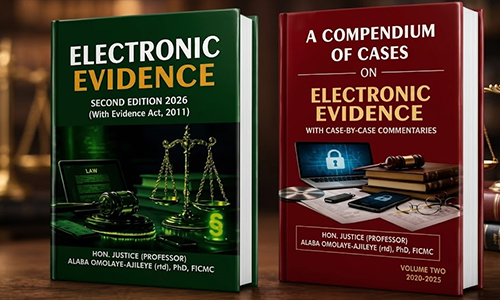
[A MUST HAVE] Evidence Act Demystified With Recent And Contemporary Cases And Materials

Available now for NGN 40,000 at ASC Publications, 10, Boyle Street, Onikan, Lagos. Beside High Court, TBS. Email publications@ayindesanni.com or WhatsApp +2347056667384. Purchase Link: https://paystack.com/buy/evidence-act-complete-annotation
______________________________________________________________________ “Enhance Legal Practice With Authoritative Reports” — Alexander Payne Offers Comprehensive Law Reports, Spanning Over A Century Of Nigerian Jurisprudence Interested buyers are encouraged to place their orders and enquiries via:
0704 444 4777, 0704 444 4999, 0818 199 9888
Website: www.alexandernigeria.com
Interested buyers are encouraged to place their orders and enquiries via:
0704 444 4777, 0704 444 4999, 0818 199 9888
Website: www.alexandernigeria.com
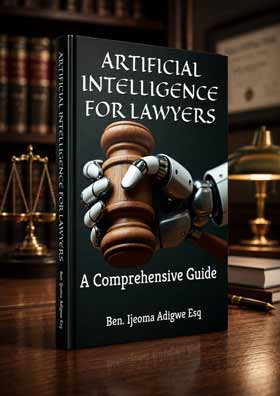 The book also examines Nigeria's legal ecosystem, focusing on the LPELR and NBA AI Guidelines. As a bonus, every purchase comes with a FREE eBook titled: How to Use the AI Features in LegalPedia and LawPavilion.
Ohio Books Ltd praises the publication, stating:
"....this is the only Nigerian book I know of on the topic."
How to Order:
📞 Call, Text, or WhatsApp: 08034917063 | 07055285878
📧 Email: benadigwe1@gmail.com
🌎 Website: www.benadigwe.com
Ebook Version: Access it directly online at https://selar.com/prv626
Authored by Ben Ijeoma Adigwe Esq., ACIarb (UK), LL.M, Dip. in Artificial Intelligence, Director at the Delta State Ministry of Justice, Asaba, Nigeria.
______________________________________________________________________
The book also examines Nigeria's legal ecosystem, focusing on the LPELR and NBA AI Guidelines. As a bonus, every purchase comes with a FREE eBook titled: How to Use the AI Features in LegalPedia and LawPavilion.
Ohio Books Ltd praises the publication, stating:
"....this is the only Nigerian book I know of on the topic."
How to Order:
📞 Call, Text, or WhatsApp: 08034917063 | 07055285878
📧 Email: benadigwe1@gmail.com
🌎 Website: www.benadigwe.com
Ebook Version: Access it directly online at https://selar.com/prv626
Authored by Ben Ijeoma Adigwe Esq., ACIarb (UK), LL.M, Dip. in Artificial Intelligence, Director at the Delta State Ministry of Justice, Asaba, Nigeria.
______________________________________________________________________