
By Balogun Sofiyullahi


According to Socrates, ” four things belong to a judge , to hear courteously, to answer wisely, to consider soberly and to decide impartially”. Blackstone was credited to be the first being, to use “living oracles” to qualify the Judges.
A judge as a living Oracle of the law said Professor Azinge, is the central figure in the judicial system and the administration of justice. Starting with his appointment, he is deemed to possess numerous attributes far beyond that of mere mortals. It is therefore understandable why he should be addressed as “My lord.” He is the Chief Priest of the temple of justice and all who worship in that temple not only defer to him but perceives him as a symbol of justice. His words are law and commands absolute obedience. He holds the power of life and death and dispenses justice without fear or favour. Like Caesar’s wife, he is not only expected to be above board but to a large extent detached from the society in which he lives. He is expected to retain the confidence of the public in the administration of justice by his honesty, impartiality and devotion to the cause of justice. The judge at all times is expected to be an embodiment of courage, an impartial arbiter and an acutely independent-minded.
{ See “The living Oracles of the Law and the Cardinal fallacy of human divination”; Sixth Justice Idigbe Memorial Lectures}
However, there is no character on earth more sublime than that of a learned and upright judge said Prof. Agom. He continues by saying that in doing his job, the judge, although human and subject to hierarchy of needs, is expected to rise above sentiment and common passion. He is to decide according to the norms of the society, yet his interraction with the same society wherein he dwells must be measured.
The Judex is indeed subject to hierarchy of needs and the humanity in him may compel his prejudices in his duty, but in the words of William Scot in Evans v. Evans(1790)1 Hagg Con.Rep 36 he said:
“The humanity of the Court has been loudly and repeatedly invoked. Humanity is the second virtue of Courts, but undoubtedly the first is justice.”
He is a sublime being on earth that ‘justice’ and what is ‘just’ is determined by him alone & not by the parties before him. The Supreme Court in OKPALA V. OKPU (2003) SCNJ 310 said: “Justice is from the point of view of the Court, and not necessarily from the point of view of the parties. After all the loosing party will always say that Injustice has been done to him.” Per Niki Tobi JSC
Prof. Agom continues in his elegant postulation that the judex is a priest at the shrine of justice and renders to everyone his due. The pronouncements of a judge do not only resolve immediate conflicts but chart future relationship in rem. { See Ogebe & The Law : The Courage of a Judge}
Without reservation, the independence of the judiciary in any democratic dispensation is to nib the bud on the head, not only sacrosanct but a case of constitutional importance with force and undisputed acceptability. Just as had been rendited in replete of authorities about its independence_ it is to me not unconnected to the fact that public confidence needs to be sustained & if not maintained, in the least.
Justice Karibi Whyte posited that irrespective of how the judge reasons and gives a decision that : ” There should be public confidence in him always, whether in his action he decided to be guided by traditional legal values and remain a mere judicial craftsmanship, or would prefer to be an innovator, that is ,to behave as an activist in the circumstance”.
{ See All Nigerian Judges Conference of 1982 : “Problems in the Interpretation and application of the Constitution”}
This, said Karibi Whyte as we know, is not just a new phenomenon. Edward Coke had fearlessly won this point over 300 years ago. Though it is now trite, I crave the indulgence to repeat the incident leading to it as I intend to state a warning which has been given by the Chief Justice of Nigeria in regards to the independence of the judiciary in this country to which, it would appear, attention has not been paid by the authorities concerned. When Coke maintained that all cases ought to be determined in a court of justice, King James retorted :
“I always thought and I have often heard the boast that your English law is founded upon reason. If that be so, why have not I and others reason as well as you Judges ?”
Coke spoke for all ages when he replied :
“True it is, please your Majesty, that God has endowed your Majesty with excellent science as well as great gifts of nature; but your Majesty will allow me to say so, with all reverence, that you are not learned in the laws of this realm of England…which is an art which requires long study and experience before that a man can attain to the cognizance of it. The law is the golden met-wand and measure to try the causes of your Majesty’s subjects and it is protected in safety and peace”.
The King, in rage, exclaimed, ” Then I am to be under the law which it is treason to affirm.” Coke referred His Majesty to Bracton who had written, ” The King is tno man but under God and the law.”. King James only came to appreciate the point made by Coke after he had tried his hand as a judge. He was more than perplexed by the difficulties involved in making judicial decisions after hearing both sides in the great and true tradition of audi alteram partem (hear both sides). The King said, no more in rage but in utter despair, “I could get on very well hearing one side only, but when both sides…,upon my word I know not which is right.”
By virtue of the scenario produced above between King James & Lord Coke, one tends not to be in a consternation that the onerous work of a judge & by virtue of his long-stand training depicts the fact that the way he reasons,talks,relates and reacts should be quite & respectfully distinct from that of an ordinary man even, if learned.
However, let me state here forthwith, that public confidence does not mean public opinion or sentiment about a matter before him. ‘No’. Because, a decision given in tandem with public sentiment from a general world view is not (always) sound in law & principles, for want of better expression. I think on this, I’m fortified by the dictum of Justice Oguntade JSC(dissented) in the celebrated case of Inakoju v. Adeleke(2007)4 NWLR (pt 125)427 and the case of FRN v. Bankole(2012) All FWLR (pt. 629)1150 HC.
The Judex, as a distinct and distinguished personality_ all his attitudinal dispositions are subject to public scrutiny & if he acts unbecoming of the office he holds, he is liable to public odium & opprobrium.
Surprisingly, a judex by virtue of a matter before him, is at times “ON TRIAL”. The trial within this context per se, is whether by the circumstances, parties(especially political figure) before him or the nature of the matter he is to adjudicate_ he can do substantial justice in the case. All his moves & actions are being studied with keen interest.
An example of a celebrated case on this point wherein a judex of High Court of Kwara State (Justice Adesiyun) of blessed memory was on “a public trial” is the case of Patrick Njovens v. State(1973)5 SC 12.
But to the surprise of the general public, the judex (Justice Adesiyun) rose above board without looking at his shoulders by convicting the public figure accused based on the justice of the case and his decision was affirmed by the Supreme Court.
{ See “Democratic Constitution making in Nigeria : The Myths & Realities, Fallacies & Illusions”. 4th Justice Adesiyun Biennial Memorial Lectures}
Similarly, in an ideal social settings the appointment of a judex is seen to be a matter of national significance that makes the appointors go on a vital voyage of discovery in order to select the best most noble,intelligible,upright,sane, dauntless and sound person to fit in the position because of the corresponding duties and obligations he is to undertake upon assumption of the sacred office and a fortiori, being a sentinel in the temple of justice.
Besides all these qualities, a great bulk of works still lies on him because , the judex, by the settled maxim of “jura novit curia” he is presumed to know all the laws if and only if, he is an omnivorous researcher . But one must strictly put to the front line of this presumption, the poignant & elegant observation of Abbot CJ over 190years ago in the case of MONTRIOU VS JEFFREYS(1825)2 C & P 113, where he said :
“No attorney is bound to know all the Law;God forbids that it should be imagined that an attorney or a counsel or even a judge is bound to know all the Law”
Finally, a judex by his professional calling is to expect matters which are at best, novel (I.e in law,facts & jurisprudence) and put on the garment of courage and keen absorbing interest in giving same a proper focus within the precinct of established principles or to see how best he can lay down principles which would at all time stand the test of time & futurity.
{See the dauntless decision of the England Court of Appeal in Gourient v. Union of Post Office Workers(1977) 1 QB 729 @ 761-762; (1977) 1 All ER; Lord Denning MR at page 714.
Conclusively, the judex being a living Oracle of the Law who is to decide or arbitrate between two or more warring parties, holds with him a scale and this is the main reason why he should at all points in time see that the scale is evenly handed because, the position occupied by a judex is at best described to be very similar to that of the Omnipotent creator and as such, if not mistaken, a representator of God on earth.
Balogun Sofiyullahi is a Final Year Law Student of Faculty of Law,
Ahmadu Bello University, Zaria. 07032676039 or balogunsofiyullahi@gmail.com
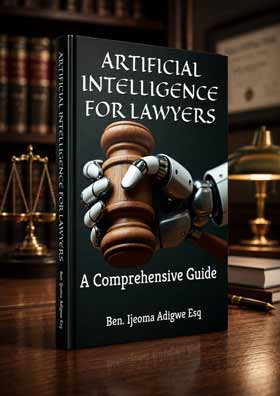 The book also examines Nigeria's legal ecosystem, focusing on the LPELR and NBA AI Guidelines. As a bonus, every purchase comes with a FREE eBook titled: How to Use the AI Features in LegalPedia and LawPavilion.
Ohio Books Ltd praises the publication, stating:
"....this is the only Nigerian book I know of on the topic."
How to Order:
📞 Call, Text, or WhatsApp: 08034917063 | 07055285878
📧 Email: benadigwe1@gmail.com
🌎 Website: www.benadigwe.com
Ebook Version: Access it directly online at https://selar.com/prv626
Authored by Ben Ijeoma Adigwe Esq., ACIarb (UK), LL.M, Dip. in Artificial Intelligence, Director at the Delta State Ministry of Justice, Asaba, Nigeria.
_______________________________________________________________________
The book also examines Nigeria's legal ecosystem, focusing on the LPELR and NBA AI Guidelines. As a bonus, every purchase comes with a FREE eBook titled: How to Use the AI Features in LegalPedia and LawPavilion.
Ohio Books Ltd praises the publication, stating:
"....this is the only Nigerian book I know of on the topic."
How to Order:
📞 Call, Text, or WhatsApp: 08034917063 | 07055285878
📧 Email: benadigwe1@gmail.com
🌎 Website: www.benadigwe.com
Ebook Version: Access it directly online at https://selar.com/prv626
Authored by Ben Ijeoma Adigwe Esq., ACIarb (UK), LL.M, Dip. in Artificial Intelligence, Director at the Delta State Ministry of Justice, Asaba, Nigeria.
_______________________________________________________________________
“Order Justice Omolaye-Ajileye’s Electronic Evidence Books Now” — Essential Guides On Evidence Act, Case Law And Digital Proof


 Interested buyers are encouraged to place their orders and enquiries via:
0704 444 4777, 0704 444 4999, 0818 199 9888
Website: www.alexandernigeria.com
Interested buyers are encouraged to place their orders and enquiries via:
0704 444 4777, 0704 444 4999, 0818 199 9888
Website: www.alexandernigeria.com