Some matters do not require trial or oral testimony of witnesses. Quite a number of matters are decided by affidavit evidence and most interlocutory applications are also decided by the court through affidavit evidence. Affidavit evidence is a major type of evidence used daily in Nigerian jurisdiction. However, there are rules to which the content of an affidavit must comply. Where an affidavit does not comply with these rules, the offending paragraphs of that affidavit will be struck out.

Section 115 of the Evidence Act 2011 provides for the contents of an affidavit. The said section 115 (1) provides that:
“Every affidavit used in the court shall contain only statement of the facts and circumstances to which the witness deposes, either of his own personal knowledge or from information which he believes to be true.”
Section 115(2) provides that:
“An affidavit shall not contain extraneous matter, by way of objection or prayer or legal argument or conclusion.”
The Court of Appeal in the case of NIGERIA L.N.G. LIMITED V AFRICAN DEVELOPMENT INSURANCE COMPANY LIMITED (1995) 8 NWLR (Pt. 416) 677 at Page 698 adjudicated upon section 86 and 87 of the Evidence Act E14 L.F.N. 2004 which is impari materia with section 115(1) and section 115(2) of the Evidence act 2011 and held as follows:
“While section 86 of the Evidence Act provides that an affidavit shall contain only a statement of facts and circumstances, Section 87 states that an affidavit shall not contain extraneous matter. The extraneous matter contemplated is a matter introduced into an affidavit by way of (a) an objection or (b) a prayer or (c) a legal argument or (d) a conclusion.”
The Supreme Court has held that such paragraph of an affidavit should be struck out. See BAMAIYI V. STATE [2001] 8 NWLR Pt. 715. [SC]. The Supreme Court per Uwaifo J.S.C., in this case, held that extraneous matter in affidavit ought to be struck out.
However, it may sometimes be difficult to discern extraneous matter in an affidavit. The Supreme Court per Uwaifo J.S.C. in Bamaiyi v State (supra) stated succinctly how to identify extraneous matter in affidavit.
“The problem is sometimes how to discern any particular extraneous matter. The test for doing this, in my view, is to examine each of the paragraphs deposed to in the affidavit to ascertain whether it is fit only as a submission which Counsel ought to urge upon the court. If it is, then it is likely to be either an objection or legal argument which ought to be pressed in oral argument; or it may be conclusion upon an issue which ought to be left to the discretion of the court either to make a finding or to reach a decision upon through its process of reasoning.
But if it is in the form of evidence which a witness may be entitled to place before the court in his testimony on oath and is legally receivable to prove or disprove some fact in dispute, then it qualifies as a statement of facts and circumstances which may be deposed to in an affidavit. It, therefore, means that prayers, objections and legal arguments are matters that may be pressed by Counsel in court and are not fit for a witness either in oral testimony or in affidavit evidence; while conclusions should not be drawn by witnesses but left for the court to reach.”
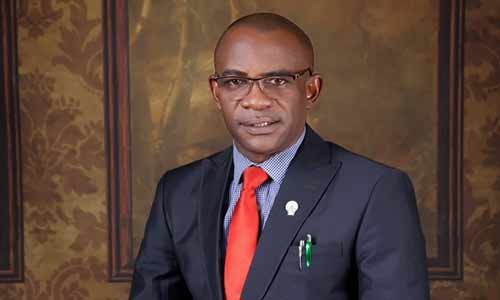
Nnamdi Raphael Anagor Esq,AICMC.
Always think Positive.
“Order Justice Omolaye-Ajileye’s Electronic Evidence Books Now” — Essential Guides On Evidence Act, Case Law And Digital Proof
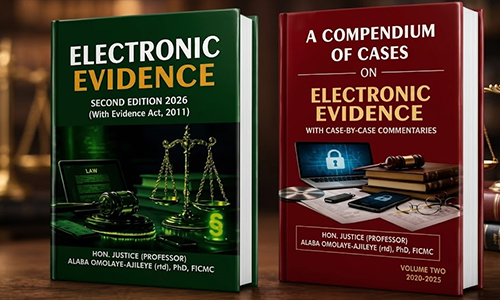
[A MUST HAVE] Evidence Act Demystified With Recent And Contemporary Cases And Materials

Available now for NGN 40,000 at ASC Publications, 10, Boyle Street, Onikan, Lagos. Beside High Court, TBS. Email publications@ayindesanni.com or WhatsApp +2347056667384. Purchase Link: https://paystack.com/buy/evidence-act-complete-annotation
______________________________________________________________________ “Enhance Legal Practice With Authoritative Reports” — Alexander Payne Offers Comprehensive Law Reports, Spanning Over A Century Of Nigerian Jurisprudence Interested buyers are encouraged to place their orders and enquiries via:
0704 444 4777, 0704 444 4999, 0818 199 9888
Website: www.alexandernigeria.com
Interested buyers are encouraged to place their orders and enquiries via:
0704 444 4777, 0704 444 4999, 0818 199 9888
Website: www.alexandernigeria.com
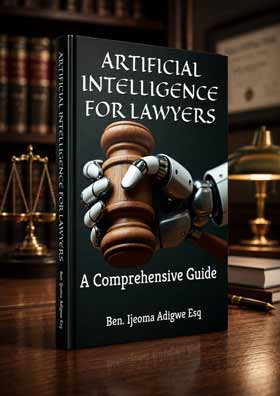 The book also examines Nigeria's legal ecosystem, focusing on the LPELR and NBA AI Guidelines. As a bonus, every purchase comes with a FREE eBook titled: How to Use the AI Features in LegalPedia and LawPavilion.
Ohio Books Ltd praises the publication, stating:
"....this is the only Nigerian book I know of on the topic."
How to Order:
📞 Call, Text, or WhatsApp: 08034917063 | 07055285878
📧 Email: benadigwe1@gmail.com
🌎 Website: www.benadigwe.com
Ebook Version: Access it directly online at https://selar.com/prv626
Authored by Ben Ijeoma Adigwe Esq., ACIarb (UK), LL.M, Dip. in Artificial Intelligence, Director at the Delta State Ministry of Justice, Asaba, Nigeria.
______________________________________________________________________
The book also examines Nigeria's legal ecosystem, focusing on the LPELR and NBA AI Guidelines. As a bonus, every purchase comes with a FREE eBook titled: How to Use the AI Features in LegalPedia and LawPavilion.
Ohio Books Ltd praises the publication, stating:
"....this is the only Nigerian book I know of on the topic."
How to Order:
📞 Call, Text, or WhatsApp: 08034917063 | 07055285878
📧 Email: benadigwe1@gmail.com
🌎 Website: www.benadigwe.com
Ebook Version: Access it directly online at https://selar.com/prv626
Authored by Ben Ijeoma Adigwe Esq., ACIarb (UK), LL.M, Dip. in Artificial Intelligence, Director at the Delta State Ministry of Justice, Asaba, Nigeria.
______________________________________________________________________