
By Olumideajayi & Kolawoleomoyajowo


INTRODUCTION
The purpose of the law and relevance of the Justice delivery system is measured by its accessibility, affordability and profitability to the public at all times. This is because, just as the air is to a man, so isthe law and its apparatuses to any society at any given time. Further to this, the law cannot be said to be in force when the structures that anchor its functionality is handicapped. That is, the existence and the efficacy of the law are contingent on the existence of structures and systems that administer it, dispense justice and midwife orderliness in the society. Hence, the outbreak of a pandemic or crisis that poses a severe threat to human life will not suffice to suspend the functionality of the court system; rather it challenges the court and its administrators to devise a dynamic model through which the objectives of the law can be realized.
It is therefore the appreciation of this fundamental concept that drove countries such as the United States of America, United Kingdom, India and even, the republic of Kenya to develop or adopt digital structures for administering the law and dispensing justice through virtual technologies, as proactive response to surmount the challenges posed by the measures to curtail the spread of the dreaded coronavirus disease. Thus, to minimize hazardous exposure to health risk, the business of justice delivery must be shifted to the cyberspace and sustained even after the ravaging of the pandemic abates. This is because the adoption of technologies for conduct proceedings is an amazing breakthrough to ease the justice delivery system. It is therefore interesting to note that countries that have erected digital structures for Online Dispute Resolution record more conformity and compliance to lockdown directives and enforcement of measures. Also, these countries have further demonstrated that it is essential to paddle the sustenance of the economy and the survival of the nation into a new world order driven and powered by technologies and artificial intelligence. In the Nigeria scenario, the traditional structures for justice delivery system have been hibernated and sadly, the administration of justice is on a substantial lockdown.[i] Little wonder, Nigeria tops the table of nations with substantial non-compliance to lockdown directives, failure of measures to contain the transmission of the dreaded coronavirus disease and a nearly economic meltdown. This distasteful record cannot be dissociated from the probable causal factor that the cessation of the administration of justice system makes the enforcement of the covid-19 curtailing measures to be difficult, if not impossible, as evidenced by the inability of the government to successfully enforce the lockdown measures in states like Lagos & Abuja. No doubt, the efficacy of the law cannot be gainfully appropriated when the court system is shutdown. In the heights of the coronavirus pandemic in Nigeria, the online vis-à-vis digital businesses are heavily patronized; some businesses are now relocating to the cyberspace, commercial & noncommercial disputes have arisen as a result of the lockdown which equally demand prompt adjudication. Yet, the Nigeria judiciary seems insensitive to this societal change.
However, the crux of this work is to critically examine the key provisions of the 2020 practice direction of the High Court of Lagos State on Remote hearing, commend the initiative of the Lagos State Judiciary, identify the loopholes in the provisions and charter a formidable pathway for the effective operation of remote hearing via digital platforms. All the provisions are critically analyzed and creative suggestions are made. This article is fashioned to be thought provoking and to stimulate further debates, rejoinders and ultimately, solid direction on the workings of electronic service of processes and online proceedings in Nigeria.
EXAMINATION OF THE KEY PROVISIONS OF THE 2020 PRACTICE DIRECTION OF THE HIGH COURT OF LAGOS STATE ON REMOTE HEARING.
ELECTRONIC FILING SYSTEM
It is worthy of note that while paragraph 3 of the Practice Direction provides for its objectives, Paragraphs 5 to 9 of the Practice Direction made provisions for Electronic filing of Court Processes for remote hearing. It is pertinent to know that filing is a major component of commencing proceedings, whether civil or criminal. As a matter of fact, it is the foundation upon which proceeding is built. It is upon filing the processes thatsame are being served on the concerned parties, and after which proceedings are commenced properly. Paragraphs 5 and 6 of the practice direction are to the effect that filing of Court Processes shall be done electronically and received by the Court electronically, in other words, via (a) Email and (b) Whatsapp. It further provides the Processes should include the email address and phone number of the Counsel and in event that a Party is not represented by Counsel, his Email Address and Phone Number should be stated in the originating processes. Although, the manual mode of filing is still allowed where electronic filing is not possible.[ii]
Moreover, it is interesting to note that the practice direction did not accept any other form or format in which the processes must be, other than scanned copies of the processes in PDF formatting style.[iii] It might be said that the reason underlining the choice of PDF formatting style and excluding others[iv] is because of the tendency of loss or distortion of contents of the processes while they are being exchanged via electronic means. But of a truth, the rationale is because of the validity requirement of affixing a seal on processes by counsel.[v] The NBA seal is only made available in hard form. That is, there is no electronic or digital seal for lawyers to affix on processes. Hence, a counsel will have prepare the processes, print them out and affix the NBA seal on it as though the processes were to be filed physically. After the affixation of the seal on the hard copy of the processes, the counsel will then scan each copy of the processes in the order of their pagination and save the scanned copies of the processes in a single-rowed PDF document. However, electronic signature is recognized under our law and as such counsel or party can affix an electronic signature on the document.
Paragraphs 7 & 8 further provide for the power of the Chief Registrar to assign designate officials for assessment of fees payable on documents filed and the mode of payment, which is by electronic transfer of filling fee into the designated account of the court as shall be made available by the court registry. Moreover, manual mode of payment is possible where there is a difficulty making payment by electronic transfer. Hence, the counsel or party will file the processes through email or whatsapp. And the court registry will then assess the due filing fee and communicate the assessed fee to the counsel or party via email, text message or whatsapp. Then, the counsel or party will proceed to make the electronic transfer and generate receipt or any other evidence of payment. He is then required to scan the receipt or evidence of payment and send it to the court registry who shall then verify the payment. After verification of payment, the processes would be deemed to have been filed and the suit is said to have commenced. It is suggested that parties and counsel should make the electronic payment through their bank mobile App so that receipt of payment can be easily generated. The process of making electronic payment would be easier and accurate if the judiciary can set up a judiciary filing portal system connected to Remita so that the process of payment can be instantaneously traceable and verifiable automatically without the physical intervention of the court registry. And immediately the portal system automatically verifies the payment, the access to filing of processes will be opened automatically and the counsel or party can file the processes easily.
ELECTRONIC MODE OF SERVICING COURT PROCESSES
One of the innovations heralded by the Practice Direction is the introduction of electronic method of effecting service of process. Paragraph 10 of the practice direction provides that the service of processes shall be done by way of transmission through e-mail address or through WhatsApp platform (that is, into the registered account of the other party on whatsApp) or through such other meansas it shall be directed by the Chief Judge. The working or functionality of this electronic service mechanism is hinged on the availability of the email addresses and phone numbers of both parties and the Central operating system that will drive this model is the technical unit of court’s registry who shall be responsible forcollecting processes filed and effecting the service of same on the other party.
It is very important to point out that the provisions of the practice direction on service of processes is to complement and not replaceOrder 9 of the High Court of Lagos State (Civil Procedure) Rules & Practice 2019 in such a way that both rules can successfully midwife the smooth operation of the system of online commencement of a suit, its hearing up to the last stage of judgment.To this extent, the radical changes introduced by the practice direction needs to be meticulously tailored into the principal rules of the High Court.
However, the remote service model still recognizes and retains the existing requirement for filing a proof of service as it were under the 2019 court rules. Hence, an affidavit of service stating the particulars of how the service of the processes was effected on the other party, through email or WhatsApp or otherwise, shall be averred and filed into the court’s record.[vi]To accomplish the requirement of filing a proper proof of service, the same paragraph 12 demands that an electronic printout containing the date and time that the service was received by the other party must be exhibited (as evidence) by the affidavit of service.
It is noteworthy that time begins to run from the date that the processes was transmitted through the email or WhatsAppby the party effecting the service. By implication, if the process served is a writ of summons to which the defendant must make appearance and file his defence within 42 days, the time (that is, the 42 days) begin to count from the very exact date that the court registry sent the writ by email or WhatsApp. Thus, no consideration is given for the date and time that when the other party had the receipt of the processes, just in the similitude of the effect of service by substituted means.
Undoubtedly, the Lagos State Judiciary has made a giant stride by being the first to herald this progressive judicial transition of proceedings to take advantage of technology in Nigeria and in West Africa. Moreover, it is further commendable that the Lagos State Judiciary attempts to simplify and ease the process of remote model of service in order to avoid every possible technicality that comes with the use of digital transmission of data. This is evident in her adoption of WhatsApp as one of the means of effecting service, being one of the most popular and patronized digital platform of communication and exchange of information in Nigeria. As commendable as these provisions are, they are not without lacuna. The practice direction leaves so many vitals not provided for. And these lacunas will trigger legal technicalities, legal disputes and if not quickly amended, the purpose and goals of the remote hearing will be clogged.
By the reason of the wordings of the provisions on service of processes under the practice direction, there is no hesitation to come to the finding that the practice direction disposes with the requirement of PERSONAL SERVICE as applicable under the 2019 civil procedure rules.[vii] The court in several decisions has held that what constitutes personal service is the physical delivery of the original or CTC of court processes to the other party in person.[viii] Of course, the 2019 High Court rules recognize service by email but as a means of substituted service and not personal service.[ix] And for email to be used for service under the 2019 court rules, an application for leave of court to employ email as a means of substituted service must be filed. But the implication of paragraph 10 of the practice direction on remote hearing is that the status of service by email has been upgraded from being a means of substituted service to a means of personal service. To buttress this analysis, paragraph 11 of the practice direction regards service through email and WhatsApp as good and sufficient service.This is quite commendable considering the realities of this technological ageand the need for the law to reflect that dynamism. The Chief Judge of the Lagos State High Court, respectfully, should have made it clear in the practice direction that service through email and whatsapp are now deemed as personal service. This analysis also affects and relates to service of processes on corporate bodies. Hence,serviceof court processes through the email or whatsapp of any of her director, secretary, or principal officer would be sufficiently regarded as a proper service.[x] This is because section 78 of the Companies & Allied Matters Act had provided that court processes are to be served on the company in the manner provided by the rules of court.
Ordinarily, the Lagos State High Courtrules 2019 determine who is to effect service of processes, namely: the sheriff, deputy sheriff, bailiff, special marshal, other officer of the court, registered chamber, and courier company or process servers.[xi] Bearing in mind that the aforementioned persons are likely not to be savvy in the use of electronic devises, there is no doubt that the court would have to engage the service of computer skilled bailiff or sheriff (e-bailiff or e-sheriff) to completely discharge the onerous task of receiving and serving court processes through electronic means. Even though email and whatsapp are commonly used, there is still possibility of loss of data, spam storage or failure in the course of transmission due to the technicalities associated with these systems all owing to internet technicalities. For these reasons, mischievous parties or crafty counsel can take advantage of that susceptibility to deny the receipt of processes served.
The need for highly competent process servers cannot be overemphasized. This is because service of processes is so fundamental such that if a party is not served with processes, the court will have no jurisdiction over him or competency to decide on that process.[xii]Hence, having competent hands on desk will further engender the generation of an accurate electronic printout to be exhibited with the affidavit of service.[xiii] Paragraph 12 demands that the service of the processes must be proved by an affidavit which must exhibit an electronic printout detailing the date and time which the processes were received by the other party. The essence of this provision is firstly to authenticate that indeed service was made and secondly, to know when it was received by the other party as well as determining whether the receiving party delayed in responding.
There is no doubt that there will be possibility of service to be disputed by the other party especially on the account of date and time of service as well as the accuracy of the content of the electronic printout as required under paragraph 12. To resolve this, the test of admissibility under section 84 of the Evidence Act would be invoked. Who is in control of the electronic devicewith which the service was made; which electronic device was used; how the processes were sent, the accuracy of the electronic device and the content of the printoutetc would be needed to be ascertained. This requires a reasonable measure of computer literacy which the court’s sheriff, bailiff etc may not be proficient thereto. If error or default is discovered in the accuracy of the electronic device and the electronic printout as regard service of processes, the hands of the court would be tied to herself because it has been held in several cases that the default on the part of the court’s registry or court officials cannot be visited on parties to suit.[xiv]But the overall effect any default on electronic service traceable to the court official who sent it is that the pace of the proceeding will be delayed.
To surmount this problem, it is strongly suggested that after serving a process via whatsapp or Email address, the court official in charge should further contact the party or counsel served through direct phone call informing him of the service of the process on him. Also, the party so served should be made to send an acknowledgment of receipt of the process immediately back to the court official so that it could be filed to ascertain the date and time the service was received by the party. It is however disheartening that the practice direction did not make provision for a party to make and return an acknowledgement of the receipt of a process via same electronic means. Rather, paragraph 12 states that the electronic print out as proof of service which is to be generated by the person that served the process that is the court official and exhibited on the affidavit of service to be filed by the process server.
The question that arise from that requirement for the content of the electronic printout by the court server is: How can the date and time when an information (court process, in this case)is received by the receiving party(the party being served the process)be available to the knowing of the sender (process server)without the receiving party disclosing it?It is therefore noteworthy that as far as electronic mailing system (email) is concerned, the sender of an information cannot know the date and time of delivery of the mail. This is because all that would be displayed on his electronic device is the date and time when the information was sent and not otherwise. But for service of process by whatsapp, the ordinary setting is such that when the recipient receives the information (court process), a blue-coloured signal in the form of a mark would be revealed but that settings can be adjusted not to display in that ordinary manner. With this water-loose provisions, controversy is bound to arise, as the failure to insert the return of acknowledgment of receipt of service by the party served, is a volatile lacuna in the practice direction.
Furthermore, by reason of Order 6 rule 1 & 6,Order 11 rule 2(1)[xv]as well as paragraph 5 of the practice direction 2020, only the claimant and defendant’s telephone number and email address or those of the counsel are required to be endorsed on the processes. Of course, while the claimant is reasonably expected to know the contact address and phone number of the defendant and required to endorse same on the originating processes but it is not all the case with the email address of the defendant, in all circumstances. Some parties may not even have email addresses as well as a registered WhatsApp account. To circumvent this difficulty associated in getting the email address through which service of the process can be made, it is suggested that the court registry should place a phone call to the defendant to inform her of an action commenced against her and that she is to provide an active whatsapp account number and email through which processes can be served on her.
Moreover, where is discovered that the electronic service is made impossible by reason of unavailability of phone number and email, genuinely or borne out of the intention to evade service, then service by substituted means is to be done either by way of newspaper publication or physical delivery in the last known address of the defendant. To buttress this, it could be gleaned from the wordings of paragraph 10 that the possibility of a service by substituted means was contemplated through the statement, “…service of court process may be effectted by email, whatsappor as otherwise directed by the court”
Lastly on the service of processes on the practice direction, paragraph 13 says that time begins to count from the date and time when the processes are served via electronic means. It is noteworthy that so many lawyers have argued against this provision on the ground that the provision did not take into consideration the possibility of technical errors or default on the part of the server which renders the delivery of the processes to fail. As plausible as this argument might appear, no reasonable and meticulously drafted rules of court or even law would place the counting of time on when the processes are actually received by the party so served, as far as electronic means of service of process is concerned. Electronic mailing systems are presumed to be instantaneous, even though rebuttable. Besides, it would be easily susceptible to fraud and evasion of service if the rule as to counting of time is contingent on the actual receipt or delivery to the other party. It is therefore our strongly held opinion, in support of the spirit and letter of paragraph 13, that the determination of time should be on the date and time it was actually sent, if and only if our suggestions as to the workings of an electronic means of process service is adhered.
Further, it is instructive to point out that the provision of paragraph 13 as discussed above does not inhibit the other party (acclaimed to have been served on certain date & time) to file a counter affidavit to the affidavit of service under paragraph 12, with averments that he was not properly served or that he was not in the receipt of the processes at the date and time so specific in the proof of service. He is so justified to do that after all, that he received the processes on the date contained in the proof of service (electronic printout) is a presumption that can be rebutted. On this point, it is necessary to make a rejoinder of opinion on the interesting but amusing submission of some commentators, who in the process of attempting to justify why the other party can disprove of the receipt of the processes on the very day it was sent, opined thatA combined reading of section 145 and 153(1)&(2) of the Evidence Act, 2011 can be utilized to create a rebuttable presumption of fact that the electronic message/court documents were received on the day it was sent.As much as the intention above is known and the rescue mission that he was devising is appreciated, we respectfully submit that his opinion as quoted above is misleading and a faulty interpretation of the purpose of section 153 of the evidence Act. The essence of section 153 is to create a presumption on the content accuracy of electronically generated documents (that is, whether the documents sent and that received contains same content). And to rebut that presumption the test laid down in section 84(2) & (3) of the evidence Act must be followed. Hence, we submit that there is no provision in the evidence Act that touches on the presumption that messages sent electronically is received electronically. But simply, then the other party still has that opportunity to dispute the imputed time and date for receipt as a fact that can be disproved by proving a contrary fact.
PREPARATION AND CONDUCT OF ONLINE PROCEEDING
The two major electronic platformswhere the court will conduct her proceeding are zoom and skype for business.[xvi] However, the court may also approve the use of any other video communication method. This is possibly because to hold the proceeding or for attendance and audience purposes, the capacity of the zoom or skype may be limiting. So, the court can approve of other video communication platform with better coverage capacity and accessibility. It is noteworthy that parties or the counsel and the registry of the court must liase properly as to the scheduling of the proceeding and the suitability as well as the availability of facilities to support access to the online proceeding.[xvii]
Hence, the counsel on behalf of the parties will have to adequately engage the registry as to date & time when the proceeding is to be fixed. Also to be discussed is which of zoom or skype for business should be use but ultimately, it is for the court to give direction as to the appropriate method of video communication to be adapted.[xviii]The flexibility of this provision with respect which method of video communication is used is quite commendable. It will enable the court to keep adopting better and improved video methods that will enable easy accessibility and improved suitability. Indeed, the practicality of this mechanism is dependent on the affordability of the necessary facilities by both the counsel and parties or the possibility of the party to be with the counsel so that a joint facility could be used.
But the case is not the same in a proceeding for bail application or a trial of a criminal suit where the defendant is in custody and possibly poor. Because of the conditions of our correctional centers and police stations, the defendant is likely not have access to video communication facilities in order to participate in the remote hearing. Hence, it is strongly suggested that the correctional service and police station should be equipped with adequate facilities to support and access designated electronic platform for the court proceeding. In the alternative, the correctional service should mobilize the suspect to the office of his counsel so that the defendant can access his counsel’s facilities. This would avail the defendant the opportunity of being properly guided by the counsel in the course of proceeding which might not be possible if the defendant and counsel are apart. If the correctional service is properly equipped with the needed digital facilities for remote hearing, the defendant should be given the option of requesting the physical presence of his counsel with him for strategic reasons so that both can jointly access the remote platform using the same facility.
Since the defendant would not be in the physical courtroom, the essential requirements such as the defendant being in the dock or a witness being in the witness box are another phase of hurdle which the practice direction did not provide for. It would not be surprising when an appeal is brought to court challenging the conviction of a defendant on the ground that his arraignment is defective as he was not placed in the dock while taking his plea. Or, that the oral evidence of the witnesses is invalid and inadmissible because the witness is not placed in the witness box while giving his testimony. We strongly opine that the challenges as posed above are mere formal technicalities that should not have the weight to affect the validity of a proceeding, in the light of the virtual realities where physical court structures are absent. The stream of justice should not be clogged by such formalities but one wonders while the practice direction requires counsel to be properly robed-a colonial antiquity.[xix]While one is prompted to suggest that the Chief Judge should amend the practice direction so that wherever the defendant is when being arraigned or where the witness is when being examined shall be deem to be the dock and witness box respectively, the validity of such a provision in the practice direction without an amendment of the relevant laws on criminal procedure might be impugned.
In any case, where the possibility of holding an online proceeding is not feasible, maybe owing to unavailability of suitable facilities to support the remote hearing on the part of the party or counsel or even the court, an adjournment would be order.[xx]But after the adjournment, what will happen? Will the court revert to the traditional courtroom proceeding? Or will the court take responsibility for providing facilities for counsel and parties? Indeed, while the court has the responsibility to ensure the availability of a courtroom for proceeding, it is the personal responsibility of the parties and counsel to walk into the courtroom.[xxi] In that similitude, if the court makes an arrangement for a space on zoom or skype (for business) to hold proceeding, save for some instances, it is the correlative personal responsibility of the parties and counsel to afford facilities that will enable them access the platform.
Commendably, when a remote hearing would be conducted for a particular case is to be stated on the cause list which would be made available on the judiciary’s website and efforts shall be made to communicate it to the counsel or parties directly through email, whatsapp or any other means of communication.[xxii] And while proceeding is ongoing, the court shall give direction on the use of the audio and video tools in order to avoid technical problem or undue disruption.[xxiii] To this extent, there is still a possibility of a person connected to the remote hearing platform to be charged and punished for contempt in facie curiae[xxiv] for tampering with the audio and video tools in such a way that it disrupted the flow of proceeding.
One of the great benefits that online proceedings usher is that it eases the court’s assiduous task of recording proceedings in handwriting. So, this remote hearing enables the court to automatically record the proceedings on her electronic device[xxv] which can be later transcribed into prints through electronic means. Hence, the court would rather pay due attention to the arguments of counsel, demeanor of the witnesses and that of the defendant. Paragraph 22 states that: “Recording of proceedings by counsel and or parties shall only be with the leave of court.” It is submitted that the intention of this provision is that the electronic recording of the proceeding cannot be done by anybody except parties or counsel, in which case, the leave of court is necessary to be sought and granted. It is doubtful if the provision would be construed to mean that the counsel or party would need to seek the leave of the court even before they note down certain portion of the proceeding by handwritten (statement of a witness during examination, plea of the defendant during arraignment or the point of argument of an opposing counsel). Ordinarily, the court does not allow the audio or video recording of her proceeding except in rare cases of which the consent of the court is sought and the face of the judge(s) is hidden. There is therefore no doubt that person connected to the remote hearing cannot be physically monitored or restrained from audio or video recording of the court proceeding, being one of the susceptibilities of online proceedings. What can be done by the court in this regard? It is submitted that this can be curtailed if the court employs video communication platform where it is possible to disable any downloading or recording function, just as in YouTube.
Moreover, due attention needs to be drawn to paragraph 14 of the practice direction which states that counsel or parties are to indicate their voluntary participation in the remote hearing through official mail to the court. It is opined that the rationale behind this provision is that counsel or parties who cannot afford the facilities to participate in the remote hearing should so indicate so that the court can devise how the case would be heard.But the wordings of the provision, prima facie, give counsel and parties a blank cheque to decide whether to participate in the proceeding or not, on the account of any excuse. This lacuna is quite disturbing because in both civil and criminal proceedings, the law demands the attendance of parties and counsel, the failure of which there are consequences for.[xxvi]
Lastly, paragraph 24 of the practice direction retains the applicable rules and procedure as to the adoption of written address as applicable under the 2019 civil procedure rules of court, the Magistrate Court rules and the administration of Criminal Justice Law. Also, judgment shall also be delivered through zoom or skype (for business) within the constitutional stipulated time and the date and time reserved for delivery of the judgment shall be notified by the court registry to the counsel and parties through whatsapp or email.[xxvii]
Does the conduct of proceedings online via Skype or zoom fulfill the constitutional requirement of trial in public places?
One of the wide commentaries on the practice direction is that conducting virtual proceedings on skype or zoom does not fulfill the requirement that court proceedings must be held in the public.[xxviii]Some have argued that since the public cannot ordinarily have access to participate in the remote hearing except if the court registry grant them access, then it cannot be said that the proceeding is held in the public. Some also have argued that there is a limit to the numbers of persons who can be accommodated on zoom or Skype then, the requirement of being held in the public has not been fulfilled.
As plausible as those arguments are, it is submitted that the advent of technology and the adoption of same for court activities come with some inevitable limitations and challenges which are best embraced and adjusted to. It is undeniable that with respect to physical courtroom proceedings, it is not every time that a random member of the public is granted access to the courtroom. There is always restriction to the courtroom where high profiled cases or political cases are held especially in the appellate courts. There are courtrooms whose capacity is so small and limited so that only the judge, court officials, parties and their counsel are allowed into the courtroom. These are practical instances of limited access to the courtroom, aside the legally justified exceptions where access to court is restricted in special cases. In the all, has any of the practical instances been invalidated?
It is submitted that this remote hearing would be said to have fulfilled the requirement of being held in the public if, apart from the parties and counsel, a sizeable portion of the public who are interested in the proceeding is able to access the remote space. Hence, it is suggested that the court registry should publish the electronic link to the remote space on the judiciary website so that interested person can through the link access the hearing. There is a possibility that the case to be heard remotely might be such that draws the acute attention of the public and as such, the number of interested person willing to access the remote space might overwhelm the system. The court registry would be justified if the electronic link to the proceeding is only made available to the parties, counsel, registered press officials, interested NGOs, correctional service officials, police force etc.
DOES THE DELIVERY OF JUDGMENT IN ONLINE PROCEEDINGS VIA SKYPE OR ZOOM FULFIL THE REQUIREMENT OF A VALID JUDGMENT?
No matter how good a law is, it perceived as being a bad when it is not in the favour of a litigant, and no matter how bad a law is, it is well embraced and perceived as being the best of all laws where a lawyer/litigant obtains favourable judgment therefrom. Premised on the foregoing, despite the commendable provisions of the Practice Direction, it becomes a subject of appeal when the court’s decisions are not in favour of a Counsel. And this brings us to the question: Does the mode of delivery of Judgment as contemplated in the Practice Direction fulfill the requirement of a valid Judgment? If NO, that means any judgment obtained from the online proceedings is likely to be invalidated and being set aside on appeal. Hence rendering the whole trial an exercise in futility.
Paragraph 24 of the Practice Direction provides that the Court shall through the Registry notify the Counsel and or parties by Email or Whatsapp of the date reserved for the delivery of judgment and or Ruling. It can be implied from this paragraph that such judgment will be delivered online, which therefore necessitates the need to examine the validity of a judgment delivered online vis a vis the extant laws.
Judgment is the outcome of any proceeding and it has been defined as the determination of the Court which includes decree, decision, order, conviction, sentence or recommendation (Section 318 of CFRN).[xxix] And for a judgment to be valid, some of the requirements of the law are that, such judgment must be in writing (Section 294(1) CFRN 1999) [xxx], by the Judge itself and must also be delivered in open court.[xxxi] It is also a trite principle of law that the Defendant must be present in Court when he is to be sentenced in Criminal Trials[xxxii]. As of this moment, there is no judicial authority or statutory provision in Nigeria on the point that online platform is an open court. Thus, one cannot authoritative aver that judgment delivered via an online communication platform fulfill the requirement of being delivered in an open court. Also, there is a possibility that the Defendant, especially the ones in custody may not have access to Electronic devices for online proceedings, given the state of the Nigerian correctional centres. Hence, the defendant’s difficulty in accessing the online platform due to unavailability of suitable facilities to access the designated online platform would render any judgment given in his absence to be a nullity.
However, judgments have been delivered in some jurisdictions such as Lagos and Borno; and there have been substantial compliance with the requirements of a valid judgment as provided by the extant laws. In the above cases, the Judge wrote down the judgment and delivered same through the online platform. As a matter of fact, the Defendant in a criminal case participated in the proceedings via Teleconferencing from the correctional centre. While this arrangement is commendable and prayed to be continued, a slight failure to connect the defendant may be fatal to the validity of the judgment. So, the point of concern is non compliance in future cases which may be resulting from the technicality associated therewith the use of Electronic Equipment, or as a result of lack of adequate facility to enable Parties to participate in the proceedings.
In the light of the foregoing, we recognize that the validity of judgment delivered online is, to a large extent, contingent on the availability of measures to ensure that the requirement of an ‘open court’ and ‘presence of a defendant’ (as in criminal case) are solidly in place. It is therefore against this backdrop that we submit that adequate facilities should be provided to support the workability of the provisions of the practice direction.
CONCLUSION
The Lagos State Judiciary has really made a commendable stride in responding creatively to the challenges posed by the outbreak of the coronavirus disease in Nigeria, Lagos being the epic centre, and the measures adopted by the government in containing the transmission of the virus. While it is expected that the Nigeria courts (Lagos especially), being the most inundated and overstretched judicial system in Africa, ought to have adopted the opportunities provided by technology and cyber science, to carry out and aid the process of dispute resolution, long before this moment; it is worth appraising nonetheless that the Chief Judge of Lagos State has made this practice direction on remote hearing to dispose urgent cases. These are cases that may have arisen from the lockdown directive or during the period of lockdown as well as pending cases that are urgent or time bound applications or court activities such as rulings, judgment etc. We conclude that the application of the practice direction should be extended to cater for other cases such as commercial cases. Or perhaps, general rules of court on remote hearing should be made taking into consideration the suggestions provided in this work. The time is ripe for the court to embrace online proceedings as this will go a long way to speed up the justice delivery system. As copiously pointed out, the exact practice direction on remote hearing is bulged with a lot of lacunas to which we have creatively fashion out suggestions which we urge the court to consider and for stakeholders in the legal profession to draw to the attention of the Chief Judge. While the practice direction is yet amended, the analysis and workings of the remote hearing as explained above will, by any standard, help the court to midwife online proceedings and electronic service of processes. Finally, members of the public or counsel who are going to conducting their cases under the application of this practice direction will find the painstaking analysis above useful.
 The book also examines Nigeria's legal ecosystem, focusing on the LPELR and NBA AI Guidelines. As a bonus, every purchase comes with a FREE eBook titled: How to Use the AI Features in LegalPedia and LawPavilion.
Ohio Books Ltd praises the publication, stating:
"....this is the only Nigerian book I know of on the topic."
How to Order:
📞 Call, Text, or WhatsApp: 08034917063 | 07055285878
📧 Email: benadigwe1@gmail.com
🌎 Website: www.benadigwe.com
Ebook Version: Access it directly online at https://selar.com/prv626
Authored by Ben Ijeoma Adigwe Esq., ACIarb (UK), LL.M, Dip. in Artificial Intelligence, Director at the Delta State Ministry of Justice, Asaba, Nigeria.
_______________________________________________________________________
The book also examines Nigeria's legal ecosystem, focusing on the LPELR and NBA AI Guidelines. As a bonus, every purchase comes with a FREE eBook titled: How to Use the AI Features in LegalPedia and LawPavilion.
Ohio Books Ltd praises the publication, stating:
"....this is the only Nigerian book I know of on the topic."
How to Order:
📞 Call, Text, or WhatsApp: 08034917063 | 07055285878
📧 Email: benadigwe1@gmail.com
🌎 Website: www.benadigwe.com
Ebook Version: Access it directly online at https://selar.com/prv626
Authored by Ben Ijeoma Adigwe Esq., ACIarb (UK), LL.M, Dip. in Artificial Intelligence, Director at the Delta State Ministry of Justice, Asaba, Nigeria.
_______________________________________________________________________
“Order Justice Omolaye-Ajileye’s Electronic Evidence Books Now” — Essential Guides On Evidence Act, Case Law And Digital Proof
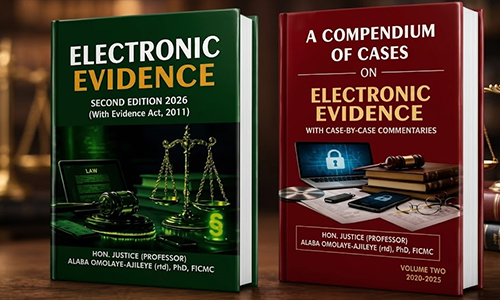

 Interested buyers are encouraged to place their orders and enquiries via:
0704 444 4777, 0704 444 4999, 0818 199 9888
Website: www.alexandernigeria.com
Interested buyers are encouraged to place their orders and enquiries via:
0704 444 4777, 0704 444 4999, 0818 199 9888
Website: www.alexandernigeria.com