INTRODUCTION


The advent of Covid-19 has dealt a global punch on all facets of human endeavours and activities. In the uniqueness of man, alternative measures have emerged and are embraced in different walks of life to mitigate the attendant harsh socio-economic effects of Covid-19. There is a surge in the use of internet and various virtual platforms to carry out the normal day-to-day activities.
The judicial system a fortiori the courts, are equally affected as they have been closed in order to contain the spread of Covid-19. Out of sheer ingenuity and the need to attend to urgent and fundamental court cases, there are widespread euphoric reports of courts adopting the use of modern technology to observe virtual proceedings through media like Skype, Zoom, Google Meet, Microsoft Team amongst others in various parts of the word, Nigeria inclusive.
As innovative as these developments are, there is a critical importance to measure these new introductions into the judicial cycle in Nigeria on the constitutional scale of our fons et origo – the Constitution of the Federal Republic of Nigeria, 1999 as amended; (hereafter called 1999 Constitution).
SUPREMACY OF THE 1999 CONSTITUTION
The 1999 Constitution is widely believed to be the organic and fundamental law of Nigeria. This means that it is the law from which all other laws emanate and derive their legitimacy and validity. In this wise, it is accordingly enshrined in S. 1 (1) of the 1999 Constitution as follows: “This Constitution is supreme and its provisions shall have binding force on all authorities and persons throughout the Federal Republic of Nigeria”.
For the avoidance of doubt, the Federal Republic of Nigeria is more particularly described to be a Federation consisting of States (actually 36 States) and a Federal Capital Territory (FCT)1.
From the foregoing, the 1999 Constitution prescribes and governs the actions and inactions of all authorities and persons in the 36 States and the FCT, Abuja.
THE PROVISION OF FAIR HEARING UNDER THE 1999 CONSTITUTION
Fair hearing is a fundamental right guaranteed under the 1999 Constitution2. It is an elaborate fundamental right that touches on composite issues that may not be waived either unanimously or on agreement of parties or suo motu. Of particular importance here is S. 36 (3) & (4) of the 1999 Constitution, which provides as follows:
“(3) The proceedings of a court or the proceedings of any tribunal relating to the matters mentioned in subsection (1) of this section (including the announcement of the decisions of the court or tribunal shall be held in public. (4) Whenever any person is charged with a criminal offence, he shall, unless the charge is withdrawn, be entitled to a fair hearing in public within a reasonable time by a court or tribunal:
Provided that –
(a) a court or such a tribunal may exclude from its proceedings persons other than the parties thereto or their legal practitioners in the interest of defence, public safety, public order, public morality, the welfare of persons who have not attained the age of eighteen years, the protection of the private lives of the parties or to such extent as it may consider necessary by reason of special circumstances in which publicity would be contrary to the interests of justice; (b) if in any proceedings before a court or such a tribunal, a Minister of the Government of the Federation or a Commissioner of the Government of a State satisfies the court or tribunal that it would not be in the public interest for any matter to be publicly disclosed, the court or tribunal shall make arrangements for evidence relating to that matter to be heard in private and shall take such other action as may be necessary or expedient to prevent the disclosure of the matter”(emphasis is mine).
In a nutshell, the above section prescribes generally that all civil and criminal judicial proceedings shall be held in PUBLIC.
Quite surprisingly, neither the 1999 Constitution nor the Interpretation Act defines the word public. The Black’s Law Dictionary defines public as “open or available for all to use, share or enjoy”. A judicial proceeding held in public is undoubtedly such that is conducted in a place that guarantees unrestricted right of ingress and egress to members of the society. It therefore means that for a trial to conform to the constitutional requirement under the aforementioned provision, the trial must be in such a manner that will ensure that people can easily access the venue.
An apt and supporting judicial definition of the word public was given in the relatively recent case of Alimi v. Kosebinu (2016) All FWLR 859, 944 at 979 paras. F-G where the Supreme Court defined public as follows; “…It is my
firm and considered view that a place qualifies under section 36(3) of the Constitution of the Federal Republic of Nigeria, 1999 to be called public; and which a regular courtroom is, if it is outrightly accessible and not so accessible on the basis of the “permission” or “consent” of the judge”.
From the above judicial authority, it appears settled that the 1999 Constitution generally guarantees the right of every person in a civil and criminal judicial proceeding, to a trial held in public from the beginning to the end of the trial and being a public right, neither party to a litigation can waive the right or adjust it as it is a right donated by the Constitution3.
It is noteworthy that in a civil judicial proceeding, the 1999 Constitution mandates compulsorily that the proceedings of a court or a tribunal (including the announcement of the decisions of the court or tribunal) shall be held in public4. This is the effect of the communal reading of S. 36(1) & (3) of the 1999 Constitution and a court or tribunal is mandatorily required to observe same in a proceeding relating to the civil rights and obligations of persons5. The court in Alimi v. Kosebinu (supra) on the effect of breach of the right to fair hearing held in clear terms that “a breach by a court of the right to fair hearing is crucial and goes to the root of the court’s jurisdiction. If established, it nullifies the entire proceeding in which the breach occurred leaving nothing”6.
In like manner, the 1999 Constitution mandatorily stipulates that a criminal judicial proceeding by a court or a tribunal be held in public7. Obviously, there is a proviso to S.36(4) of 1999 Constitution, that is, sanctioning not holding a criminal judicial proceeding in public on grounds of interest of defence, public safety, public order, public morality, welfare of persons less than 18 years, protection of the private lives of the parties or special circumstances in the interest of justice8. Another ground for application of the proviso is where a Minister or Commissioner satisfies the court or tribunal that any matter should not be publicly disclosed in the public interest9.
It is accordingly submitted that on the strength of the above legal authorities and applying literal interpretation, a virtual judicial proceeding runs contrary to S. 36(3) and (4) of the 1999 Constitution and is unconstitutional, being a breach of the right to fair hearing. This is because a virtual judicial proceeding cannot fit literally into the constitutional provision for trial in the open or public and undoubtedly will deny people opportunity to witness court proceeding especially as justice must not only be done but must manifestly be seen to be done. A virtual proceeding in the face of the extant legal framework is akin to a proceeding in the chambers of a judge which violates the right to fair hearing.
It is worthy of note that courts in some States have operated virtual proceedings without any statutory backup other than the status quo. On the contrary, Lagos and Ogun States on the 4th of May, 2020 and 5th of May, 2020 respectively came up with Practice Directions pursuant to the powers of the Chief Judge to legalize virtual, remote or online judicial proceedings. This is salutary and a well-conceived pacesetting as the practice directions took care of several important issues. Nevertheless, it is strongly submitted that to the extent that the practice directions empowered the courts to conduct virtual proceedings, they are inconsistent to the 1999 Constitution as the right of fair hearing would still be violated as enshrined in S. 36(3) and (4) of the 1999 Constitution. It is of no moment that the practice directions were made pursuant to SS. 6(6) and 274 of the 1999 Constitution.
It is also important to emphasize the common law reasonable man’s test of determining impartiality and that the essence of conducting a trial in public is so that a reasonable man who can freely access the court at any time without obtaining the court’s permission can form an opinion on whether the proceeding does justice10. In fact, the tenor and diction of the 1999 Constitution admits of no exception and demands total compliance. This position is further reinforced by the dictum of the court in Alimi v. Kosebinu (supra) that where a part of the court’s proceedings which ought to be public is given a confined conduct, it “is clearly one done in secrecy and detracts from the impartiality, independence, publicity and unqualified respect which enshrouds justice given openly without fear or favour11.
The author is not unaware of the fact that the link of the virtual proceeding may be shared online for interested persons to access the judicial proceeding in order to cure the constitutional anomaly already created so that the virtual proceeding would still be in public although this may appear to be stretching the word public to an absurd limit. But, the virtual proceeding will still suffer a great challenge because vicissitudes of poor internet connection, epileptic power supply, data availability, dearth of technological know-how, lack of access to virtual gadgets, technological inefficiency among others will operate to restrict the openness or accessibility of the virtual judicial proceeding, thereby preserving the secrecy that the constitution abhors on this score. It is somewhat conceded that it may be argued on the other hand that in criminal trials, virtual proceedings may be adopted by a court or tribunal without offending the constitutional right to fair hearing anchored on the premise that the Covid-19 pandemic fits into the grounds of public safety and the protection of the private lives of the parties to the proceedings. However, part of the proviso that requires a Minister of Federal Government or Commissioner of a State Government to satisfy a court or tribunal to receive evidence in camera cannot apply to empower a court or tribunal to conduct virtual proceedings throughout an entire proceeding. At any rate, a court or tribunal can only conduct virtual proceedings under the proviso in so far as it relates to taking evidence only on a privileged matter that ought not to be publicly disclosed in the public interest.
It therefore flows from the foregoing that in civil trial, the 1999 Constitution does not make room whatsoever for the adoption of virtual proceedings. Meanwhile, in criminal trials, the proviso to S. 36(4)(a) & (b) of the 1999 Constitution may arguably be employed to give constitutional flavour and backing to virtual proceedings as analyzed above.
CONCLUSION
The use of technology is indeed a growing and welcome development in diverse areas of human affairs. The adoption of virtual proceeding is commendable especially in emergency situations as posed by Covid-19 pandemic.
However, there is a great need to amend and fine tune the legal frameworks in Nigeria beginning with the 1999 Constitution in order to properly accommodate virtual proceedings and avoid unnecessary violations of the fundamental right to fair hearing since one of the attributes of fair hearing is that the proceedings shall be held in public and all concerned shall have access to and be informed of such a place of public hearing12. I will further restate the words of the Supreme Court per Ogundare JSC as follows: “The right to publicity is thus not a right which belongs only to the parties and which they can waive by consent or conduct”13.
It has been widely reported that several courts in Nigeria have conducted virtual proceedings due to Covid-19 pandemic. This author strongly believes that to the extent that any judicial proceeding conducted in Nigeria contravenes the 1999 Constitution (right fair hearing), notwithstanding the legal backing in the form of practice directions as is obtainable in Lagos and Ogun States especially as the 1999 Constitution preponderates over and above all authorities, persons and laws, such proceedings though beautifully conducted will be inconsistent with the 1999 Constitution, hence null and void.
- 2 (2) of the 1999 Constitution.
- 36 of the 1999 Constitution.
- Alimi v. kosebinu (2016) All FWLR 859, 944 at 968, para. A.
- 36(1) & (3) of the 1999 Constitution.
- Alimi v. kosebinu (supra) at 972, para. H.
- Ibid at 972 para. C-D.
- 36(4) of the 1999 Constitution.
- 36(4) (a) of the 1999 Constitution.
- 36(4) (b) of the 1999 Constitution.
- Alimi v. kosebinu (supra) at 977, paras. C-D.
- Ibid at 96.
- Alimi v. kosebinu (supra) at 977, paras. B.
- NAB Ltd v. Barri Eng. (Nig) Ltd (1995) LPELR-SC.1/1994 at 45 para. C.
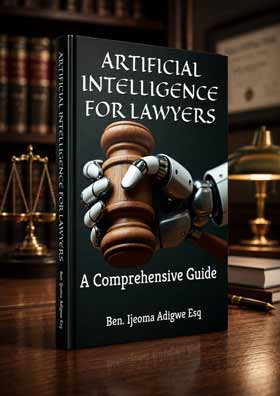 The book also examines Nigeria's legal ecosystem, focusing on the LPELR and NBA AI Guidelines. As a bonus, every purchase comes with a FREE eBook titled: How to Use the AI Features in LegalPedia and LawPavilion.
Ohio Books Ltd praises the publication, stating:
"....this is the only Nigerian book I know of on the topic."
How to Order:
📞 Call, Text, or WhatsApp: 08034917063 | 07055285878
📧 Email: benadigwe1@gmail.com
🌎 Website: www.benadigwe.com
Ebook Version: Access it directly online at https://selar.com/prv626
Authored by Ben Ijeoma Adigwe Esq., ACIarb (UK), LL.M, Dip. in Artificial Intelligence, Director at the Delta State Ministry of Justice, Asaba, Nigeria.
_______________________________________________________________________
The book also examines Nigeria's legal ecosystem, focusing on the LPELR and NBA AI Guidelines. As a bonus, every purchase comes with a FREE eBook titled: How to Use the AI Features in LegalPedia and LawPavilion.
Ohio Books Ltd praises the publication, stating:
"....this is the only Nigerian book I know of on the topic."
How to Order:
📞 Call, Text, or WhatsApp: 08034917063 | 07055285878
📧 Email: benadigwe1@gmail.com
🌎 Website: www.benadigwe.com
Ebook Version: Access it directly online at https://selar.com/prv626
Authored by Ben Ijeoma Adigwe Esq., ACIarb (UK), LL.M, Dip. in Artificial Intelligence, Director at the Delta State Ministry of Justice, Asaba, Nigeria.
_______________________________________________________________________
“Order Justice Omolaye-Ajileye’s Electronic Evidence Books Now” — Essential Guides On Evidence Act, Case Law And Digital Proof
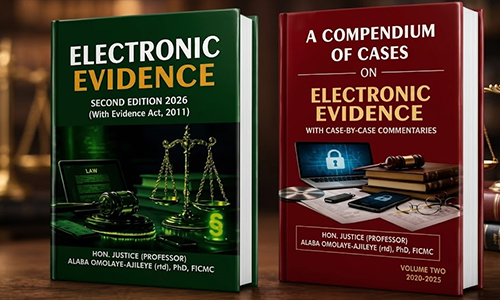

 Interested buyers are encouraged to place their orders and enquiries via:
0704 444 4777, 0704 444 4999, 0818 199 9888
Website: www.alexandernigeria.com
Interested buyers are encouraged to place their orders and enquiries via:
0704 444 4777, 0704 444 4999, 0818 199 9888
Website: www.alexandernigeria.com