The Nigerian judiciary is one of the arms of government (as in my humble view, it is legally wrong and underestimating to regard or refer to the judiciary as the third arm of government as some persons misconceive it to be because neither the Constitution nor any law having effect in Nigeria has categorized the judiciary as such and therefore, the Judiciary is not different from the status and or rank as given to it by the Constitution i.e. just an arm of the government and that is all!). Furthermore, there have been thoughts that when a lawyer has been appointed to the judiciary (the bench), then such Judge is low in rank except and until he is appointed as a Justice of the Court of Appeal or a Justice of the Supreme Court. This view, in my humble view is misconceived with due respect and this misconception is what this paper aims to correct (with due respect) by setting the dignified structures of the judiciary properly.


First and foremost, the creation of all courts in Nigeria is made pursuant to section 6 of the Constitution with courts being categorized as Federal Courts and States Courts. Section 6(1), (2) and (3) of the Constitution is clear on this position where it provides thus
‘6.—(1) The judicial powers of the Federation shall be vested in the courts to which this section relates, being courts established for the Federation.
(2) The judicial powers of a State shall be vested in the courts to which this section relates, being courts established, subject as provided by this Constitution for a State.
(3) The courts to which this section relates established by this Constitution for the Federation and for the States specified in subsection (5) (a) to (i) of this section shall be the only superior courts of record in Nigeria; and save as otherwise prescribed by the National Assembly or by the House of Assembly of a State, each court shall have all the powers of a superior court of record.’.
From the above provision of the Constitution, the courts therein listed under section 6(5) of the Constitution are specifically categorized under different headings in Chapter VII Judicature Part I Federal Courts (under the Constitution). The Supreme Court of Nigeria has been categorized as a Federal Court, with the Honourable the Chief Justice of Nigeria as the Chief Justice of Nigeria. See: section 230 of the Constitution. Also, the Part B of the Chapter categorized the Court of Appeal of Nigeria as a Federal Court with the President of the Court as the Head of the Court of Appeal. See: section 237 of the Constitution. Also, Part C of the Chapter created the Federal High Court of Nigeria and it has been categorized as a Federal Court with the Chief Judge of the Federal High Court of Nigeria as the Head of the Court. See: section 249 of the Constitution. Also, by virtue of section 6 of the Constitution’s Third Alteration, Act, 2010, the National Industrial Court of Nigeria under Part CC of the altered Principal Act, has been categorized as a Federal Court under section 254A with a President of the Court as the Head of the Court. Furthermore, the Part D of the Constitution has categorized the High Court of the Federal Capital Territory, Abuja, as a Federal Court with the Chief Judge of the High Court of the Federal Capital Territory, Abuja, as the Head of the Court. See: section 255 of the Constitution. Furthermore, the Sharia Court of Appeal of the Federal Capital Territory and the Customary Court of Appeal of the Federal Capital Territory, Abuja, have respectively been categorized as Federal Courts under Part E and F respectively. The above are the Federal Courts created by the Constitution with each of the Courts having its constitutional powers and functions therein stated. Then, the Constitution by virtue of Part II of Chapter VII, creates State Court for each State of the Federation with the Chief Judge as the Head of the Court. See: section 270 of the Constitution. Furthermore, the Sharia Court of Appeal of the State and the Customary Court of Appeal of the State have been respectively created under Part B and C respectively. Each of these courts too, has its own powers and functions under the Constitution.
From the foregoing, it is clear in my humble view that the structures of the Nigerian judiciary is such that a high court of a State’s Judge is a judge and rises in rank in seniority among His Lordship’s colleagues (just like the normal promotion or rise in seniority that occurs in the civil service) up to when he becomes the Chief Judge as the most senior judicial officer in the State (the same is applicable at the Federal High Court of Nigeria and all other Superior courts of record mentioned above). This is also the trend in the Court of Appeal of Nigeria (the Court of Appeal though higher in seniority and rank than the high court, is a different and separate structure in the judiciary where a Justice of the Court of Appeal too rises in seniority till His Lordship becomes the President of the Court of Appeal). This same dignified structure is applicable in the Supreme Court of Nigeria (the Supreme Court of Nigeria though higher in seniority and rank than the high court and the Court of Appeal as the apex/highest court of Nigeria, is a different and separate structure in the judiciary where a Justice of the Supreme Court too rises in seniority till His Lordship becomes the Chief Justice of Nigeria). Therefore, a judge of the high court or a Justice of the Court of Appeal or a Justice of the Supreme Court of Nigeria (including the other superior court of record) might retire as a judge of that particular court (depending on his age in service as prescribed by law) or rises to become either the Chief Judge of the High Court (of the State or of the Federal High Court or President of the National Industrial Court or the Grand Kadi of the Sharia Court of Appeal or the President of the Customary Court of Appeal) or the President of the Court of Appeal or the Chief Justice of Nigeria as the case might be. So, what matters is the seniority in the High Court or seniority in the Court of Appeal or seniority in the Supreme Court (or seniority in the other superior courts of record). Therefore, in my humble view, a Judge of the High Court (whether of the State or of the Federal High Court) may prefer to remain as a Judge of the High Court and rises through the rank in the State or the Federal Judiciary and retire in such service or a Justice of the Court of Appeal may prefer to remain as a Justice of the Court of Appeal and rises through the rank in the Court of Appeal’s judiciary and retire in such service and same for the Supreme Court of Nigeria (and other superior courts of record). It might however be the dream of almost every judge of the high court or the court of appeal (or other superior court of record) to rise to the Supreme Court due to other benefits of that judicial institution! With due respect, a Judge of the High Court needs not get disturbed (with due respect), when appointed as a judge rather, His Lordship should think of making all His Lordship’s sacrifices in that particular judiciary and where he feels that he desires to proceed in rank to the Court of Appeal’s judiciary, and having been qualified for such appointment, he might apply according to the prescription of the law (same is for the Justice of the Court of Appeal that intends to proceed to the Supreme Court). More so, the High Court, the Court of Appeal and the Supreme Court (as well as National Industrial Court, the Shariah Court of Appeal of the FCT and of a State (as the case might be) and the Customary Court of Appeal of the FCT or of a State) are Superior Court of Record. See: the relevant sections of the Constitution (referred to above) and the Revised National Judicial Council of Nigeria’s Guidelines and Procedural Rules for the Appointment of Judicial Officers of all Superior Courts of Record in Nigeria (the latest Rules. What I have is the 2014 Revised Edition. I was unable to complete my findings on whether there was a review to the 2014 Rules at the time of preparing this paper). Also, the emoluments of a High Court’s Judge/Judiciary, the Court of Appeal’s Judiciary and the Supreme Court’s Judiciary (as well as other superior court of record) are already prescribed by the National Judicial Council.
Finally therefore, it is my humble view that a Judge of a High Court (or of the National Industrial Court or of the Shariah Court of Appeal or of the Customary Court of Appeal) or of the Court of Appeal or of the Supreme Court is dignified. It is further my observation that each of these judiciary’s structures as a unit has its own structure which is different entirely from the other and a Judge of the High Court might rise and retire in that particular judiciary just as a Justice of the Court of Appeal might be as well as a Justice of the Supreme Court of Nigeria (and other superior court of record). This observation (i.e. this paper) is in my humble view important and useful for any lawyer or person who has the ambition of becoming a judge in future!
Email: hameed_ajibola@yahoo.com
 Interested buyers are encouraged to place their orders and enquiries via:
0704 444 4777, 0704 444 4999, 0818 199 9888
Website: www.alexandernigeria.com
Interested buyers are encouraged to place their orders and enquiries via:
0704 444 4777, 0704 444 4999, 0818 199 9888
Website: www.alexandernigeria.com

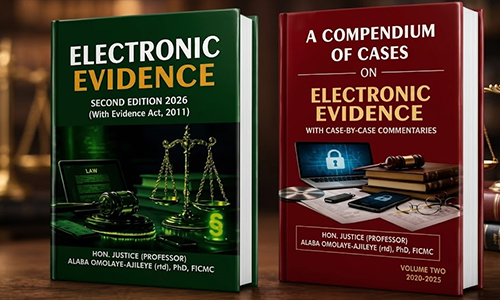
“Order Justice Omolaye-Ajileye’s Electronic Evidence Books Now” — Essential Guides On Evidence Act, Case Law And Digital Proof
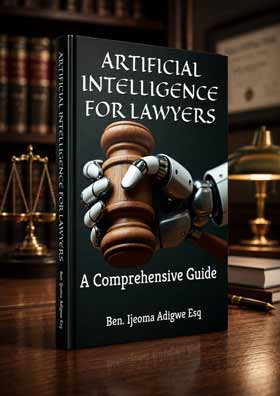 The book also examines Nigeria's legal ecosystem, focusing on the LPELR and NBA AI Guidelines. As a bonus, every purchase comes with a FREE eBook titled: How to Use the AI Features in LegalPedia and LawPavilion.
Ohio Books Ltd praises the publication, stating:
"....this is the only Nigerian book I know of on the topic."
How to Order:
📞 Call, Text, or WhatsApp: 08034917063 | 07055285878
📧 Email: benadigwe1@gmail.com
🌎 Website: www.benadigwe.com
Ebook Version: Access it directly online at https://selar.com/prv626
Authored by Ben Ijeoma Adigwe Esq., ACIarb (UK), LL.M, Dip. in Artificial Intelligence, Director at the Delta State Ministry of Justice, Asaba, Nigeria.
_______________________________________________________________________
The book also examines Nigeria's legal ecosystem, focusing on the LPELR and NBA AI Guidelines. As a bonus, every purchase comes with a FREE eBook titled: How to Use the AI Features in LegalPedia and LawPavilion.
Ohio Books Ltd praises the publication, stating:
"....this is the only Nigerian book I know of on the topic."
How to Order:
📞 Call, Text, or WhatsApp: 08034917063 | 07055285878
📧 Email: benadigwe1@gmail.com
🌎 Website: www.benadigwe.com
Ebook Version: Access it directly online at https://selar.com/prv626
Authored by Ben Ijeoma Adigwe Esq., ACIarb (UK), LL.M, Dip. in Artificial Intelligence, Director at the Delta State Ministry of Justice, Asaba, Nigeria.
_______________________________________________________________________