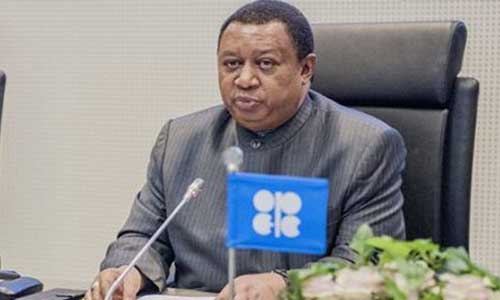
The Organisation of Petroleum Exporting Countries and its oil-producing allies on Sunday finalised a historic agreement to cut production by 9.7 million barrels per day, following multiple days of discussions and back-and-forth between the world’s largest energy producers.

Sunday’s emergency meeting which – was the second in four days – came as oil-producing nations scrambled to reach an agreement to prop up falling prices as the coronavirus outbreak continues to hammer demand.
Under OPEC+’s new agreement, Mexico will cut 100,000 barrels per day, instead of the 400,000 barrels per day it had initially been asked to cut, while the U.S., Brazil and Canada will contribute another 3.7 million barrels as their production declines.
The 9.7 million barrels per day cut will begin on May 1, and will extend through the end of June.
The signing of the OPEC+ deal had been delayed since Thursday, after Mexico resisted at the production cuts it was asked to make.
Talks continued on Friday when energy ministers from the Group of 20 major economies met, and while all agreed that stabilization in the market is needed, the group stopped short of discussing specific production numbers.
OPEC+ had been seeking 5 million barrels a day of output reductions from producers in the Group of 20. The group, however, didn’t mention any curbs in its communique following a meeting on Friday, only saying it would take measures to ensure stability.
Mexican President Andres Manuel Lopez Obrador said on Friday that U.S. President Donald Trump had offered to make extra U.S. cuts on his behalf, an unusual offer by a Trump who has long railed against OPEC.
Despite the record size of the cut, some fear that it’s still not large enough to combat the drop-off in demand. On Thursday West Texas Intermediate crude dropped more than 9%. The market was closed on Friday.
Both Brent and WTI futures are in bear market territory, down 53percent and 63percent, respectively since climbing to a January peak.
Chris Midgely, S&P Global Platts’ global head of analytics, said that the cut isn’t enough “to plug the 15- to 20-million b/d near-term imbalance in the marketplace and avoid tank tops in May.” The cut “won’t be enough to bring sustainable, restorative support to oil prices, not unless OPEC goes further,” he added.
That said, Ann-Louise Hittle, vice president of macro oils at Wood Mackenzie, noted that the deal “will make a difference to the market,” even if “poorly implemented.”
“We expect the second half of 2020 to show an implied stock draw, in contrast to the record-breaking oversupply of the first half of 2020,” she said.
The biggest one-off cut previously agreed by OPEC alone was 2.2 million bpd which was during the 2008 financial crisis.
The global oil price crash is setting up a bleak second quarter for many nations including countries like Nigeria whose economies are heavily dependent on oil receipts. Nigeria is particularly vulnerable.
Its fiscal and monetary buffers are non-existent today and it does not have the capacity to join in the dog fight for market share following years of neglect and huge capital flight away from its oil industry.
Most analysts have questioned the decision of Nigeria’s new production cut of 1.4 million which was arrived based on 23 percent reduction in its October oil production of 1.83 million bpd.
“Nigeria cannot afford to cut output to the suggested levels for long, — how sincere the government is about such steep production cuts will be swiftly put to a test next week, when the revised 2020 budget is expected to be put to a vote in the National Assembly,” Teneo Intelligence vice president Malte Liewerscheidt said in a note late Friday.
Production at these levels triggered by militants’ attacks in 2016-17 resulted in shortfalls in government revenues and foreign exchange proceeds. This led to “the largest expansion in foreign borrowing in 20 years and the introduction of measures to ration access to foreign exchange that are still in place today,” Liewerscheidt said.
Nigeria’s oil production reached 2.3 million barrels of crude per day as of April 5 with an increase planned to 3 million, according to state-owned oil company group managing director Mele Kyari.
“This does not look like a good deal for Nigeria. We should have negotiated for a 23 percent cut on production of 2.3 million bpd not 1.83 million bpd,” Charles Akinbobola, energy analyst at Lagos based Sofidam Capital said.
Akinbobola said the new OPEC decision will impact the economy adversely considering the economic significance of the commodity.
[A MUST HAVE] Evidence Act Demystified With Recent And Contemporary Cases And Materials

Available now for NGN 40,000 at ASC Publications, 10, Boyle Street, Onikan, Lagos. Beside High Court, TBS. Email publications@ayindesanni.com or WhatsApp +2347056667384. Purchase Link: https://paystack.com/buy/evidence-act-complete-annotation
______________________________________________________________________ “Enhance Legal Practice With Authoritative Reports” — Alexander Payne Offers Comprehensive Law Reports, Spanning Over A Century Of Nigerian Jurisprudence Interested buyers are encouraged to place their orders and enquiries via:
0704 444 4777, 0704 444 4999, 0818 199 9888
Website: www.alexandernigeria.com
Interested buyers are encouraged to place their orders and enquiries via:
0704 444 4777, 0704 444 4999, 0818 199 9888
Website: www.alexandernigeria.com