TheNigerialawyer Editorial

Whether a civil servant who is a legal practitioner can engage in private practice or not is a matter outside the realm of conjecture.
The answer is clearly provided in paragraphs 1 and 2 of the 5th schedule of the constitution of the Federal Republic of Nigeria, 1999 which shall henceforth be referred to as the constitution and sections 5 and 6 of the Code of Conduct Bureau and tribunal (CCBT) Act. Paragraphs 1 and 2 of the 5th schedule to the constitution which are in pari materia with the aforementioned sections of the CCBT Act provide as follows:
“1. A public officer shall not put himself in a position where his personal interest conflicts with his duties and responsibilities.
- Without prejudice to the generality of the foregoing paragraph, a public officer shall not–
(a) Receive or be paid the emolument of any public office at the same time as he receives or is paid the emoluments of any other public office; or
(b) Except where he is not employed on full times basis, engage or participate in the management or running of any private business, profession or trade but nothing in this sub-paragraph shall prevent a public officer from engaging in farming.” (Underlined for emphasis)
This takes us to section 318 of the constitution which defines the phrase “Public Service” to mean “the service of the Federation in any capacity in respect of the Government of the Federation. It is submitted that the phrases “civil servant” and “public servant” both mean the same thing and can be used interchangeably. For the avoidance of doubt, it was held in ADETOYE V. FED. INST. OF IND. RESEARCH OSHODI & ORS (2011) LPELR-3615(CA) that:
“A civil servant is a public servant in the employment of the civil service of the Federation or a State. The Civil Service of the Federation is defined in S.318(1) of the Constitution of the Federal Republic of Nigeria 1999 as “service of the Federation in a civil capacity as a staff of the office of the President, Vice-President, a Ministry or Department of the Government of the Federation assigned with the responsibility for any business of the Government of the Federation.” (underlined for emphasis)
It is therefore clear from a community construction of the provisions of paragraphs 1 and 2(b) of the 5th Schedule (supra), section 5 and 6 of CCBT Act and the meaning of “public service” as defined by Section 318 of the Constitution above that a lawyer in civil service shall not engage in private practice.
The express prohibition of public officers from engaging or continuing to engage in private practice dates back to the enactment and coming into effect of the Regulated and other professions (private Practice Prohibition) Act’ on the 12th day of December, 1984, in connection with any of the scheduled professions. The scheduled professions or calling are Architecture, Accountancy, Dental Technology, Engineering, Estate Management, Law, Medical Technology, Medicine and Dentistry, Midwifery and Nursing, Pharmacy, Psyiotherapy, Quantity Surveying, Radiography, Surveying, Teaching, and Veterinary Medicine.
Under section 1(2) of the Act, “private practice” in relation to any scheduled profession connotes the rendering of or offering to any other person (not being the employer or any other person normally entitled in the course of his official duties to receive such services) of any service relative to the profession concerned whether or not after his normal hours of work or on work free days, for money or money’s worth or for any other valuable consideration. This includes in particular (a) the performance of services of all descriptions relating to the profession concerned including the rendering of advice or provision of consultancy services connected with or relating to the profession concerned; (b) the issue of certificates, the certification of documents connected with or relating to any of the aforementioned services; or (c) the establishment of any undertaking either by the professional concerned or in partnership, or in any other form of association with any other person (whether or not himself a public officer) for the provision of any of the services or matters earlier enumerated. It shall however be lawful for the professional concerned, apart from during the course of his normal official duties to render any of the services to himself, or to any person in an emergency, or to any person (whether corporate or unincorporated) authorized generally or specially by the government to receive the services of that professional for the time being or, where a period is specified, for that specified period. The professional concerned is also authorized to render service free of charge to any member of his family, charitable organizations or professional associations which he is a member or to any other person or group of persons purely on humanitarian grounds.
A “public officer” within the purview of the Act means any person who holds office in the public services of the federation or a state within the meaning of the constitution of the Federal Republic of Nigeria. On the other hand, a professional” means any practitioner of or any person entitled to practice any scheduled profession under the Act provided that “professional concerned” shall be constructed accordingly.
Criminal sanctions are prescribed for any public officers who engage in or continues to engage in private practice in contravention of the provisions of the Act. Thus, such a person is guilty of an offence and liable upon conviction for the first offence to a fine of N2000.00 or imprisonment for one year. Upon conviction for the second offence, he shall be liable to a fine of N5,00.00 or imprisonment for two years while conviction for a third offence attracts a three year imprisonment term without option of a fine and such a public officer convicted for a third offence shall have his name and particulars removed from the register or struck off the roll by the appropriate disciplinary body or tribunal or where there is no such tribunal, by the relevant professional association as the case may be. The Federal High Court, High Court of a State or the High Court of the Federal Capital Territory Abuja are concurrently vested with the original jurisdiction to try offences under the Act. No appeal shall lie from a decision of the court under the Act but the Registrar of the court which has awarded the conviction shall within fifteen days after delivery of such judgment forward certified copy thereof to the President for confirmation or disallowance. An order of the president confirming or disallowing a conviction shall have effect according to its tenor.
By the Regulated and other professions (Private Practice Prohibition) (Law Lecturers Exemption) (No. 2) order 1992 made in the exercise of the powers conferred on the President and Commander – in chief of the Armed Forces, Federal Republic of Nigeria under section 1 (5) of the Regulated and other professions (Private Practice Prohibition) Act 1984, it is provided that, with effect from the 14th day of September 1992, a public officer engaged in the practice of law as a full time law lecturer is exempted from the provisions of the Regulated and other professions (private Practice Prohibition) Act.
It follows therefore that public officers engaged in the practice of law as full-time lecturers in the Universities, Polytechnics, Nigerian Law School, and allied academic and research institutes are insulated from the erstwhile provisions of the Act prohibiting them from engaging or continuing to engage in private practice.
The constitutionality of Regulated and other Professions (Private practice prohibition) (Law Lectures Exemption) (No. 2) order, 1992 has been a subject of debate. In fact the issue has come up several times in courts. However, all the cases were struck out for want of jurisdiction because all of them came up before High Courts instead of Code of Conduct Tribunal. See Ahmed V Ahmed (2013) ALL FWLR (PT. 699) 1025 and the recent Plateau State University Bokkos V Joseph (2018) LPELR-46049.
Though it is not within the purview of this write-up to re-open the argument as to the constitutionality or otherwise of the Regulated and other Professions (Private practice prohibition) (Law Lectures Exemption) (No. 2) order, 1992, it is submitted that the law is good as it would enable law lecturers to impart practical knowledge on students as opposed to theories.
Conclusively, it is submitted that apart from farming, a public lawyer can represent family members or any association (example NBA) of which he is a member on pro bono basis.
TheNigerialawyer Editorial
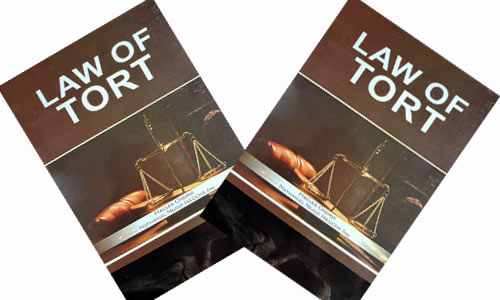 The book, titled The Law of Torts in Nigeria: A Functional Approach, authored by Professor Hagler Sunny Okorie Ph.D and Ikeocha, Nathaniel Ngozi Esq, offers law students, practitioners, and academics a comprehensive guide to understanding and applying tort law in Nigerian courts. Interested buyers can place orders via the following contact numbers: 08028636615, 08037667945, 08032253813, or +234 902 196 2209.
______________________________________________________________________
[A MUST HAVE] Evidence Act Demystified With Recent And Contemporary Cases And Materials
The book, titled The Law of Torts in Nigeria: A Functional Approach, authored by Professor Hagler Sunny Okorie Ph.D and Ikeocha, Nathaniel Ngozi Esq, offers law students, practitioners, and academics a comprehensive guide to understanding and applying tort law in Nigerian courts. Interested buyers can place orders via the following contact numbers: 08028636615, 08037667945, 08032253813, or +234 902 196 2209.
______________________________________________________________________
[A MUST HAVE] Evidence Act Demystified With Recent And Contemporary Cases And Materials

 ARTIFICIAL INTELLIGENCE FOR LAWYERS: A COMPREHENSIVE GUIDE
Reimagine your practice with the power of AI “...this is the only Nigerian book I know of on the topic.” — Ohio Books Ltd
Authored by Ben Ijeoma Adigwe, Esq., ACIArb (UK), LL.M, Dip. in Artificial Intelligence, Director, Delta State Ministry of Justice, Asaba, Nigeria.
Bonus:
Get a FREE eBook titled “How to Use the AI in Legalpedia and Law Pavilion” with every purchase.
ARTIFICIAL INTELLIGENCE FOR LAWYERS: A COMPREHENSIVE GUIDE
Reimagine your practice with the power of AI “...this is the only Nigerian book I know of on the topic.” — Ohio Books Ltd
Authored by Ben Ijeoma Adigwe, Esq., ACIArb (UK), LL.M, Dip. in Artificial Intelligence, Director, Delta State Ministry of Justice, Asaba, Nigeria.
Bonus:
Get a FREE eBook titled “How to Use the AI in Legalpedia and Law Pavilion” with every purchase.
How to Order: 📞 Call, Text, or WhatsApp: 08034917063 | 07055285878 📧 Email: benadigwe1@gmail.com 🌐 Website: www.benadigwe.com
Ebook Version: Access directly online at: https://selar.com/prv626
________________________________________________________________________ The Law And Practice Of Redundancy In Nigeria: A Practitioner’s Guide, Authored By A Labour & Employment Law Expert Bimbo Atilola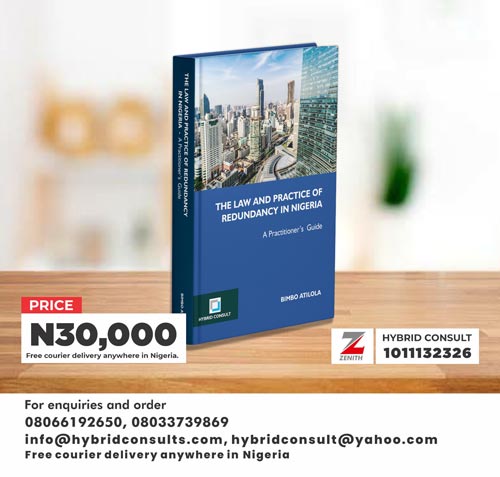 _______________________________________________________________________
“Enhance Legal Practice With Authoritative Reports” — Alexander Payne Offers Comprehensive Law Reports, Spanning Over A Century Of Nigerian Jurisprudence
_______________________________________________________________________
“Enhance Legal Practice With Authoritative Reports” — Alexander Payne Offers Comprehensive Law Reports, Spanning Over A Century Of Nigerian Jurisprudence
 Interested buyers are encouraged to place their orders and enquiries via:
0704 444 4777, 0704 444 4999, 0818 199 9888
Website: www.alexandernigeria.com
Interested buyers are encouraged to place their orders and enquiries via:
0704 444 4777, 0704 444 4999, 0818 199 9888
Website: www.alexandernigeria.com