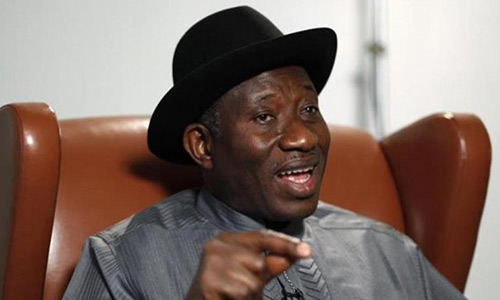
Former President Goodluck Jonathan has called for the implementation of the report of the 2014 National Constitutional Conference, saying that he convened the conference because he believed that the call for a national dialogue could no longer be ignored, in view of the yearnings of Nigerians for reforms.

He explained that it was a decision taken to reconcile ethnic differences, heal old wounds and promote peace, adding that the nation needs to implement the recommendations of the conference, in order to make progress.
The former President who stated this yesterday in Lagos at the public presentation of a book by Senator Femi Okurounmu titled ‘The Dream: Pursuing The Black Renaissance Through the Murky Waters of Politics’, also stressed that his administration could not implement the recommendations because it did not have enough time to do so.
Jonathan also reiterated his call for the review of the process of appointing leaders of the Independent National Electoral Commission (INEC), as means of boosting the people’s confidence in the electoral process and ensuring the impartiality and independence of the electoral management body.
Making a case for the implementation of the 2014 conference recommendations, Jonathan said: “The call for reforms has continued to grow louder, gathering the kind of momentum that should no longer be overlooked, if the nation must make real progress.
“I believe that the solutions to most of the problems we face today lie in our honest assessment of the recommendations of the 2014 National Conference. If we take politics out of our consideration, there is every likelihood that a diligent implementation of the key recommendations of the conference will lead the nation out of the woods. This will heal frayed nerves, promote solidarity, engender peace and reposition our nation for meaningful growth and sustainable development.”
On why his government could not implement the recommendations, the former president noted that the report was submitted to him less than one year to the end of his tenure when the nation was already in the mood of electioneering.
He said further: “Then, the members of the National Assembly, whose duty it was to consider and validate the process, were preoccupied with the battle for political survival.
“I believed that given the nature of the consultations and due deliberations involved in advancing the process, an orderly and systematic implementation could not have been conducted in less than one year. It was obvious we did not have that time before the end of my administration. I did not insist on a rushed implementation because my administration did not embark on the conference to “achieve political popularity but to genuinely advance the course of nation-building.
“We assembled 492 reputable individuals, drawn from all walks of lives and shades of opinion, who emerged through a rigorous selection process, to conduct diligent deliberations over a period of 120 days. We did this not to score a political point, but to come up with ideas on how to strengthen the pillars of our democracy and build a new foundation for sustainable nationhood.”
The former president further advised the National Assembly to take relevant measures towards ensure the impartiality and independence of the Electoral Management Body (EMB), as a means of guaranteeing the credibility and legitimacy of electoral processes.
He said: “In many thriving democracies, the responsibility of appointing electoral umpires is no longer left in the hands of one powerful politician. This is because no matter how he goes about it, his intentions and choices will not be entirely trusted by the stakeholders, on account of his or her partisan political leaning.
“So, if the process of appointing the key members of the EMB, is institutionalized, it would inspire confidence among all stakeholders. One way this can be achieved is for the relevant arms of the National Assembly to study the different models of recruiting members of EMBs in other countries as a guide towards establishing a functional template that would secure true independence for INEC, in a manner that meets the expectations of the people.”
[A MUST HAVE] Evidence Act Demystified With Recent And Contemporary Cases And Materials

Available now for NGN 40,000 at ASC Publications, 10, Boyle Street, Onikan, Lagos. Beside High Court, TBS. Email publications@ayindesanni.com or WhatsApp +2347056667384. Purchase Link: https://paystack.com/buy/evidence-act-complete-annotation
______________________________________________________________________ “Enhance Legal Practice With Authoritative Reports” — Alexander Payne Offers Comprehensive Law Reports, Spanning Over A Century Of Nigerian Jurisprudence Interested buyers are encouraged to place their orders and enquiries via:
0704 444 4777, 0704 444 4999, 0818 199 9888
Website: www.alexandernigeria.com
Interested buyers are encouraged to place their orders and enquiries via:
0704 444 4777, 0704 444 4999, 0818 199 9888
Website: www.alexandernigeria.com