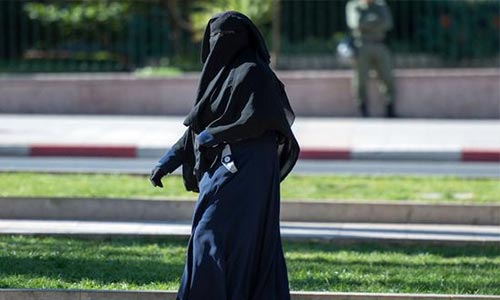
Tunisia’s premier on Friday banned the niqab Muslim face covering for women in government offices, citing security concerns after attacks in the North African country.

Prime Minister Youssef Chahed signed a government circular “banning access to public administrations and institutions to anyone with their face covered… for security reasons,” his office said.
The ban on the niqab, which covers the entire face apart from the eyes, comes at a time of heightened security following a June 27 double suicide bombing in Tunis that left two dead and seven wounded.
The interior minister instructed police in February 2014 to step up supervision of the wearing of the niqab as part of anti-terrorism measures, to prevent its use as a disguise or to escape justice.
Reactions to the ban were mixed in the Tunisian capital.
“They have the right to prohibit (the niqab) given the events we are currently witnessing,” said Ilhem, a young Tunisian woman.
“But in the end, it remains an individual freedom,” she added.
Lina questioned “why the woman must make sacrifices every time there are security measures to be taken”.
The Tunisian League for the Defence of Human Rights urged that the measure be only temporary.
“We are for the freedom to dress (as one pleases), but today with the current situation and the terrorist threats in Tunisia and across the region we find justifications for this decision,” the league’s president Jamel Msallem told AFP.
He said that the ban should be repealed as soon as “a normal security situation returns in Tunisia”.
The niqab and other outward shows of Islamic devotion were not tolerated under the regime of longtime autocrat Zine El Abidine Ben Ali but have made a comeback since he was toppled in Tunisia’s 2011 revolution.
After bloody attacks in 2015 that targeted security forces and tourists, there were calls in Tunisia to re-impose the ban.
(AFP)
[A MUST HAVE] Evidence Act Demystified With Recent And Contemporary Cases And Materials

Available now for NGN 40,000 at ASC Publications, 10, Boyle Street, Onikan, Lagos. Beside High Court, TBS. Email publications@ayindesanni.com or WhatsApp +2347056667384. Purchase Link: https://paystack.com/buy/evidence-act-complete-annotation
______________________________________________________________________ “Enhance Legal Practice With Authoritative Reports” — Alexander Payne Offers Comprehensive Law Reports, Spanning Over A Century Of Nigerian Jurisprudence Interested buyers are encouraged to place their orders and enquiries via:
0704 444 4777, 0704 444 4999, 0818 199 9888
Website: www.alexandernigeria.com
Interested buyers are encouraged to place their orders and enquiries via:
0704 444 4777, 0704 444 4999, 0818 199 9888
Website: www.alexandernigeria.com