According to Brigadier General J. I. James (retd.) “We should constantly search for, and implement new truths to attain new realities… We must never be afraid to try the new if the intention is to renew…” In contemporary third world African countries, European and American standards have become the working template for the sort of clime we crave. Nearly nothing that works in Nigeria is devoid of external templates and influences. One can argue that it is a unique method of neo-colonization but that is a topic for another day. This is evident in all aspects of human endeavor even down to institution building. Elections and transition process is one of the many borrowed cultures that have become a part and parcel of our system. As at date, Nigeria’s democracy is almost two decades. Election is arguably the strongest point of a democracy. Voting is embedded in a democracy and democracy is considered as one of the global cardinal values and principles of the United Nations, a body which Nigeria belongs to. Voting is one of the ways of expressing freedom and freedom is one of the pillars of democracy. Article 21 of the Universal Declaration of Human Rights (which Nigeria is signatory to) states that “The will of the people shall form the basis for the authority of government; this will shall be expressed in periodic and genuine elections, shall be by universal or equal suffrage and shall be by secret ballot or any equivalent free voting procedures”. The above quoted article presupposes that whilst democracy is upheld on the world stage, countries are at liberty to draft guidelines to achieve a free and fair election, based on prevailing realities in various jurisdictions. According to a BBC report, Nigerians living in Poverty currently stands at nearly 61% of the country’s population. If the population of Nigeria which has currently been pegged at 200M persons is anything to go by, it implies that more than 120M people currently live in poverty. Worthy of note is that poverty here was defined to mean those who can afford only the “bare essentials” and those living on less than $1 daily. Funnily enough, Nigeria has good indices in terms of economic growth. The indices do not sadly support the reality of the visible abject squalor. On the 27th of November 2017, the minister of education came out with an official statement that more than 60 million Nigerians are illiterates and 60% of this figure are women. It is arguable that this figure is not a true representation of the academic state of the nation but one would not want to raise such dust. Also, the parameters for judging illiteracy was not established but for the purpose of this piece, I would define an illiterate to be someone who did not complete the academic curriculum of a Secondary School. A juxtaposition of Nigeria’s illiteracy and poverty indices would be a clear explanation for the sort of country we live in. There have been many years of an unholy romance between politicians and these extremely poor and uneducated people. These people are the bride (or prostitutes if you like) of politicians and the age long instrument and vehicle for attaining political destinations in Nigeria. That is why when lettered people make noise about the state of the economy, politicians do not respond. When educated people raise heavy dust as to critical issues, politicians do not lose sleep. The reality is that it is neither the educated ones nor the elites that select a leader, but the extremely poor ones whose vote of confidence to install a person in political office for four years is given in exchange for a fanciful bag containing three balls of onions, not even a bag of rice that is currently the minimum wage, and at the end of the day, election is still about the numbers. Like it or not, the numbers lie with these same poor and uneducated people as a lot of social media giants do not even have Permanent Voters’ Cards. How do we explain the fact that there are election wards in every nook and cranny in the country but no development? Is the right to vote for important than the outcome of such vote? It is bereft of reason how that politicians know all the wards across the country which is a few numbers shy of 10,000 (Ten thousand) and this same ward delineation cannot become the jurisdictional template for nationwide development. By this piece, I am proposing that these poor and illiterate persons be temporarily stripped of their civic responsibility of voting because whether any one accepts it or not, they are not informed enough to determine who should lead them. Enough of politicians going to woo them with bags of rice, salt, onion balls and other demeaning items and leave them for another four years with their only clothes being the campaign face caps and T shirts given to them with various pictures and “impossible slogans” of politicians. Worthy of note is the fact that it is in these same places that elections are rigged the most. The workability of this proposition is simple. Let voting and leadership selection process be a business of educated people who are informed enough to collate data on prospective candidates for various electoral offices based on past leadership performance or performance is the candidate’s field, analyse such data and form an opinion for the purpose of determining a suitable candidate who would work assiduously to take education down to the areas it is lacking and them empower the rural people educationally and economically so they get elevated to being able to participate in electoral processes as better informed persons and not just for gathering numbers. To my mind, at least people who have attained Secondary education possess this ability. This proposition has become necessary because a lot of persons in political offices in Nigeria are not qualified to hold offices. They only thrive because they are wealthy or supported enough to take relief materials to these disadvantaged areas who in turn churn out votes many a time without the true knowledge of whom they are voting. We therefore loose visionary candidates because they lack the financial firepower to play the politics of “IDPcamping”. One can argue that it would lead to disenfranchisement of voters on the basis of education. The above position would particularly be held by the same politicians who are thriving on this reality but the truth remains that lots of the people being referred to here, do not in the real sense of it, know whom they are voting so one wonders what the point is. I am of the considered view that it is better to have a credible government put in place at all levels by the close scrutiny of educated folks so much so that leaders can deliver on their promises and then people in the lower cadre of the ladder get promoted to promoted till they can exercise their franchise because of credible leadership, than to have them exercise their right every four years in exchange for paltry items and sums, with no means to question the government of the day. As we draw nearer to another decisive year, our media would soon be littered with the voices and demeanors of politicians, renewing the marital vows of poverty in the unholy union with the poor and uneducated persons in rural areas, with salt, yards of wrapper, onion balls and many other unthinkable items in the desperate move to win and leave them in the same or worse condition as they were. This practice is no longer sustainable and that is why I believe that the way forward is adopting the position suggested in this article for a longer term development.]]>


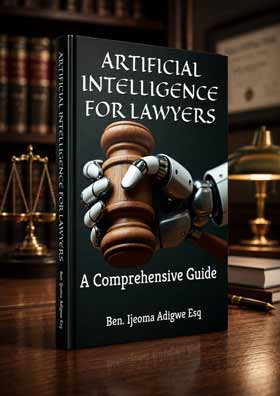 The book also examines Nigeria's legal ecosystem, focusing on the LPELR and NBA AI Guidelines. As a bonus, every purchase comes with a FREE eBook titled: How to Use the AI Features in LegalPedia and LawPavilion.
Ohio Books Ltd praises the publication, stating:
"....this is the only Nigerian book I know of on the topic."
How to Order:
📞 Call, Text, or WhatsApp: 08034917063 | 07055285878
📧 Email: benadigwe1@gmail.com
🌎 Website: www.benadigwe.com
Ebook Version: Access it directly online at https://selar.com/prv626
Authored by Ben Ijeoma Adigwe Esq., ACIarb (UK), LL.M, Dip. in Artificial Intelligence, Director at the Delta State Ministry of Justice, Asaba, Nigeria.
_______________________________________________________________________
The book also examines Nigeria's legal ecosystem, focusing on the LPELR and NBA AI Guidelines. As a bonus, every purchase comes with a FREE eBook titled: How to Use the AI Features in LegalPedia and LawPavilion.
Ohio Books Ltd praises the publication, stating:
"....this is the only Nigerian book I know of on the topic."
How to Order:
📞 Call, Text, or WhatsApp: 08034917063 | 07055285878
📧 Email: benadigwe1@gmail.com
🌎 Website: www.benadigwe.com
Ebook Version: Access it directly online at https://selar.com/prv626
Authored by Ben Ijeoma Adigwe Esq., ACIarb (UK), LL.M, Dip. in Artificial Intelligence, Director at the Delta State Ministry of Justice, Asaba, Nigeria.
_______________________________________________________________________
“Order Justice Omolaye-Ajileye’s Electronic Evidence Books Now” — Essential Guides On Evidence Act, Case Law And Digital Proof
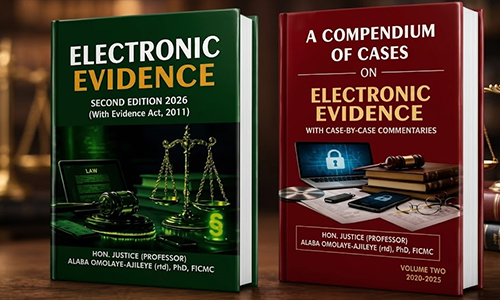

 Interested buyers are encouraged to place their orders and enquiries via:
0704 444 4777, 0704 444 4999, 0818 199 9888
Website: www.alexandernigeria.com
Interested buyers are encouraged to place their orders and enquiries via:
0704 444 4777, 0704 444 4999, 0818 199 9888
Website: www.alexandernigeria.com