Under the previous Rules of the court, a Plaintiff could file only a Writ of Summons without accompanying it with the Statement of Claim. Mere service of the Writ of Summons on the Defendant a times made him to develop cold feet and ran to the Plaintiff for settlement. When some Plaintiffs achieved this “miracle of intimidation”, they eventually abandoned the suits they had earlier filed in court. With the coming into force of the Lagos State High Court Civil Procedure Rules 2004, the initiator of a suit used to be known as the PLAINTIFF was renamed the CLAIMANT who under the new rules is required not only to accompanying his suit with Writ of Summons and Statement of Claim but also the List of Witnesses, their Statements on Oath as well as the copies of the documents he intends to rely on at the trial . He must also have done something akin to the pre-action notice to the defendant. With this innovation by the Lagos State Judiciary, many other High Courts in the Federation followed suit including the Federal High Court and later the National Industrial Court. Some years later, precisely in 2012, Lagos State Judiciary further improved on its frontloading rules wherein it changed the Pre-Trial Conference (PTC) under the 2004 Rules to the Case Management Conference (CMC) under the 2012 Rules. With all these changes and innovations made to improve on the speedy dispensation of justice, the desire for quick dispensation of justice is still found wanting. You can only know when you institute an action but cannot be sure when it will actually come to an end. Since we operate a system where a party that is aggrieved with a judgement can appeal against it, you cannot prevent such party from exercising his right of appeal. The delay in cases has become a big phenomenon that seems to have resisted solutions even as in the past. All these were or are not without lamentations particularly from those on the bench. For instance in the case of ARIORI Vs. ELEMO (1983) 1 SC at pages 74-75 where the great late Jurist, Kayode Eso, JSC read the lead judgment, his Lordship lamented: “It is unfortunate that a case that has been litigated through a space of twenty two years is still not brought to an end and has to be reopened again due to the avoidable fault of the trial judge especially when some of the witnesses might have died or perhaps cannot now be traced. Indeed the trial judge himself has retired from the service. If it is possible to make an order other than a retrial I would have readily acceded to it. But to my mind the course of justice can only be satisfied by a retrial and I do hope the Chief Judge of Lagos State will look into the issue of speedy trial and assign a judge to this case, who would attend to the trial from day to day and complete it with utmost dispatch”. Justice Eso made the above observation in 1983. In the case of HENSHAW Vs. EFFIANGA (2009) 11 NWLR (Pt. 1151) Pg.65 at 88 Paras C-E, Omokri, JCA also observed that: “The instant case on appeal presents peculiar problem which should be addressed in the interest of justice and fairness. This case was instituted in 1982 at the court below and the proceedings commenced in January 1983. Hearing was concluded and judgment delivered by the Chief Judge on 6th March 2000.That meant that the case was conducted for a period of 18 years. In my humble view, order for a retrial in this matter will no doubt defeat the objective of justice in the adjudication process. It will cause an unnecessary delay and hardship on the hapless litigants. Justice delayed Justice denied. As at the date of this judgment, this case on appeal had been on for 26 years. No one knows when the case will be concluded if sent back for retrial. Perhaps in another 26 years or so. In my considered view, this is an appropriate case where this court can evaluate the evidence of the witnesses and make its own finding” In the same year 2009, Hon. Justice Ogbuagu , JSC descended heavily on the appellants in the case of OSHOBOJA Vs. AMIDA (2009) 18 NWLR (Pt. 1172) at Pg. 207 Paras A-B, when he said : “The appellants perhaps enjoy or have “gluttony” for unwarranted and prolonged litigation of dispute or subject matter that this court had long pronounced effectively upon. In 1992, this case had lasted for 35 years. It is now about 54 years from when it started. No party is entitled to have such gluttony. It is regrettable and perhaps unfortunate.” If you take your time to do the calculation, you will discover that a man or a woman that was 54 years old at 2009 and was born when the case started must have been Grand Pa or Grand Ma and the case still did not come to an end. In 2014 when Dr. Goodluck Jonathan (GCFR) was the President of the Federal Republic of Nigeria, the Supreme Court in the case of SOCIETE BIC S.A. & 2 Ors Vs. CHARZIN INDUSTRIES LTD. (2014) 4 CLRN Pg. 26 Lines 29-40 had this to say per Rhode Vivour , JSC: “This suit was filed in 1995. Nineteen year ago. It took nineteen years to resolve the simple issue of jurisdiction. This case would now be sent back to the High court for hearing of the main suit. That would possibly be settled after fifteen years or more .This is unfortunate and sad state of affairs for the rule of law. Cases must be heard with dispatch and resolved quickly. The better course would have been for the trial judge to proceed with the hearing of the case after the Ruling on the jurisdiction .Since the Ruling on jurisdiction could easily be a subject of appeal after judgment .This is clearly an unnecessary interlocutory appeal, a waste of client’s resource and judicial time. Such unnecessary interlocutory appeals have been frowned upon by this court in a plethora of cases.” This year ,2018 when the politician are preparing for the 2019 General elections, we are yet to do away with the unnecessary delay of cases as the Court of Appeal per Ogunwumiju JCA in the case of AMCO Vs. ONYEDIKA & ANOR. (2018) LPELR -43764 (CA) has this to say: “The Ruling of the trial court was delivered in June, 2013 while the appeal was heard in January, 2018 just a few months shy of its fifth anniversary. The substantive matter is still pending at the High Court where there has been zero progress on the matter. The 1st Respondent must now proceed to file the requisite pre-action notice so that trial can commence in earnest. What a waste of time and resources!” One can go on and on to cite more cases to illustrate this issue at hand. With all these lamentations, our jurists have clearly identified some of the causes of these delays which include unnecessary appeal against interlocutory decisions as well as gluttony for unwarranted and prolonged litigation of dispute .One of the ironies of the litigation is that we operate a system where the defendant hardly throws in the towel even where it has no defence to the suit of the claimant. Many defendants are always prepared for battle and fight it to the end. By the time a defendant starts to release his series of preliminary objections, a claimant who does not have the liver for such fight may decide to abandon the fight when he sees that the defendant is out to frustrate his claims. Also the desire of many lawyers to attain the rank of the Senior Advocate of Nigeria (SAN) some time sharpen the desire to argue an appeal up to the Supreme court no matter how frivolous the appeal may be, which is more the reason why we have suggested somewhere else that arguing cases up to the Apex court must not be a strict yardstick for the attainment of the rank. Our jurists especially those on the appellate bench have propounded a solution that the issue of preliminary objection and substantive issue should be taken together and judgement delivered while any aggrieved party can then bring both the interlocutory and final appeal together at the end. Hon. Justice Uwais, former CJN in the case of AMADI Vs. NNPC (2000) FWLR (Pt. 9) 1527; (2000) 10 NWLR (Pt. 674) 76 observed that: “Finally this appeal succeeds and it must be allowed. The chequered history of this case once more brings to light the dilatory effect of interlocutory appeals to the substantive suit between the parties. The action in this case was brought on 29th April 1987.The motion on notice to strike out the case for want of jurisdiction…It has thus taken thirteen years for the case to reach this stage . With the success of the plaintiff’s appeal before us, the case is to be sent back to the High court to be determined, hopefully, on its merits after a delay of 23 years. Surely, this could have been avoided had it been that the point was taken in the substantive claim to enable any aggrieved party to appeal on both the issue of jurisdiction on merit in the proceedings as the case might be. I believe that counsel owe it as a duty to the court to help reduce the period of delay in determining cases in our courts by avoiding unnecessary preliminary objections as the one here; so that the adage justice delayed is justice denied may cease to apply to proceedings in our court.” I am of the view that taking this path will go a long way in addressing the issue of delay in our judicial system. By the time the court and the counsel adopt the style of killing two birds with one stone, the issue of delay in the dispensation may soon become things of the past. REMARKABLE PRONOUNCEMENT ON REFORM FOR THE SUPREME COURT “I cannot but comment on nature of cases that now inundate the Supreme Court. That this Apex court which ordinarily should confine itself dealing with important cases more particularly constitutional matters would now be crowded with non-discreet pedestrian cases like deciding on who should be a chief in a village or community. This court should borrow a leaf from the U.S Supreme Court where that court on its own, turns it back and refuses to handle some matters which they in their wise discretion and wisdom regards as frivolous or would not advance the growth of jurisprudence. Such banal, dreary and utterly vapid cases ought to end in the Court of Appeal and this court should on its own decide whether some cases filed in this court should necessarily be heard by this court. To my mind it is the duty of this court to reject in toto an application for appeals in a matter where: (a) there have been concurrent findings of fact in the lower courts and no constitutional issue of law is involved unless in a case where this court is of the view that it has to depart from some precedents hitherto resorted to because we inherited them from English report (b) cases which counsel took up because they want to use it to advance or increase the number of cases they handle in Supreme court for the purpose of application for SAN. Of course novel cases that have arisen in the lower courts could of necessity find their way in this court for determination. That is what this court is instituted for, not for ordinary drab, dull and strictly non-contentious issues where counsels merely wish to make themselves heard.” Per PATS-ACHOLONU, JSC in A-G Adamawa State Vs. Ware (2006) 4 NWLR (Pt. 970) Pgs. 417-418 Paras F-C THE SETTLED PRINCIPLE OF LAW “It is also settled that it is no credit to any counsel who takes a brief knowing fully well that there is not a slim chance of success, to blindly prosecute the case. There is need for counsel, to have confidence in the success of a case, before accepting it.” See KALLAMU Vs. GURIN (2005) ALL FWLR (Pt. 241) Pg. 351 Paras C-D For more Settled Principles of Law and Remarkable Pronouncements from our Supreme Court Jurists from 1956-2016, obtain or order for your copies of LAW PRACTICE KIT and LEGAL LUMINARIES. Call or text 08055476823, 08164683735 or email:rasheedibraheem68@yahoo.com. Your library is incomplete without these books. 30th September 2018]]>


 Interested buyers are encouraged to place their orders and enquiries via:
0704 444 4777, 0704 444 4999, 0818 199 9888
Website: www.alexandernigeria.com
Interested buyers are encouraged to place their orders and enquiries via:
0704 444 4777, 0704 444 4999, 0818 199 9888
Website: www.alexandernigeria.com

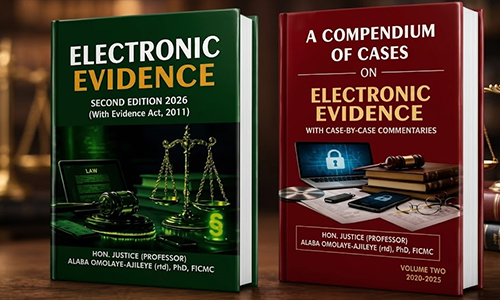
“Order Justice Omolaye-Ajileye’s Electronic Evidence Books Now” — Essential Guides On Evidence Act, Case Law And Digital Proof
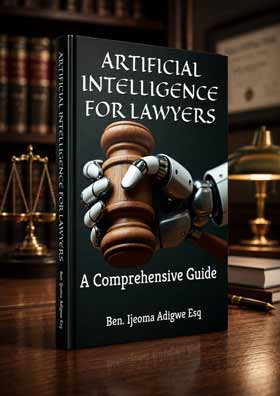 The book also examines Nigeria's legal ecosystem, focusing on the LPELR and NBA AI Guidelines. As a bonus, every purchase comes with a FREE eBook titled: How to Use the AI Features in LegalPedia and LawPavilion.
Ohio Books Ltd praises the publication, stating:
"....this is the only Nigerian book I know of on the topic."
How to Order:
📞 Call, Text, or WhatsApp: 08034917063 | 07055285878
📧 Email: benadigwe1@gmail.com
🌎 Website: www.benadigwe.com
Ebook Version: Access it directly online at https://selar.com/prv626
Authored by Ben Ijeoma Adigwe Esq., ACIarb (UK), LL.M, Dip. in Artificial Intelligence, Director at the Delta State Ministry of Justice, Asaba, Nigeria.
_______________________________________________________________________
The book also examines Nigeria's legal ecosystem, focusing on the LPELR and NBA AI Guidelines. As a bonus, every purchase comes with a FREE eBook titled: How to Use the AI Features in LegalPedia and LawPavilion.
Ohio Books Ltd praises the publication, stating:
"....this is the only Nigerian book I know of on the topic."
How to Order:
📞 Call, Text, or WhatsApp: 08034917063 | 07055285878
📧 Email: benadigwe1@gmail.com
🌎 Website: www.benadigwe.com
Ebook Version: Access it directly online at https://selar.com/prv626
Authored by Ben Ijeoma Adigwe Esq., ACIarb (UK), LL.M, Dip. in Artificial Intelligence, Director at the Delta State Ministry of Justice, Asaba, Nigeria.
_______________________________________________________________________