
*Defence Disputes Charges

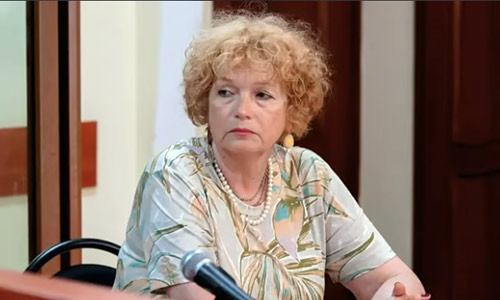
A Russian court has sentenced a 66-year-old human rights lawyer, Maria Bontsler, to 12 years in prison for treason over allegations that she provided information concerning Russian security officers and criminal proceedings to Ukraine.
The judgment was delivered on Thursday, November 12, 2026, by a court in Kaliningrad, Russia’s Baltic exclave situated between Lithuania and Poland.
The sentence was confirmed by the human rights group Slovo Zashchite, which disclosed that Bontsler had represented several defendants accused of political offences in Kaliningrad.
According to the group, the court also imposed an additional one-year restriction on the lawyer’s activities following her prison sentence.
Russian prosecutors had requested a 15-year prison term after accusing Bontsler of disclosing sensitive information to Ukraine.
However, her defence lawyers challenged the allegations, maintaining that the information cited by the prosecution was not classified or secret.
The case centred on allegations that Bontsler provided Ukrainian authorities with information concerning security personnel operating in Kaliningrad, as well as details of criminal proceedings that were allegedly of interest to Kyiv.
In a statement published on Telegram, the court disclosed that the accused had been detained by Russia’s Federal Security Service (FSB) over allegations of passing information to Ukraine beginning in 2024.
Although the statement did not identify Bontsler by name, it outlined allegations concerning the transmission of information about security officers and criminal cases in the region.
Prosecutors maintained that the information was sensitive and that its disclosure constituted treason under Russian law.
The defence, however, disputed the characterisation of the information as secret, arguing that the materials relied upon by prosecutors did not contain protected intelligence.
According to Slovo Zashchite, the proceedings were conducted behind closed doors, raising concerns about the circumstances under which the lawyer was tried and convicted.
The rights group further alleged that Bontsler and her lawyers were prevented from attending the trial proceedings, with the defendant permitted only to make a closing statement.
It maintained that the restrictions affected the conduct of the proceedings, during which the prosecution pursued a lengthy custodial sentence.
The group also disclosed that Bontsler had been experiencing ill health while in detention.
Despite the defence’s objections concerning the nature of the information allegedly disclosed, the court convicted the lawyer of treason and sentenced her to 12 years’ imprisonment.
The court imposed the additional year of restrictions on her activities, although the available report did not specify the precise conditions attached to that order.
Bontsler’s conviction comes against the background of Russia’s continuing prosecution of individuals accused of offences involving national security, political dissent and activities connected to Ukraine.
Since Russia launched its full-scale invasion of Ukraine in February 2022, the country’s parliament has introduced legislation criminalising certain public actions considered to discredit the Russian armed forces.
The authorities have also enacted laws prohibiting the dissemination of information classified as false concerning the military.
The measures have attracted attention because of their implications for public commentary, political expression and legal proceedings involving individuals accused of opposing government policies.
Russian courts have also convicted lawyers who represented defendants in politically sensitive cases.
In January 2025, a Russian court sentenced three lawyers who had represented the late opposition leader Alexey Navalny to prison terms ranging from three and a half years to five and a half years.
The lawyers were convicted on charges of extremism in proceedings widely viewed as an attempt to discourage legal practitioners from representing defendants in politically sensitive matters.
The earlier convictions raised concerns about the professional risks facing defence lawyers involved in cases concerning political opposition and national security.
Bontsler’s case has now drawn attention to similar concerns, particularly because of her work representing individuals charged with political offences in Kaliningrad.
The allegations against her, however, concerned the alleged transmission of information to Ukraine, rather than simply her representation of politically sensitive defendants.
The prosecution’s position was that the information she allegedly supplied concerned Russian security officers and criminal cases of interest to Ukrainian authorities.
Her lawyers maintained that the prosecution failed to establish that the information was secret.
The dispute over the status of the information formed a central issue in the case, alongside the rights group’s account of the closed proceedings and restrictions on the participation of the accused and her lawyers.
Although prosecutors sought a 15-year sentence, the court imposed 12 years in prison and an additional year of restrictions.
The judgment represents another conviction of a Russian legal practitioner in a politically sensitive case since the outbreak of the war in Ukraine.
However, the available account does not establish that Bontsler disclosed classified information or provide details of the evidence relied upon by the court in reaching its decision.
With the trial conducted behind closed doors, the prosecution’s allegations and the defence’s objections remain central to the publicly reported account of the proceedings.
The case has consequently raised questions about the treatment of lawyers handling politically sensitive matters in Russia, the confidentiality of information involved in national security prosecutions and the conduct of criminal trials held outside public scrutiny.
[A MUST HAVE] Evidence Act Demystified With Recent And Contemporary Cases And Materials
Available now for NGN 40,000 at ASC Publications, 10, Boyle Street, Onikan, Lagos. Beside High Court, TBS. Email publications@ayindesanni.com or WhatsApp +2347056667384. Purchase Link: https://paystack.com/buy/evidence-act-complete-annotation
______________________________________________________________________ “Enhance Legal Practice With Authoritative Reports” — Alexander Payne Offers Comprehensive Law Reports, Spanning Over A Century Of Nigerian Jurisprudence Interested buyers are encouraged to place their orders and enquiries via:
0704 444 4777, 0704 444 4999, 0818 199 9888
Website: www.alexandernigeria.com
“A Comprehensive Guide To Evidence Law” — Releases Second Edition In Three Volumes, Covering 4,051 Cases
For enquiries and orders, contact: 08035526491 Email: jerryamadisilk@gmail.com
 Prof. Jerry Amadi’s Evidence Law, Second Edition (2026), contains 3,314 pages in three volumes, covering the Evidence Act 2011, its 2023 amendment, and 4,051 Nigerian and English cases.