The Inspector-General of Police, IGP Mohammed Adamu, has headed for the Supreme Court seeking to upturn Wednesday’s judgment of the Court of Appeal, which nullified the ongoing recruitment of 10,000 constables across the nation.

The notice of appeal of three grounds together was filed alongside an application for stay of execution of the Appeal Court’s judgment.
The Police Service Commission (PSC) had last year dragged the Nigeria Police Force (NPF), the Inspector General of Police, and the Minister of Police Affairs as first, second, and third respondents respectively to the Federal High Court in Abuja. The Attorney General was subsequently added as a fourth respondent.
The PSC had sought to restrain the defendants, their officers, and representatives, including anybody or person acting on their behalf from appointing, recruiting, or attempting to appoint or recruit by any means whatsoever any person into any office in the first defendant.
Delivering his judgment in the matter in December 2019, Justice Inyang Ekwo of the Federal High Court had dismissed the case.
The PSC then headed to the Court of Appeal.
A three-man panel of the Court of Appeal led by Justice Olabisi Ige on Wednesday unanimously held that the IGP and the NPF lacked the power to recruit the constables.
It held that it was the Police Service Commission that had the responsibility to carry out the recruitment.
Following these, the IGP and the NPF, through their lawyer, Dr. Alex Izinyon (SAN), had written a letter dated October 2, 2020, to the Chairman of the PSC contending that no step could be taken to enforce the judgment after an appeal and the motion for injunction they had filed against the contested verdict of the Court of Appeal.
The letter was copied to PSC’s lead counsel, Chief Kanu Agabi (SAN).
The notice of appeal faulted the Court of Appeal’s judgment as to the IGP and the NPF contended that the court “erred in law when they held that the provision of section 71 of the Nigeria Police Regulations 1968 made pursuant to section 46 of the Police Act is inconsistent with the provision of paragraph 30 Part I of the Third Schedule to the 1999 Constitution”.
They argued section 71 of the Nigeria Police Regulations 1968 specifically conferred on the IGP “the power and responsibility of enlisting recruit constables”, while the provision of “Paragraph 30 Part I of the Third Schedule to the 1999 Constitution and section 6 of the Police Service Commission (Establishment) Act, 2001, the 1st respondent is empowered to appoint persons to offices in the 1st appellant”.
The appellant’s lawyer added that the lower court “was on an error in its findings that the provision of Section 71 of the Nigerian Police Regulations, 1968 made pursuant to Section 46 of the Police Act is inconsistent with the provision of paragraph 30 Part I of the Third Schedule to the 1999 Constitution”.
He also faulted the judgment on the grounds that the court erred in law when it held that the IGP and the NPF “are not conferred with powers to enlist recruit constables.”
They also argued the Court of Appeal erred in law when it held that the PSC was conferred with powers to enlist recruit constables into the NPF by virtue of the provision of paragraph 30, Part I of the Third Schedule to the 1999 Constitution.
The appellants in the matter before the Supreme Court are seeking an order setting aside the judgment of the Court of Appeal delivered on September 30, 2020, another dismissing the appeal filed by the PSC, and another affirming the judgment of the Federal High Court delivered by the Federal High Court on December 2, 2019.
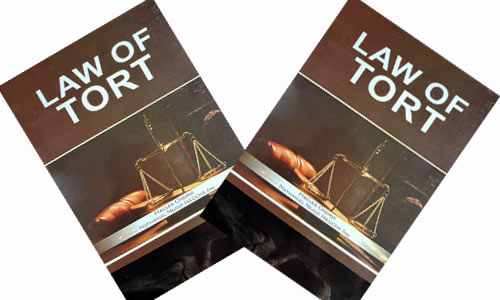 The book, titled The Law of Torts in Nigeria: A Functional Approach, authored by Professor Hagler Sunny Okorie Ph.D and Ikeocha, Nathaniel Ngozi Esq, offers law students, practitioners, and academics a comprehensive guide to understanding and applying tort law in Nigerian courts. Interested buyers can place orders via the following contact numbers: 08028636615, 08037667945, 08032253813, or +234 902 196 2209.
______________________________________________________________________
[A MUST HAVE] Evidence Act Demystified With Recent And Contemporary Cases And Materials
The book, titled The Law of Torts in Nigeria: A Functional Approach, authored by Professor Hagler Sunny Okorie Ph.D and Ikeocha, Nathaniel Ngozi Esq, offers law students, practitioners, and academics a comprehensive guide to understanding and applying tort law in Nigerian courts. Interested buyers can place orders via the following contact numbers: 08028636615, 08037667945, 08032253813, or +234 902 196 2209.
______________________________________________________________________
[A MUST HAVE] Evidence Act Demystified With Recent And Contemporary Cases And Materials

 ARTIFICIAL INTELLIGENCE FOR LAWYERS: A COMPREHENSIVE GUIDE
Reimagine your practice with the power of AI “...this is the only Nigerian book I know of on the topic.” — Ohio Books Ltd
Authored by Ben Ijeoma Adigwe, Esq., ACIArb (UK), LL.M, Dip. in Artificial Intelligence, Director, Delta State Ministry of Justice, Asaba, Nigeria.
Bonus:
Get a FREE eBook titled “How to Use the AI in Legalpedia and Law Pavilion” with every purchase.
ARTIFICIAL INTELLIGENCE FOR LAWYERS: A COMPREHENSIVE GUIDE
Reimagine your practice with the power of AI “...this is the only Nigerian book I know of on the topic.” — Ohio Books Ltd
Authored by Ben Ijeoma Adigwe, Esq., ACIArb (UK), LL.M, Dip. in Artificial Intelligence, Director, Delta State Ministry of Justice, Asaba, Nigeria.
Bonus:
Get a FREE eBook titled “How to Use the AI in Legalpedia and Law Pavilion” with every purchase.
How to Order: 📞 Call, Text, or WhatsApp: 08034917063 | 07055285878 📧 Email: benadigwe1@gmail.com 🌐 Website: www.benadigwe.com
Ebook Version: Access directly online at: https://selar.com/prv626
________________________________________________________________________ The Law And Practice Of Redundancy In Nigeria: A Practitioner’s Guide, Authored By A Labour & Employment Law Expert Bimbo Atilola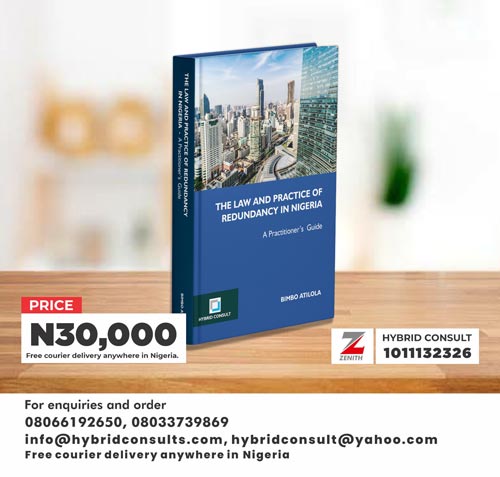 _______________________________________________________________________
“Enhance Legal Practice With Authoritative Reports” — Alexander Payne Offers Comprehensive Law Reports, Spanning Over A Century Of Nigerian Jurisprudence
_______________________________________________________________________
“Enhance Legal Practice With Authoritative Reports” — Alexander Payne Offers Comprehensive Law Reports, Spanning Over A Century Of Nigerian Jurisprudence
 Interested buyers are encouraged to place their orders and enquiries via:
0704 444 4777, 0704 444 4999, 0818 199 9888
Website: www.alexandernigeria.com
Interested buyers are encouraged to place their orders and enquiries via:
0704 444 4777, 0704 444 4999, 0818 199 9888
Website: www.alexandernigeria.com