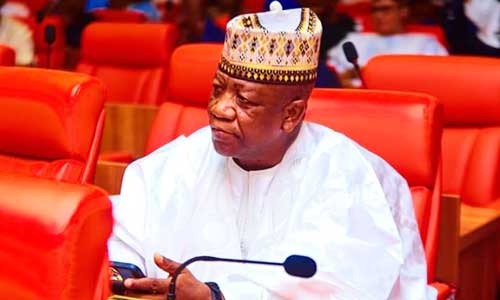
The Chairman of the Board of Directors of Geregu Power Plc, Senator Abdulaziz Yari, has attributed the company’s default on a N40 billion bond obligation to its former majority owner and Chairman, Femi Otedola, and its former Chief Executive Officer, Akin Akinfemiwa, while assuring investors that the outstanding issues are being addressed.

The statement comes as a lawyer, Faruk Yusuf, Managing Partner at Segun Suleiman & Co., alleged in an interview on Arise News Channel that the former owners misled the company’s new owners, MA’AM Energy Limited, over funds meant to secure the bond obligations, claiming that the money was held in an escrow account when it had allegedly already been utilised.
The allegations have heightened concerns over the company’s ability to meet its obligations to bondholders following the default, placing its financial position and corporate governance under increased scrutiny.
On 29 December 2025, Otedola, then the majority shareholder, sold his interest in Geregu Power to MA’AM Energy Limited for about $750 million, resulting in a change of controlling ownership and a new board led by Yari.
In a statement he personally signed, Yari said that although the bond was issued and the underlying arrangements made under the tenure of the former owners and management, he had decided to provide the funds required to settle the immediate outstanding obligation. The intervention was in the sum of N6 billion.
He was careful to define the limits of the step. “I want to be precise about what this means and what it does not mean. This is not an admission that the obligation is personally mine, nor is it a judgment that the current board or management created this problem. It is a decision made in the interest of the institution I am privileged to chair,” he said.
He said discussions with the previous owners were continuing. “I have also been in ongoing discussions with the former owners and management of the company, under whose tenure the bond in question was issued and the underlying arrangements were made. I am encouraged to report that they have indicated their willingness to continue engaging toward a lasting and amicable solution.”
He added: “This intervention addresses the immediate concern facing bondholders. It does not close the underlying matter, and it does not absolve the former owners of a disappointing legacy.”
The former Zamfara State governor acknowledged that the situation had generated legitimate concerns among bondholders, shareholders and the wider market, noting that the company’s reputation for reliability and sound governance made it imperative to address the matter decisively.
He said his decision to provide the funds personally was driven by the need to protect that reputation and restore investor confidence rather than by any acceptance of responsibility for the obligation.
He said he had been closely engaged with the board, management, financial and legal advisers and other relevant parties since the matter emerged, in an effort to establish how the obligation arose and to determine the appropriate path to resolution. The immediate funding, he said, would protect bondholders from further uncertainty while discussions continued on the underlying liability.
He said the former owners and management had committed to working in good faith towards “a full and fair accounting of how the obligation arose and how it should be treated and resolved between the parties.”
He set out the objective. “Our objective, ultimately, is a final, mutually acceptable resolution: fair treatment or reimbursement of the funds I am advancing now to protect the company, and clear, dependable arrangements for the company’s future obligations to bondholders.”
He drew a distinction between the board’s oversight function and the daily running of the company, noting that he is not involved in day-to-day management.
He closed with an assurance. “To our bondholders, our shareholders, and everyone who has built something lasting with Geregu Power: this company’s obligations will be honoured, its governance will remain sound, and its future is not in question.”
Agusto & Co recently withdrew the ‘A’ credit rating it had assigned to Geregu Power and to its N40.09 billion Series 1 Senior Unsecured bond, following the company’s default on the eighth coupon payment and fourth principal repayment.
The rating agency said the withdrawal was prompted both by the default and by its conclusion that it no longer had sufficient reliable information to maintain a credit rating opinion on the company and its bond.
Explaining the circumstances of the default, Yusuf said the total value of the bond should not be confused with the amount that actually fell due.
According to him, only about N6.026 billion was due as at 28 July 2026, while N40.9 billion represents the total value of the instrument.
“This bond was taken in July 2022 and they had the repayments ever since on both the principal and the coupon. The coupon here, for those of us who are not accountants or auditors, is the interest rate. The interest rate has been paid seven times. The principal had been paid three times,” he said.
He explained that the bond had an initial moratorium period before repayment commenced, and that ownership of the company changed in December 2025.
Yusuf said the bond was raised for a specific purpose that was never achieved.
“That bond was not taken as working capital. It was not taken to enhance Geregu Power Plant working capital in 2022. It was taken to acquire another power plant. And that failed. They couldn’t meet up with the BPE requirement, Bureau of Public Enterprises,” he said.
Following the failure of the proposed acquisition, he said, the funds were expected to remain in an escrow or restricted account, where they would generate interest and subsequently be used to meet the bond obligations as they fell due.
According to him, the company’s records showed a bond payable of about N34 billion and restricted cash of about N31 billion.
“We went behind to carry out a review of their books and discovered that, yes, that money was kept in an escrow account, which is right, generating interest, because since their business was unable to go on, that is, the acquisition of that power plant that the bond was taken for, couldn’t happen,” he said.
Yusuf alleged that when the new owners attempted to access the funds after the 28 July payment fell due, they were told the money was gone.
“And unfortunately, they were told that that money had been utilised. Utilised by who? Yes, utilised by the former owners that handed over to them,” he alleged.
He said documents exchanged during the ownership transition had indicated that the funds remained intact.
“Part of that asset handed over to the new owners, where correspondence was exchanged, that N31 billion that is in an escrow account confirmed to us its existence. And it was confirmed that it is there. And it is from there that liquidation should take place to take care of liabilities when they fall due.”
He said the discovery had left the new management searching for alternative funds. “They have to go into another avenue of sourcing for funds to be able to meet up with their obligations as they fall due, to be able to assure and restore confidence of the bondholders,” he said.
The allegation has raised questions about the due diligence conducted during the December 2025 transition and the representations made to the new owners about the company’s assets and liabilities.
Yusuf acknowledged the limits of the process. “There can never be 100 per cent due diligence when there is a merger or acquisition. It is when you have taken over that certain things will begin to reveal themselves,” he said.
Asked whether the Economic and Financial Crimes Commission, the Securities and Exchange Commission and the Central Bank of Nigeria could become involved, he said regulators were already engaged.
“The regulatory process is already ongoing, and that is why the new owners have not been able to come up with full details of what is behind the scenes. The regulators are aware. The processes are already ongoing with the regulators,” he said.
[A MUST HAVE] Evidence Act Demystified With Recent And Contemporary Cases And Materials

Available now for NGN 40,000 at ASC Publications, 10, Boyle Street, Onikan, Lagos. Beside High Court, TBS. Email publications@ayindesanni.com or WhatsApp +2347056667384. Purchase Link: https://paystack.com/buy/evidence-act-complete-annotation
______________________________________________________________________ “Enhance Legal Practice With Authoritative Reports” — Alexander Payne Offers Comprehensive Law Reports, Spanning Over A Century Of Nigerian Jurisprudence Interested buyers are encouraged to place their orders and enquiries via:
0704 444 4777, 0704 444 4999, 0818 199 9888
Website: www.alexandernigeria.com
Interested buyers are encouraged to place their orders and enquiries via:
0704 444 4777, 0704 444 4999, 0818 199 9888
Website: www.alexandernigeria.com