The House of Representatives Committee on Finance has directed the Nigeria Customs Service, NCS, to submit a comprehensive breakdown of the estimated ₦34 trillion import duty waivers granted in 2025.

The committee also demanded details of the beneficiaries, the legal basis for the approvals, and the economic objectives the waivers were meant to achieve.
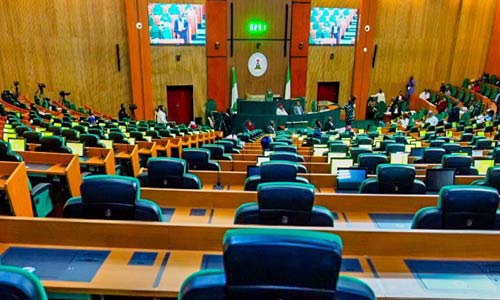
The directive was issued on Wednesday when the management of the Nigeria Customs Service appeared before the committee as part of the National Assembly’s ongoing oversight of revenue-generating agencies and implementation of the 2025 budget.
Chairman of the committee and member representing Ikeja Federal Constituency, Lagos State, Hon. James Abiodun Faleke, said lawmakers were not opposed to the Federal Government’s policy of granting duty waivers, but insisted that the process must be transparent and properly scrutinised.
Faleke said the committee wanted to know whether the concessions achieved their intended economic benefits and whether due process was followed in granting them.
“Waiver is good. It is not a bad thing to grant waiver. But we want to know those who benefited from the waiver and the purpose for such waiver. It is okay if you grant waiver on medical and agricultural products.
“If you grant waiver, it is aimed at helping the economy to grow. For example, if you grant waiver on agricultural products, it is aimed at reducing the cost of food. So, we are not against waiver. But we want to know the beneficiaries of this ₦34 trillion waiver,” Faleke said.
Import duty waivers are fiscal incentives granted by the Federal Government to exempt certain imports from customs duties, usually to support strategic sectors such as agriculture, healthcare, manufacturing, infrastructure, security and other public-interest interventions.
The latest House directive follows an earlier disclosure by the Comptroller-General of Customs, Bashir Adewale Adeniyi, before the Senate Committee on Finance that Import Duty Exemption Certificate, IDEC, approvals rose to about ₦34 trillion in 2025, significantly affecting Customs’ revenue performance.
Adeniyi had said about 60 per cent of the approvals related to military hardware procurements, which enjoyed duty exemptions due to Nigeria’s security challenges. Other government-backed waivers reportedly covered compressed natural gas, CNG, electric and hybrid vehicles, healthcare equipment, medical supplies, industrial machinery, manufacturing inputs and food import intervention programmes.
He, however, maintained that fiscal waivers should not be assessed only from the standpoint of revenue loss, but also from their broader economic and social objectives.
The Customs boss also called for stronger monitoring to ensure that beneficiaries deliver the expected outcomes, including lower prices, increased industrial production and improved access to healthcare.
At Wednesday’s House hearing, the committee also queried the Nigeria Customs Service over what it described as inconsistencies in its revenue reporting despite the agency repeatedly surpassing its annual collection targets.
Faleke acknowledged Customs’ strong revenue performance but said the financial documents submitted to the committee did not clearly show how the agency generated revenue above approved projections.
According to him, lawmakers required a month-by-month breakdown to properly assess the service’s performance.
“We are not going to applaud your efforts now because your account books are not balanced. We know that you want to be transparent, but you have not told us how the excess money you are reporting came about.
“I can see that in some months, you under-declare your revenue collection and in other months, you overshoot the collection. We want to know what is responsible for this,” Faleke said.
The Deputy Chairman of the committee, Hon. Saidu Mohammed Abdullahi, urged the Federal Government to review upward the revenue targets assigned to Customs, saying the agency had shown capacity to generate more revenue.
He noted that Customs exceeded its ₦5 trillion target in 2024 by generating ₦6.1 trillion, and also surpassed its 2025 target of about ₦6 trillion after recording ₦7.2 trillion.
Responding on behalf of the Customs management, the Deputy Comptroller-General in charge of Finance, Administration and Technical Services, Kikelomo Adeola, clarified that Customs does not approve import duty waivers.
She said the waivers are approved by the Federal Ministry of Finance in line with existing laws and government policies, while Customs only implements the approvals.
Adeola also urged state governments to invest in inland dry ports, saying such infrastructure would reduce congestion at seaports, improve cargo clearance and strengthen trade facilitation.
She explained that cargo marked for inland ports would be moved directly to those facilities for examination, thereby reducing pressure on the nation’s main ports.
On delays in cargo examination, she told lawmakers that most Customs scanning machines were operational, with only a few undergoing repairs.
A member of the committee, Hon. Ifeanyi Uzokwe, however, urged the Customs management to hold officers accountable where negligence contributes to equipment failure or cargo processing delays.
The committee’s directive comes amid renewed legislative scrutiny of revenue-generating agencies, tax expenditures, duty waivers and other fiscal concessions at a time the Federal Government is seeking to expand non-oil revenue.
Lawmakers said the requested documents would help determine whether the ₦34 trillion waivers were properly granted, whether the beneficiaries complied with the conditions attached to them, and whether the concessions delivered measurable economic value to Nigerians.
[A MUST HAVE] Evidence Act Demystified With Recent And Contemporary Cases And Materials

Available now for NGN 40,000 at ASC Publications, 10, Boyle Street, Onikan, Lagos. Beside High Court, TBS. Email publications@ayindesanni.com or WhatsApp +2347056667384. Purchase Link: https://paystack.com/buy/evidence-act-complete-annotation
______________________________________________________________________ “Enhance Legal Practice With Authoritative Reports” — Alexander Payne Offers Comprehensive Law Reports, Spanning Over A Century Of Nigerian Jurisprudence Interested buyers are encouraged to place their orders and enquiries via:
0704 444 4777, 0704 444 4999, 0818 199 9888
Website: www.alexandernigeria.com
Interested buyers are encouraged to place their orders and enquiries via:
0704 444 4777, 0704 444 4999, 0818 199 9888
Website: www.alexandernigeria.com