The Independent National Electoral Commission has said it will not base its findings on artificial intelligence analysis or screenshots in the ongoing investigation into alleged digital impersonation linked to its chairman, Professor Joash Amupitan.

INEC’s Director of Information and Communication Technology, Lawrence Bayode, disclosed this in an interview on Channels Television on Monday while reacting to resurfaced social media posts attributed to an account allegedly linked to the commission’s chairman.
Bayode said the commission is already engaging security agencies and external forensic experts to verify the authenticity of the content and accounts involved.
Bayode stated that despite claims alleging that the chairman made a partisan post on X, no verified forensic evidence links him to the said post.
“Even though we are seeing that some guys have carried out a forensic investigation on that account, as we speak, there is no verified forensic evidence linking the chairman to the post,” he stated.
The ICT Director said the commission is taking the matter seriously and would engage external experts.
“We are taking this further because even though we have referred this to security agencies, we rely on evidence. We are also going to be engaging a third party, for instance, forensic experts, to look into this,” he said.
Bayode emphasised that the commission would not rely on unverified materials in reaching conclusions.
“I will not base my judgments on screenshots. I will not allow that to guide my conclusion,” he said.
“I know that the commission will engage a third-party expert to also look at this, and that will guide the conclusion of the commission.”
According to Bayode, the commission is also considering technical and forensic review processes as part of its internal investigation.
“We are already looking at it in-house. We are preparing for an election. This is happening,” he said.
During the interview, the anchor referenced claims generated by the AI tool GROK, suggesting possible links to the account.
Responding, Bayode cautioned against relying on artificial intelligence for definitive conclusions.
“You know, Grok honestly can hallucinate just like any modern artificial intelligence system,” he said.
“I think the key is to verify important information, especially for decision or public communication. So yes, any AI system can hallucinate. And so Grok can also hallucinate.”
The ICT Director said the issue goes beyond a single account, describing it as part of a broader pattern of digital impersonation and misinformation.
“What we are seeing is something bigger. What we are seeing is digital impersonation,” he said.
He noted that the account in question had reportedly been renamed at some point, raising further concerns about manipulation.
“That account was renamed; the content there, maybe, would have been manipulated again,” Bayode stated.
He also argued that publicly available information can be exploited for malicious purposes.
“Email addresses and phone numbers you mentioned are in public domain. Anyone who wants to create havoc can use all of this information and use it this way,” he said.
Bayode explained how digital impersonation and content manipulation can mislead the public.
“I think all these are in the public domain, so anyone who wants to create havoc can use all of this information and use it as they will,” he added.
Bayode also noted that a social media account could be opened using someone else’s email address.
“If people can hack into your system if it’s not well protected, if not for a time like this where our social media platforms are protected by two-factor authentication,” he stated.
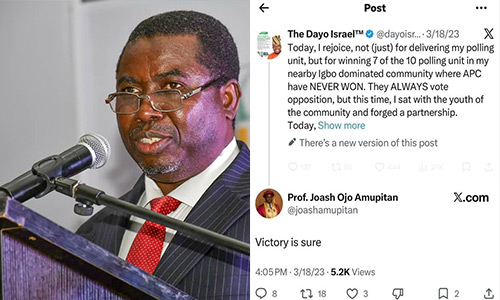
The controversy stems from a 2023 post shared by APC National Youth Leader, Dayo Israel, which was later linked by critics to alleged engagement from an account said to belong to the INEC chairman.
The post read: “Today I rejoice, not just for delivering my polling unit, but for winning 7 of the 10 polling units in my nearby Igbo-dominated community where APC have NEVER WON… I sat with the youth of the community and forged a partnership.”
The post resurfaced alongside claims that the account responded with the phrase “Victory is sure,” sparking allegations of partisan involvement.
INEC has repeatedly dismissed the claims, describing them as false and part of a coordinated misinformation campaign.
The commission insists the chairman does not operate any personal X account and has never engaged in partisan political commentary, adding that it is working with security agencies to track those behind the impersonation.
Bayode stressed that the commission plans to expand its use of technology ahead of the 2027 general elections, warning that emerging digital threats must be addressed early.
“We are going to be deploying technology massively during the 2027 general election. If this is already happening now, then we need to ensure that we do the needful,” he said.
The alleged partisan social media activity attributed to the INEC Chairman has become a significant controversy as Nigeria approaches the 2027 elections.
For critics of INEC, particularly within the opposition parties already accusing the commission of bias over the ADC leadership crisis, the alleged “Victory is sure” response to an APC post would represent evidence of partisanship at the highest level of the electoral body.
However, INEC’s response that no verified forensic evidence exists and that the account may have been created through digital impersonation raises important questions about the reliability of social media evidence in the age of widespread manipulation.
Bayode’s warning that “Grok can hallucinate” highlights the limitations of AI tools in verifying digital information. While AI systems like Grok can analyse patterns and connections, they are known to sometimes generate inaccurate or fabricated information.
The commission’s decision to engage third-party forensic experts suggests it is taking the allegations seriously while refusing to rush to conclusions based on screenshots or AI analysis alone.
For Nigerians concerned about the integrity of the electoral process, the outcome of this investigation will be significant. If the account is proven to be an impersonation, it would vindicate INEC’s position. If evidence emerges linking the chairman to partisan activity, it would raise serious questions about the commission’s neutrality.
Meanwhile, Fresh controversy has emerged over alleged digital links to the Independent National Electoral Commission (INEC) Chairman, as technology analysts outline how phone numbers, email addresses, and account data may have been used in the ongoing impersonation claims.
During a News Central TV discussion monitored by our correspondent , a tech commentator explained that investigations by online analysts revealed what he described as a “digital trail” connecting the controversial X (formerly Twitter) account to consistent registration details, including a phone number and email address.
According to him, such platforms typically require user verification through mobile numbers and authentication systems, making account creation traceable through what he referred to as a technological footprint.
“There’s what we call a paper trail, or more accurately, a technology trail,” he said, noting that the same phone number and email appeared repeatedly across checks conducted by independent users.
The analyst further claimed that some online investigators used digital tools to cross-check the details, allegedly linking the email and phone number associated with the X account to records connected to a company reportedly linked to the INEC Chairman.
He added that device identification systems, such as unique mobile identifiers, could also assist in tracing account origins, although he did not provide independently verified evidence.
“There’s no way you can register an account without a phone number. With two-factor authentication, everything keeps pointing somewhere,” he stated.
The analyst also raised concerns over the sudden alteration of the account in question, which was reportedly renamed and later designated as a parody account, describing the development as “suspicious” in the context of the controversy.
However, despite these claims, INEC has firmly denied any connection between its Chairman and the account, insisting that the allegations are false and part of a coordinated misinformation campaign.
The commission has maintained that publicly available information such as phone numbers and email addresses can be exploited by malicious actors to create misleading digital identities, warning that impersonation remains a growing threat in the digital space.
INEC has also reiterated that no verified forensic evidence currently links its Chairman to the alleged account and has engaged security agencies and independent experts to conduct a comprehensive investigation.
[A MUST HAVE] Evidence Act Demystified With Recent And Contemporary Cases And Materials

Available now for NGN 40,000 at ASC Publications, 10, Boyle Street, Onikan, Lagos. Beside High Court, TBS. Email publications@ayindesanni.com or WhatsApp +2347056667384. Purchase Link: https://paystack.com/buy/evidence-act-complete-annotation
______________________________________________________________________ ARTIFICIAL INTELLIGENCE FOR LAWYERS: A COMPREHENSIVE GUIDE
Reimagine your practice with the power of AI “...this is the only Nigerian book I know of on the topic.” — Ohio Books Ltd
Authored by Ben Ijeoma Adigwe, Esq., ACIArb (UK), LL.M, Dip. in Artificial Intelligence, Director, Delta State Ministry of Justice, Asaba, Nigeria.
Bonus:
Get a FREE eBook titled “How to Use the AI in Legalpedia and Law Pavilion” with every purchase.
ARTIFICIAL INTELLIGENCE FOR LAWYERS: A COMPREHENSIVE GUIDE
Reimagine your practice with the power of AI “...this is the only Nigerian book I know of on the topic.” — Ohio Books Ltd
Authored by Ben Ijeoma Adigwe, Esq., ACIArb (UK), LL.M, Dip. in Artificial Intelligence, Director, Delta State Ministry of Justice, Asaba, Nigeria.
Bonus:
Get a FREE eBook titled “How to Use the AI in Legalpedia and Law Pavilion” with every purchase.
How to Order: 📞 Call, Text, or WhatsApp: 08034917063 | 07055285878 📧 Email: benadigwe1@gmail.com 🌐 Website: www.benadigwe.com
Ebook Version: Access directly online at: https://selar.com/prv626
______________________________________________________________________ “Bridging Theory And Courtroom Practice” — Hagler Sunny Okorie, Nathaniel Ngozi Ikeocha Unveil ‘Functional’ Tort Law Book For Nigerian Legal System The book, titled The Law of Torts in Nigeria: A Functional Approach, authored by Professor Hagler Sunny Okorie Ph.D and Ikeocha, Nathaniel Ngozi Esq, offers law students, practitioners, and academics a comprehensive guide to understanding and applying tort law in Nigerian courts. Interested buyers can place orders via the following contact numbers: 08028636615, 08037667945, 08032253813, or +234 902 196 2209.
______________________________________________________________________
“Enhance Legal Practice With Authoritative Reports” — Alexander Payne Offers Comprehensive Law Reports, Spanning Over A Century Of Nigerian Jurisprudence
The book, titled The Law of Torts in Nigeria: A Functional Approach, authored by Professor Hagler Sunny Okorie Ph.D and Ikeocha, Nathaniel Ngozi Esq, offers law students, practitioners, and academics a comprehensive guide to understanding and applying tort law in Nigerian courts. Interested buyers can place orders via the following contact numbers: 08028636615, 08037667945, 08032253813, or +234 902 196 2209.
______________________________________________________________________
“Enhance Legal Practice With Authoritative Reports” — Alexander Payne Offers Comprehensive Law Reports, Spanning Over A Century Of Nigerian Jurisprudence
 Interested buyers are encouraged to place their orders and enquiries via:
0704 444 4777, 0704 444 4999, 0818 199 9888
Website: www.alexandernigeria.com
Interested buyers are encouraged to place their orders and enquiries via:
0704 444 4777, 0704 444 4999, 0818 199 9888
Website: www.alexandernigeria.com