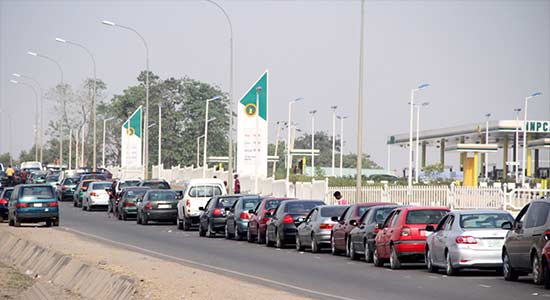
The scarcity of premium motor spirit (PMS), known as petrol, persisted yesterday in Lagos and its environs with most filling stations closed while the few that opened for business sold the product for between N190 and N205 per liter.

Officially, petrol per litre still remains at N162 to N165 per litre as fixed by the federal government. However, for over four months now, no filling station has sold petrol at less than N169 per litre.
At some major marketers filling stations that had the product, price per litre range from N180 to N185 per liter , while independent marketers owned filling stations sold for between N190 and N205.
The unavailability of fuel at Nigerian National Petroleum Company Limited (NNPCL) depots controlled depots like Mosinmi, Satellite, Ejigbo among others, has not helped matters. Besides, privately owned depots have hiked the depot price of the commodity from N143 to N145 to between N178 and N180 per litre.
According to the Independent Petroleum Marketers Association of Nigeria (IPMAN), Western Zone, it has become practically impossible for its members to continue to sell at N175/180 per litre given the prevailing realities and situation on ground- a development that has led to depot price increase.
Stakeholders in the industry blame the development on the rising cost incurred by marketers and some depot owners to pay for the services of “Daughter vessels” required to evacuate imported petrol from the “Mother vessel” from its offshore position to the ports and their depots.
The Executive Secretary, Major Oil Marketers Association of Nigeria (MOMAN), Clement Isong, explained that hiring a daughter vessel to bring the product from onshore to offshore now cost $45, 000 per day as against the previous $20, 000 per day it used to cost because of the high cost of diesel. This is aside other charges paid including the Nigeria Ports Authority (NPA), Nigerian Maritime Administration and Safety Agency (NIMASA) among other charges.
“A daughter vessel is hired for 10 days to discharge the content from the mother vessel; this means that the cost has shot up from $200, 000 to $450, 000. Then marketers and depot owners also pay NPA and NIMASA charges in dollars. Yet, the dollar is scarce and difficult to get,” Isong explained.
The Chairman of IPMAN Western zone, Dele Tajudeen, explained that private depots are taking advantage of the NNPC Limited’s inability to make supply available to hike the commodity’s price. He argued that to keep the business running and to avoid a total paralysis on the region in the event of them shunning selling the product, his members opted to patronize private depots irrespective of the hike in price.
“Buying at N178 per litre from depots and selling at N170 or N180/litre is not realistic. Our members have no other option than to sell between N195 and N200 per litre within Lagos, Ogun, and Oyo states. We will sell between N200 and N210 in Kwara, Ondo, Osun, and Ekiti states,” Tajudeen said.
The President, PETROAN, Billy Gillis-Harry, confirmed that his team had moved round the country and figured out that most depots had limited products to dispense.
“The reality is that there are no products,” he stated.
The oil marketers president added, “There are no products to lift in many states and once there are no products to lift, then you’ll have scarcity. So, the NNPC, being the only supplier, should act fast.”
Gillis-Harry also called for the prompt rehabilitation of Nigeria’s refineries, stressing that marketers had consistently asked the government to involve PETROAN in getting the refineries running.
“We have repeatedly stated that we cannot continue importing petrol. It is not sustainable and not healthy to the slim funds at our disposal. We must get our refineries working and marketers are ever willing to support the government in this,” he stated.
On his part, the Executive Secretary, Major Oil Marketers Association of Nigeria, Clement Isong, earlier stated that MOMAN had been calling for the deregulation of the downstream oil sector and the rehabilitation of refineries.
He said, “Of course, we want our refineries to come back on stream. It is important to make sure that people have fuel to buy at filling stations. This is why we keep saying, ‘deregulate and make life easier for everybody.’
“This is because it is not that simple to get petrol to customers on the street. It is difficult and people don’t know and may not appreciate this.”
Also speaking, the Secretary, Abuja-Suleja IPMAN, Mohammed Shuaibu, stated that the current challenges of poor distribution and supply shortage of petrol might lead to widespread queues for PMS during the festive period in December.
“Our worry as marketers is that the festive month is at hand and if nothing is done quickly to address the current concerns around supply, I am afraid that it would escalate during the festivities, because it has started,” he stated.
Shuaibu described the situation as very precarious, stressing that it was the government that had capacity to address it, through NNPC.
He said, “We are in a very precarious situation and we pray it does not escalate beyond this. But then the government has to wake up to its duties, because as you know, none of the four refineries are productive. They are more or less obsolete.
“We also have 21 depots across the country, nine in the North and 12 in the South. But these depots, which are supposed to be storage facilities, are not productive because the pipelines that supply products to them are old or are vandalised.
“So, the only way to get petroleum products into Nigeria today is through imports. That is only done by NNPC and when it imports the product, it dumps it in private depots. Who now takes charge of the products?”
Shuaibu added, “But right now the private depots have raised the price of products. This is making everyone apprehensive. Those who have paid at the government-approved price would wake up to find out that they can no longer buy products.
“We also have a shortfall in supply. So, the government has to wake up and do the right thing, because they are the sole importer of the product. If the refineries were working, it wouldn’t be like this.”
The IPMAN official further said the supply chain was poor, adding that the floods posed a challenge recently because roads were covered with water between Lokoja and Abuja.
He, however, stated that the water had receded “and still we have scarcity.”
Shuaibu said, “As it is now, all the Northern parts of Nigeria have been affected and the depots that are supposed to be the storage facilities do not have products. Everybody now relies on going down South to bring in products.
[A MUST HAVE] Evidence Act Demystified With Recent And Contemporary Cases And Materials

Available now for NGN 40,000 at ASC Publications, 10, Boyle Street, Onikan, Lagos. Beside High Court, TBS. Email publications@ayindesanni.com or WhatsApp +2347056667384. Purchase Link: https://paystack.com/buy/evidence-act-complete-annotation
______________________________________________________________________ “Enhance Legal Practice With Authoritative Reports” — Alexander Payne Offers Comprehensive Law Reports, Spanning Over A Century Of Nigerian Jurisprudence Interested buyers are encouraged to place their orders and enquiries via:
0704 444 4777, 0704 444 4999, 0818 199 9888
Website: www.alexandernigeria.com
Interested buyers are encouraged to place their orders and enquiries via:
0704 444 4777, 0704 444 4999, 0818 199 9888
Website: www.alexandernigeria.com