*Flags Split ₦53.6m Computer Contract At FCT Judicial Service Committee

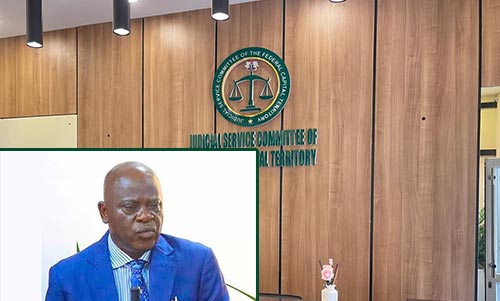
The Judicial Service Committee of the Federal Capital Territory, the body that vets the professional qualifications, background and integrity of lawyers who want to be judges in Abuja, could not produce documents to account for roughly N979.1 million of public money spent in 2023, and did not answer a single one of the six queries the Auditor-General of the Federation put to it.
The figure is made up of about N866.5 million in five queried contracts and N112.6 million in 93 salary vouchers the Committee did not produce.
The findings appear in Volume II of the 2024 report of the Office of the Auditor-General of the Federation, the volume dealing with judiciary institutions, which covers the Committee’s finances for the year 1 January to 31 December 2023. The report was submitted to the National Assembly by the Auditor-General of the Federation, Shaakaa Chira, on 17 July. The only other judicial body whose infractions for that year appear in the section is the Code of Conduct Tribunal.
The Committee is chaired by the Chief Judge of the High Court of the Federal Capital Territory, Hon. Justice Husseini Baba-Yusuf, who has held that office and the chairmanship since 2021, and is run day to day by an Executive Secretary.
The Auditor-General attributed every one of the six findings to the same cause: “weaknesses in the internal control system” at the Committee.
The Committee procured and paid for the supply of a motor vehicle for N302.3 million from contractors “who were not among the list of accredited local manufacturers/assemblers in Nigeria for the procurement of federal government vehicles”. The type and make of the vehicle are not disclosed in the report.
The audit found this to have flouted paragraph 2305 of the Financial Regulations 2009, which provides that “as much as it is practicable, goods must be purchased from reputable manufacturers or their accredited agents”, and that where goods are obtained through an agent “the procuring officer will satisfy himself that the goods are authentic”.
It also found an infringement of paragraph 1 of Executive Order No. 3 of 2017, which directs that “all Ministries, Departments and Agencies of the Federal Government of Nigeria shall grant preference to local manufacturers of goods and service providers in their procurement of goods and services”, and of paragraph 1 of Establishment Circular Ref. No. NADDC.NAIDP/S.137/1/36 dated 17 March 2023, which issued the updated list of accredited local manufacturers and assemblers.
The audit said the breach “does not encourage local manufacturer/industrialisation in Nigeria”, and exposed the government to the risks of “supply of sub-standard vehicles” and “diversion of public funds”.
Seven vouchers totalling over N192 million were raised and paid to different companies for the provision of services and the supply of goods.
The Committee produced no documentary evidence of any kind that the contractors were qualified bidders: no tax clearance certificate, no Corporate Affairs Commission certificate of registration, no PenCom certificate, no Industrial Training Fund certificate, no Nigeria Social Insurance Trust Fund certificate.
The audit cited section 16(7) of the Public Procurement Act 2007: “The procuring entity may require a bidder to provide documentary evidence or other information it considers necessary as proof that the bidder is qualified in accordance with this Act and the solicitation documents and for this purpose any such requirements shall apply equally to all bidders.”
Contracts worth over N174.2 million were awarded to four contractors for renovation and rehabilitation with no advertisement in two national dailies, no bid documents submitted, and no detailed bid evaluation report.
The contractors’ files lacked information about the contractors, pictorial evidence of the work done, and proof that the contractors had been filing annual tax returns with the Federal Inland Revenue Service, now the revenue service. One company “was inactive on the CAC dashboard”.
The audit found breaches of section 24(1) of the Public Procurement Act 2007, which provides that “except as provided by this Act, all procurements of goods and works by all procuring entities shall be by way of open competitive bidding”, and of paragraph 2907(i) of the Financial Regulations 2009, which requires that “to ensure transparency and accountability, achievement of value for money, economy and efficiency, and equity and fairness, all procurements falling within the Bureau’s thresholds shall be by way of Open Competitive Bidding”.
The risks identified were “insider dealing”, described in the reporting as using internal information to win public contracts unfairly, and diversion of funds.
Contracts worth over N144 million were awarded to eight companies with inactive status on both the Corporate Affairs Commission and the revenue service portals.
The audit cited section 16(5) and (6) of the Public Procurement Act 2007, quoting subsection (6) as requiring that all bidders “possess the legal capacity to enter into the procurement contract”, “not be in receivership, the subject of any form of insolvency or bankruptcy proceedings or the subject of any form of winding up petition proceedings”, and, as the quoted text appears, “not have fulfilled all its obligations to pay taxes, pensions and social security contributions”.
(The last of those three, as quoted, states the opposite of what the provision requires. See the note at the foot of this report.)
The risks identified were loss and diversion of public funds.
The audit found that a contract for the supply of computers and laptops, given in the detailed finding as N53.6 million, was split into six.
The contract was for the supply of the same products and ought to have been awarded as a single contract. Instead it was split into six, each at a price that fell within the approval threshold of the Executive Secretary, and all six were awarded at about the same period in 2023. The splitting, the audit said, enabled the Executive Secretary to circumvent tenders’ procedures.
The Committee also failed to provide any document showing the distribution of the computers and laptops, the records of the officers to whom they were issued, or the locations or user departments where they ended up.
The provision cited is section 20(2) of the Public Procurement Act 2007, which places overall responsibility for the planning and organisation of tenders, the evaluation of tenders and the execution of all procurements on the accounting officer of every procuring entity, and in particular makes that officer responsible for “ensuring that no reduction of values or splitting of procurements is carried out such as to evade the use of the appropriate procurement method”.
The risks identified were payments for “fictitious transactions” and diversion of funds.
The Committee failed to present 93 salary vouchers totalling over N112.6 million, creating, the audit said, the risk of payments to non-existent staff and contravening paragraph 601 of the Financial Regulations, which requires that “all payment entries in the cash book/accounts shall be vouched for on one of the prescribed treasury forms”, that vouchers “shall be made out in favour of the person or persons to whom the money is actually due”, and that “under no circumstances shall a cheque be raised or cash paid for services for which a voucher has not been raised”.
The Committee did not respond to any of the six queries.
The Auditor-General therefore recommended that the Secretary of the FCT Judicial Service Committee, Omolola Akindele, account for all the funds, recover and remit them to the treasury, and forward the evidence to the Public Accounts Committees of the National Assembly. Failure to comply, the report states, attracts sanctions.
[A MUST HAVE] Evidence Act Demystified With Recent And Contemporary Cases And Materials

Available now for NGN 40,000 at ASC Publications, 10, Boyle Street, Onikan, Lagos. Beside High Court, TBS. Email publications@ayindesanni.com or WhatsApp +2347056667384. Purchase Link: https://paystack.com/buy/evidence-act-complete-annotation
______________________________________________________________________ “Enhance Legal Practice With Authoritative Reports” — Alexander Payne Offers Comprehensive Law Reports, Spanning Over A Century Of Nigerian Jurisprudence Interested buyers are encouraged to place their orders and enquiries via:
0704 444 4777, 0704 444 4999, 0818 199 9888
Website: www.alexandernigeria.com
Interested buyers are encouraged to place their orders and enquiries via:
0704 444 4777, 0704 444 4999, 0818 199 9888
Website: www.alexandernigeria.com