
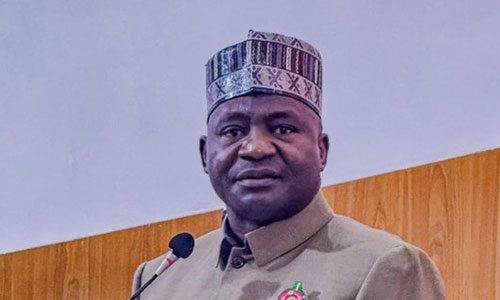
The Minister of Defence, Christopher Musa, has disclosed that the United States is providing the Nigerian military with real-time intelligence, satellite imagery and training support to strengthen ongoing operations against terrorists, bandits and other armed criminal groups across the country.

Musa said the improved intelligence cooperation between Nigeria and the United States had enabled troops to identify, track and eliminate several terrorist and bandit leaders during overnight military operations in the North-East and North-West.
The minister made the disclosure while speaking to journalists during a briefing on the country’s security situation and ongoing efforts to combat insurgency, banditry and kidnapping.
According to him, Nigerian troops have intensified their offensive against armed groups, conducting operations almost daily to dismantle terrorist networks and destroy their hideouts.
He explained that intelligence obtained through cooperation with American authorities had improved the military’s ability to locate and strike militant targets, including those operating in difficult terrain.
“We took out a lot of the bandit leaders and the terrorists themselves,” Musa said.
The Defence Minister maintained that the provision of real-time intelligence, satellite surveillance and military training had strengthened the operational capacity of Nigerian forces, particularly in areas where armed groups had previously exploited difficult terrain to evade security operations.
The development comes as Nigeria continues to confront security challenges involving Boko Haram, the Islamic State West Africa Province (ISWAP), armed bandits and kidnapping gangs operating across different parts of the country.
The latest cooperation builds on decades of security partnership between Nigeria and the United States, including counterterrorism assistance, military training, intelligence sharing and the provision of defence equipment.
Washington has also supported Nigeria’s efforts against Boko Haram and ISWAP, particularly in the Lake Chad Basin, where the insurgency has persisted for approximately 17 years.
However, the country’s security challenges have expanded beyond the North-East to the North-West, where communities have continued to experience bandit attacks, mass abductions and other forms of armed violence.
The growing connection between terrorist organisations and criminal gangs has also heightened concerns about the possible expansion of extremist networks into areas previously dominated by economically motivated criminal activities.
Musa explained that improved surveillance capabilities were helping the Nigerian military identify the locations and movements of armed groups more effectively.
He said the collaboration had also strengthened the capacity of troops to conduct targeted operations against terrorist and bandit leaders.
Beyond intelligence sharing, the minister disclosed that Nigeria was expecting additional military helicopters from the United States and Italy to reinforce ongoing security operations.
According to him, the anticipated aircraft would support the military’s efforts against insurgents, bandits and kidnapping gangs operating in different parts of the country.
With the 2027 general elections approaching, Musa said security agencies were also intensifying intelligence-led operations to prevent armed groups from disrupting the electoral process.
He explained that security authorities were taking steps to ensure that terrorists and other criminal networks did not exploit political activities to carry out attacks before, during or after the elections.
The minister maintained that intelligence gathering and preventive security operations would play an important role in addressing potential threats to the electoral process.
He also expressed concern over the increasing sophistication of criminal networks, particularly their adoption of modern technology to coordinate attacks and sustain their operations.
Musa disclosed that Nigerian security agencies were monitoring the use of Starlink satellite internet services, cryptocurrencies and commercial drones by terrorists and other armed groups.
According to him, these technologies were being exploited by criminal networks to maintain communications, facilitate financial transactions and support their activities.
He said the government was collaborating with American authorities to disrupt the financial networks and logistical arrangements used by the armed groups.
The minister maintained that weakening the financial and logistical structures supporting terrorist organisations was essential to reducing their operational capacity.
Musa also disclosed that Nigeria had reached an agreement with Cameroon, Niger and Chad allowing troops to pursue terrorists and bandits up to five kilometres across their shared borders.
He explained that the arrangement was intended to address the operational challenges posed by armed groups that fled across international boundaries to escape pursuing security forces.
According to him, terrorists and bandits had repeatedly exploited porous borders and difficult terrain to evade military operations after carrying out attacks on Nigerian communities and security formations.
The cross-border agreement is expected to improve the ability of security forces to respond to such movements and prevent armed groups from using neighbouring territories as escape routes.
The minister identified border security as an important component of ongoing counterterrorism operations, particularly around Nigeria’s frontiers with neighbouring countries, including Niger and Benin.
He noted that armed groups had also continued to exploit extensive forest networks and weaknesses in border controls to avoid confrontation with security forces.
However, Musa maintained that improved surveillance and intelligence gathering were increasingly restricting their movements and making it more difficult for them to operate freely.
The Defence Minister further raised concerns over attempts by Islamic State Sahel to recruit criminal gangs operating in Nigeria’s North-West.
He warned that such recruitment efforts could transform banditry, which has largely been driven by criminal and economic motivations, into a more dangerous ideologically motivated insurgency.
According to him, the possibility of criminal gangs adopting extremist ideologies and organisational structures similar to those of ISWAP posed an additional security challenge.
Musa said the military was determined to prevent armed groups in the North-West from acquiring the ideological orientation and operational capacity associated with established terrorist organisations.
He explained that security operations were therefore focused not only on eliminating armed group leaders but also on disrupting recruitment, financial support and logistical supply networks.
The minister maintained that preventing the consolidation of links between terrorist organisations and criminal gangs was critical to containing the spread of insurgency.
He said Nigerian forces were continuing to target the internal structures sustaining the operations of these groups while strengthening intelligence cooperation with international security partners.
“We don’t want them to develop that capacity. We’re blocking the logistics and taking them out from within Nigeria,” Musa told Reuters.
[A MUST HAVE] Evidence Act Demystified With Recent And Contemporary Cases And Materials
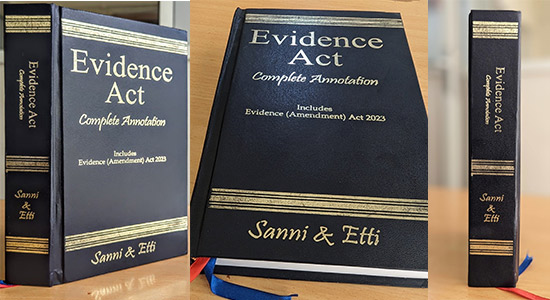
Available now for NGN 40,000 at ASC Publications, 10, Boyle Street, Onikan, Lagos. Beside High Court, TBS. Email publications@ayindesanni.com or WhatsApp +2347056667384. Purchase Link: https://paystack.com/buy/evidence-act-complete-annotation
______________________________________________________________________ “Enhance Legal Practice With Authoritative Reports” — Alexander Payne Offers Comprehensive Law Reports, Spanning Over A Century Of Nigerian Jurisprudence Interested buyers are encouraged to place their orders and enquiries via:
0704 444 4777, 0704 444 4999, 0818 199 9888
Website: www.alexandernigeria.com
“A Comprehensive Guide To Evidence Law” — Releases Second Edition In Three Volumes, Covering 4,051 Cases
For enquiries and orders, contact: 08035526491 Email: jerryamadisilk@gmail.com
 Prof. Jerry Amadi’s Evidence Law, Second Edition (2026), contains 3,314 pages in three volumes, covering the Evidence Act 2011, its 2023 amendment, and 4,051 Nigerian and English cases.