By Opatola Victor

The US-Iran war did not start suddenly, it has been coming, signals were everywhere, oil markets were tightening, shipping routes were becoming riskier, proxy escalations, oil volatility. Serious Countries read these signals early, buffers, coordinate policy, and design targeted interventions. If this escalates, what happens to our people? Then the political leaders think ahead of the crisis. Nigeria leaders (both state and federal) did not, and this the recurring failure of the Nigerian state; our leaders refusal to think ahead is our recurring bane. While others planned for disruption in energy, food, logistics, and finance, Nigeria’s political class remained where it is most comfortable: looking inward, calculating power, already drifting toward 2027. A country of over 200 million people, with 63% already in poverty, entered a global economic shock with no visible buffers, no coordinated response, no sense of urgency from both state and federal government.
Now the war is here, and the consequences are already transmitting through the system. Nigerians actually lives on the cost of fuel, food, transport, and survival. Fuel prices rise, transport costs rise. Transport costs rise, food prices rise. Fertilizer becomes more expensive, farming becomes more expensive. Imports become more expensive. Everything begins to move in one direction, upwards and relentlessly.
The Nigerian state appears curiously detached. There is no coherent articulation of risk, no visible framework for mitigation, and no sense of urgency proportionate to the scale of the threat. Instead, what we see is a familiar pattern of political distraction, with elite attention fully drifted toward 2027 elections rather than present dangers. Milton Friedman warned that inflation is taxation without legislation. In Nigeria, it is worse. It is taxation without protection. The citizen pays more for fuel, more for food, more for survival, and receives nothing in return. No buffer. No shield. No protection.
As always, the government appears to believe that the system will adjust on its own, that markets will find equilibrium, that citizens will absorb the pressure, and that the economy will self-correct if left alone. It is the same logic that underpinned the removal of fuel subsidy: that Nigerians, however strained, will adapt. And indeed, Nigerians always adapt. But adaptation is not the same as resilience, and endurance is not the same as policy success. What is celebrated as “adjustment” is often nothing more than the silent redistribution of pain from the state to the citizen.
Other countries are intervening. They are cushioning households, managing energy costs, anticipating supply disruptions, planning for prolonged instability. They understand that this War will be fought through prices, supply chains, and economic pressure. They are acting accordingly. Nigeria leaders are watching.
There is no clear plan for rising food prices. No visible framework to manage transport inflation. No aggressive move to stabilize fuel distribution. No structured communication to citizens about what lies ahead. Just silence, and the quiet hope that oil revenue will somehow compensate for systemic weakness. The Nigerian State is a machine that extracts from citizens while refusing to reciprocate even minimal protective functions during foreseeable shocks.
This posture is made all the more grotesque by the exporter upside the crisis creates. The shock is net negative for citizens, pump prices surging relentlessly as global crude volatility transmits unchecked, but net revenue-positive for the federation account. Analysts (including NESG projections) are already floating additional inflows from ₦2.3 trillion in a short shock to as much as ₦30 trillion if the Hormuz blockade severely drags on. The real problem isn’t the shock alone, it is also that this windfall will almost certainly be leaked through recurrent spending nonsense, hoarded for political patronage, or diverted into election-cycle largesse instead of ring-fenced for genuine buffers, targeted household relief, strategic petroleum reserves, or accelerated domestic refining capacity. Past oil booms prove the pattern: revenue arrives, elites feast, citizens absorb the pain alone. The state doesn’t just fail to protect; it actively converts potential national gain into further citizen deprivation. By abdicating its role in ring-fencing the windfall or enforcing safeguards, the state creates the precise conditions in which private dealers, importers, distributors, hoarders, and speculators, can narrow competition, hoard, and speculate, pursuing profits directly at the public’s expense in ways Adam Smith explicitly warned against.
Adam Smith, often misunderstood as a prophet of laissez-faire, was clear that markets require moral and institutional foundations to function properly. “The interest of the dealers,” he wrote, “is always in some respects different from, and even opposite to, that of the public.” In moments of crisis, this divergence sharpens. Without state intervention, opportunism fills the vacuum, hoarding, speculative pricing, artificial scarcity.
Other countries understand this. They are not waiting for equilibrium to restore itself. They are actively shaping outcomes, through targeted subsidies, price monitoring, strategic reserves, and demand management policies. They are protecting vulnerable households, stabilizing key sectors, and communicating clearly with their citizens. These actions are not ideological; they are pragmatic responses grounded in the recognition that economic shocks, if left unmanaged, can escalate into social crises.
Nigeria, by contrast, continues to rely on a dangerous assumption: that hardship can be normalized and citizens endure. That citizens will “adjust” as they did before. But this assumption ignores a critical fact, adjustment has limits. A population already burdened by inflation, unemployment, and widespread poverty cannot endlessly absorb shocks without consequence. With over 63 percent of Nigerians living in poverty, even marginal increases in the cost of living translate into real deprivation. As Amartya Sen has argued, poverty is not merely low income but vulnerability, the inability to withstand shocks and maintain basic capabilities. In such a context, inaction is not neutral; it is regressive.
John Maynard Keynes once said, “the market can remain irrational longer than you can remain solvent.” Nigeria is not even dealing with irrational markets, it is dealing with predictable shocks. Yet the state behaves as though time will wait, as though consequences will delay themselves, as though citizens can endlessly absorb pressure. And still, there is no urgency. No sense that this moment demands decisive action. No indication that government understands that crises are not managed after they peak, but before they fully unfold.
Nigeria has faced shocks before, and each time, the story is the same: predictable crises become human suffering, foreseeable challenges become burdens on the poorest, and opportunities to protect, stabilize, and transform are squandered. If the Nigerian state continues to watch, delay, and assume citizens will “adjust,” it will not only fail economically, it will fail in the most fundamental duty of governance: to shield its people from harm. The war is unfolding, prices are rising, and lives are at stake. The question is simple: will Nigeria act before the shock deepens, or will it, once again, let its citizens bear the cost of its indifference?
Opatola Victor is the National Coordinator, Lawyers for Civil Liberties and can be reached via victor@lacivler.org

 ARTIFICIAL INTELLIGENCE FOR LAWYERS: A COMPREHENSIVE GUIDE
Reimagine your practice with the power of AI “...this is the only Nigerian book I know of on the topic.” — Ohio Books Ltd
Authored by Ben Ijeoma Adigwe, Esq., ACIArb (UK), LL.M, Dip. in Artificial Intelligence, Director, Delta State Ministry of Justice, Asaba, Nigeria.
Bonus:
Get a FREE eBook titled “How to Use the AI in Legalpedia and Law Pavilion” with every purchase.
ARTIFICIAL INTELLIGENCE FOR LAWYERS: A COMPREHENSIVE GUIDE
Reimagine your practice with the power of AI “...this is the only Nigerian book I know of on the topic.” — Ohio Books Ltd
Authored by Ben Ijeoma Adigwe, Esq., ACIArb (UK), LL.M, Dip. in Artificial Intelligence, Director, Delta State Ministry of Justice, Asaba, Nigeria.
Bonus:
Get a FREE eBook titled “How to Use the AI in Legalpedia and Law Pavilion” with every purchase.
How to Order: 📞 Call, Text, or WhatsApp: 08034917063 | 07055285878 📧 Email: benadigwe1@gmail.com 🌐 Website: www.benadigwe.com
Ebook Version: Access directly online at: https://selar.com/prv626
________________________________________________________________________ The Law And Practice Of Redundancy In Nigeria: A Practitioner’s Guide, Authored By A Labour & Employment Law Expert Bimbo Atilola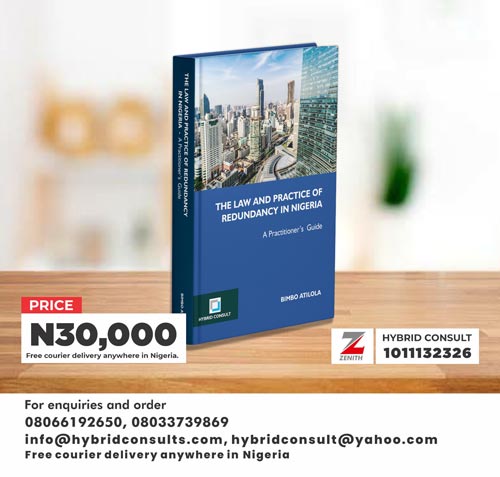 _______________________________________________________________________