By Emmanuel Aziken

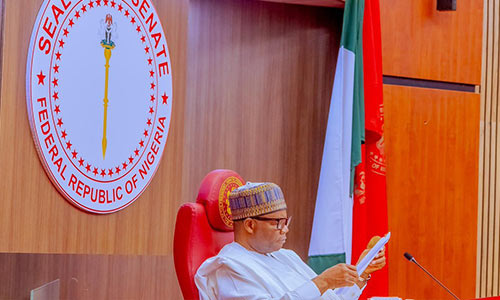
An associate once claimed that Senator Godswill Akpabio initially aspired to be a comedian before fate and fortune nudged him toward law and eventually politics. If that early ambition ever existed, one might argue that the comedic streak never entirely left him. As presiding officer of the Senate, he often peppers proceedings with humour, laughter, and playful asides. To some aides and admirers, he is a jolly good man, generous to loyalists and keen on uplifting those around him.
But beyond the red carpets and cordial smiles, the perception among many ordinary Nigerians is far less positive. That harsher judgment was on display this week at the gates of the National Assembly, where civil society groups rallied, casting Akpabio as a symbol — fairly or unfairly — of what they describe as the major threat against electoral reform.
As the political dynamics for and against electoral reforms continue to evolve, two striking absurdities from what is increasingly called “the Akpabio Senate” came sharply into focus this week.
One was the unsettling spectacle during the 2026 budget defence of the Federal Ministry of Works. The session should have been a moment of sober accountability and an opportunity for lawmakers to interrogate how ¦ 3.4 trillion in public funds would be deployed to rescue Nigeria’s battered road infrastructure. Across the country, highways crumble, commuters face daily peril, and economic productivity suffers from logistical nightmares. A budget defence in such circumstances ought to be meticulous, even forensic.
Instead, what unfolded was drama.
At the centre of the drama was the Minister of Works, David Umahi, who appeared before senators to justify allocations and defend policy decisions. What should have been a rigorous oversight session degenerated into a shouting match that exposed more than executive-legislative tension; it revealed a deeper institutional malaise.
The spark came from Senator Adams Oshiomhole, who questioned the reported revocation of the Abuja–Kaduna highway contract from Julius Berger and its alleged reassignment to Mikano, a company many Nigerians associate with the supply of generators.
Oshiomhole’s query was not trivial. Infrastructure contracts of that magnitude demand transparency, technical competence, and strict adherence to due process.
“Why did you award the contract to a new company owned by Mikano?” Oshiomhole pressed.
Rather than explain, Umahi responded with defiance, challenging Oshiomhole to inspect the project with consultants and vowing to resign if the work proved substandard. It is the kind of arrogance that was unexpected of a public servant seated before the representatives of the people.Yet what unsettled many observers was not merely the clash between the minister and senators. It was the conduct of some senators themselves.
Enter Senator Onyeka Nwebonyi, Deputy Chief Whip and a key figure in Akpabio’s inner caucus. Instead of maintaining institutional neutrality, Nwebonyi reportedly turned the session into what critics described as a praise singing session for Minister Umahi, his political godfather. At a time when Nigerians expect lawmakers to ask difficult questions, the optics of a senior senator appearing to shield a minister from scrutiny were troubling.
Matters escalated further when Nwebonyi clashed openly with the presiding committee chairman, Senator Rufai Hanga who could not suffer his foibles any further. The disagreement spiralled into a shouting exchange at the committee session as Umahi imperiously watched his attack dog leash on his interrogators.
What should have been a solemn exercise in oversight became a spectacle of discord.
The episode revives a lingering question: why do ministers increasingly appear dismissive of the Senate? And why do some senators seem more inclined to act as political surrogates of ministers than as constitutional watchdogs?
In any democracy, the legislature’s authority rests not merely on constitutional text but on conduct. When lawmakers openly compete to defend ministers rather than interrogate them, the balance of power tilts. Indeed, accountability becomes selective, and the Senate diminishes its stature.
Your correspondent posits that the perception that the executive is increasingly emboldened while the legislature grows fragmented is a nightmare that could herald a civilian dictatorship.
Respect is never demanded; it is earned. If ministers appear combative and senators appear divided — some confrontational, others protective — the institution itself absorbs the reputational blow.
The second absurdity emerging from the current Senate concerns the position of Minority Whip. Reports indicate that Senator Osita Ngwu, who is said to have defected to the ruling APC, continues to occupy the office of Minority Whip.
The whip’s role in parliamentary systems is clear: to enforce party discipline and coordinate legislative strategy within a party caucus. The Minority Whip, by definition, represents the opposition bloc. If a senator who has crossed to the ruling party retains that position, it presents not merely a procedural anomaly but a constitutional oddity.
How does a lawmaker reportedly aligned with the majority continue disciplining the minority? How does the Senate leadership reconcile such contradiction without eroding institutional logic? In established democracies, such a scenario would be swiftly rectified to preserve coherence. Here, it lingers — another example, critics argue, of institutional elasticity stretched to uncomfortable limits.
Taken together, these developments feed a narrative that the Senate under Akpabio struggles with perception and discipline. His humour and convivial style may soften proceedings, but the gravitas of his office demands more than levity. It demands order. It demands credibility.
The Senate is not a theatre troupe as the likes of Nwebonyi make of it, nor is it an arena for factional bravado as the actions of Senator Ngwu indicate. It is the crucible of national lawmaking and oversight. When budget defences become shouting contests and party roles blur into contradictions, the institution weakens itself.
Nigeria’s democracy, still consolidating, cannot afford a legislature that appears unsure of its boundaries or too eager to trade oversight for loyalty displays. The absurdities of the moment may pass. But the larger question remains: will the Senate reclaim its dignity, or will it continue to flirt with self-diminution?
In politics, comedy may entertain. In governance, it rarely reassures.
 ARTIFICIAL INTELLIGENCE FOR LAWYERS: A COMPREHENSIVE GUIDE
Reimagine your practice with the power of AI “...this is the only Nigerian book I know of on the topic.” — Ohio Books Ltd
Authored by Ben Ijeoma Adigwe, Esq., ACIArb (UK), LL.M, Dip. in Artificial Intelligence, Director, Delta State Ministry of Justice, Asaba, Nigeria.
Bonus:
Get a FREE eBook titled “How to Use the AI in Legalpedia and Law Pavilion” with every purchase.
ARTIFICIAL INTELLIGENCE FOR LAWYERS: A COMPREHENSIVE GUIDE
Reimagine your practice with the power of AI “...this is the only Nigerian book I know of on the topic.” — Ohio Books Ltd
Authored by Ben Ijeoma Adigwe, Esq., ACIArb (UK), LL.M, Dip. in Artificial Intelligence, Director, Delta State Ministry of Justice, Asaba, Nigeria.
Bonus:
Get a FREE eBook titled “How to Use the AI in Legalpedia and Law Pavilion” with every purchase.
How to Order: 📞 Call, Text, or WhatsApp: 08034917063 | 07055285878 📧 Email: benadigwe1@gmail.com 🌐 Website: www.benadigwe.com
Ebook Version: Access directly online at: https://selar.com/prv626
______________________________________________________________________ New Year Promo: Get Five Maritime Law Books For N150,000 — 63% Discount The promotion, which commenced on January 8 and runs until February 8, 2026, offers five core maritime law books authored by Dr. Emeka Akabogu, SAN, ordinarily valued at N405,000, for just N150,000 — a 63% discount.
Interested buyers can place their orders through the following channels:
Phone: 0704 329 3271
Online Store: https://paystack.shop/aa-bookstore
Website: www.akabogulaw.com
______________________________________________________________________
[A MUST HAVE] Evidence Act Demystified With Recent And Contemporary Cases And Materials
The promotion, which commenced on January 8 and runs until February 8, 2026, offers five core maritime law books authored by Dr. Emeka Akabogu, SAN, ordinarily valued at N405,000, for just N150,000 — a 63% discount.
Interested buyers can place their orders through the following channels:
Phone: 0704 329 3271
Online Store: https://paystack.shop/aa-bookstore
Website: www.akabogulaw.com
______________________________________________________________________
[A MUST HAVE] Evidence Act Demystified With Recent And Contemporary Cases And Materials

 _______________________________________________________________________