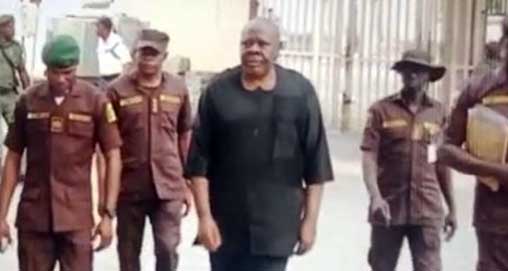
The Court of Appeal in Yola has granted bail to businessman Fred Ajudua, setting aside a November 2025 decision of the Lagos State High Court which refused him pre-trial release.

In a judgement delivered on 30 January, Frederick Oho, who read the lead decision of the three-member panel, held that the trial court misapplied a previous Supreme Court ruling in denying the defendant bail. Other members of the panel, Olusumbo Goodluck and Abdulazeez Waziri, consented.
Mr Ajudua, 65, is standing trial on charges of conspiracy, obtaining money by false pretence, forgery and uttering forged documents under Sections 516, 419 and 467(2) of the Criminal Code, Laws of Lagos State.
He had applied for bail before the Lagos High Court on 22 July 2025, citing deteriorating health and the need for specialised medical care.
In support of his application, he tendered medical reports dated 29 July and 19 November 2025 from A.J. Adewunmi, a consultant physician and nephrologist at the Lagos University Teaching Hospital (LUTH).
The reports indicated that he suffered from chronic kidney disease, had a solitary kidney, and required further investigations, including a possible kidney biopsy and cholecystectomy.
The trial court refused bail, holding that the Supreme Court’s 9 May 2025 judgement — which allowed an earlier appeal by the prosecution and revoked his previous bail — foreclosed any fresh application.
The court also held that his medical condition did not amount to exceptional circumstances warranting release.
But the Court of Appeal disagreed.
Mr Oho held that the lower court relied on extraneous considerations and misinterpreted the Supreme Court’s ruling, noting that the Supreme Court did not expressly prohibit Mr Ajudua from filing a fresh bail application.
“The affidavit evidence and medical reports disclosed special and exceptional circumstances which the trial court ought to have relied upon,” the appellate court held.
It added that judicial discretion in bail matters must be exercised judiciously and in the interest of justice, taking into account all relevant materials placed before the court, including an applicant’s health condition.
The appellate court also dismissed preliminary objections filed by EFCC, which sought the striking out of the appeal as incompetent and to prevent the transfer of the case for a trial de novo before another judge.
The court held that the objections lacked merit, noting that the Supreme Court had not determined the substantive issue of bail nor barred a retrial before a different judge.
Mr Ajudua’s legal team, led by Senior Advocate of Nigeria Olalekan Ojo, argued that the trial court failed to exercise its discretion judicially and wrongly imported conclusions into the Supreme Court’s decision.
Lawyers for the prosecution — S.K. Atteh, T.J. Banjo and Patrick Igbi Ugama — maintained that the defendant’s health claims were exaggerated and that the Supreme Court’s ruling justified his continued detention.
In a concurring opinion, Ms Goodluck agreed entirely with the lead ruling, stating that discretion cannot be subject to rigid rules, but must be guided by common sense and the facts placed before the court.
She held that the trial court ought not to have ignored the uncontroverted medical evidence regarding the appellant’s deteriorating health, particularly his chronic kidney disease compounded by having a solitary kidney.
Granting bail, she observed, would enable him to address his critical medical condition and adequately prepare his defence, noting that it is expedient for an accused person to be alive and medically stable to exercise his constitutional right to fair hearing.
Also, Mr Waziri dismissed the prosecution’s preliminary objection, describing it as lacking legal substance.
He agreed that the trial court failed to properly exercise its discretion judicially and judiciously and adopted the reasoning of the lead judgment in full.
The panel unanimously allowed the appeal and set aside the High Court’s ruling.
The court granted Mr Ajudua bail in the sum of N30 million with two sureties in like sum. Each surety must depose to an affidavit of means and show evidence of property worth at least N50 million within Lagos State.
The defendant is to surrender his passport to the Chief Registrar of the Lagos State High Court and must remain in Nigeria throughout the trial.
However, he may travel abroad for treatment if a consultant nephrologist at LUTH certifies that the required medical care is unavailable in Nigeria.
The charges against Mr Ajudua stem from allegations dating back to 1993.
EFCC alleged that he and an accomplice, Joseph Ochunor, forged documents purportedly issued by the Central Bank of Nigeria and the Nigerian National Petroleum Corporation to defraud a German businessman, Michael Kreamer.
According to the prosecution, Mr Kreamer was persuaded to part with large sums of money after being impressed by what he described as Mr Ajudua’s lavish office, luxury vehicles and apparent credibility.
The EFCC alleged that $550,000 was initially paid in cash through a Palestinian businessman, Zad Abu Zalaf, followed by additional sums of $268,000 and $225,000 in April and May 1993.
Mr Ajudua has denied wrongdoing.
His legal battles have spanned more than three decades, marked by multiple adjournments and appeals.
Between 2005 and 2009, he reportedly failed to appear in court at least 24 times, leading to a temporary dismissal of the case. It was reinstated in 2017, and he was re-arraigned in June 2018.
In May 2025, the Supreme Court unanimously revoked the bail earlier granted to him by the Court of Appeal in 2018, holding that his appeal had been filed out of time and directing that the trial continue before Justice Mojisola Dada of the Lagos High Court.
Despite that setback, the Court of Appeal held in its latest ruling that repeated bail applications are permissible where new and exceptional circumstances — such as serious illness — are demonstrated.
The court reiterated that the primary purpose of bail is to secure an accused person’s attendance at trial, not to punish before conviction.
With the ruling, Mr Ajudua is expected to be released from custody once he meets the bail conditions, pending the continuation of his trial.
The judgement raises the question of why it was the faraway Yola Division of the Court of Appeal that sat on Mr Ajudua’s appeal which stemmed from the ruling of the Lagos State High Court. The development appears to be at odds with expectation that the Lagos Division of the Court of Appeal, by default, handles the appeals on cases originating from lower courts in Lagos State.
But PREMIUM TIMES gathered on Friday that the appeal was heard last month in Lagos by a panel of three justices drawn from different divisions of the Court of Appeal as part of the extraordinary measures set up to decongest the overburdened docket of the Lagos division of the court.
The President of the Court of Appeal, Monica Dongban-Mensem, said at the time that 16 panels comprising 40 justices drawn from various divisions of the court of appeal were constituted to deal with about 360 appeals during the special session which ran for about two weeks in January.
In that regard, the presiding justice of the panel, Mr Oho, was drawn from Yola Division. While Ms Goodluck was drafted from the Kano Division, Mr Waziri was brought from Makurdi Division.
The judgement was attributed to Kano Division because it was delivered by Mr Oho from Kano in a virtual court proceeding on 30 January, after the special court decongestion sessions had ended.
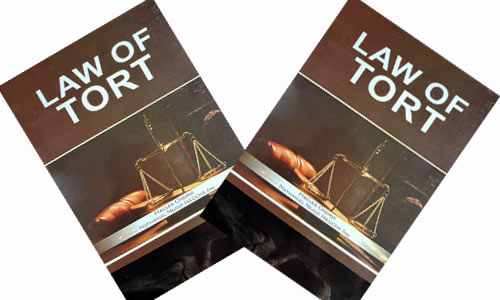 The book, titled The Law of Torts in Nigeria: A Functional Approach, authored by Professor Hagler Sunny Okorie Ph.D and Ikeocha, Nathaniel Ngozi Esq, offers law students, practitioners, and academics a comprehensive guide to understanding and applying tort law in Nigerian courts. Interested buyers can place orders via the following contact numbers: 08028636615, 08037667945, 08032253813, or +234 902 196 2209.
______________________________________________________________________
[A MUST HAVE] Evidence Act Demystified With Recent And Contemporary Cases And Materials
The book, titled The Law of Torts in Nigeria: A Functional Approach, authored by Professor Hagler Sunny Okorie Ph.D and Ikeocha, Nathaniel Ngozi Esq, offers law students, practitioners, and academics a comprehensive guide to understanding and applying tort law in Nigerian courts. Interested buyers can place orders via the following contact numbers: 08028636615, 08037667945, 08032253813, or +234 902 196 2209.
______________________________________________________________________
[A MUST HAVE] Evidence Act Demystified With Recent And Contemporary Cases And Materials

 ARTIFICIAL INTELLIGENCE FOR LAWYERS: A COMPREHENSIVE GUIDE
Reimagine your practice with the power of AI “...this is the only Nigerian book I know of on the topic.” — Ohio Books Ltd
Authored by Ben Ijeoma Adigwe, Esq., ACIArb (UK), LL.M, Dip. in Artificial Intelligence, Director, Delta State Ministry of Justice, Asaba, Nigeria.
Bonus:
Get a FREE eBook titled “How to Use the AI in Legalpedia and Law Pavilion” with every purchase.
ARTIFICIAL INTELLIGENCE FOR LAWYERS: A COMPREHENSIVE GUIDE
Reimagine your practice with the power of AI “...this is the only Nigerian book I know of on the topic.” — Ohio Books Ltd
Authored by Ben Ijeoma Adigwe, Esq., ACIArb (UK), LL.M, Dip. in Artificial Intelligence, Director, Delta State Ministry of Justice, Asaba, Nigeria.
Bonus:
Get a FREE eBook titled “How to Use the AI in Legalpedia and Law Pavilion” with every purchase.
How to Order: 📞 Call, Text, or WhatsApp: 08034917063 | 07055285878 📧 Email: benadigwe1@gmail.com 🌐 Website: www.benadigwe.com
Ebook Version: Access directly online at: https://selar.com/prv626
________________________________________________________________________ The Law And Practice Of Redundancy In Nigeria: A Practitioner’s Guide, Authored By A Labour & Employment Law Expert Bimbo Atilola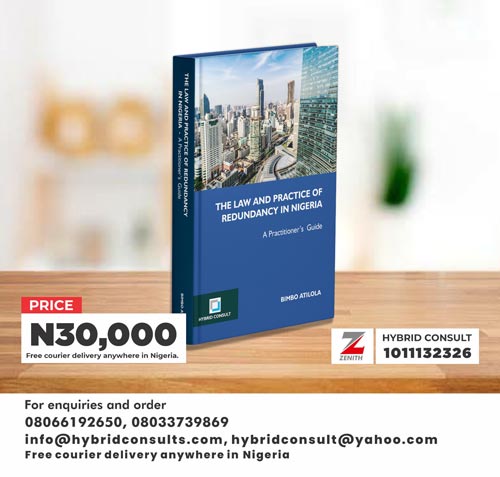 _______________________________________________________________________