President Bola Ahmed Tinubu has warned the National Assembly (NASS) to steer clear of attempts to centralise lotto and other betting games in the country through the Central Gaming Bill, vowing not to grant presidential assent to the bill.

The President made the declaration on Thursday while addressing the National Caucus meeting of the All Progressives Congress (APC), describing lotto and betting as a residual matter that the National Assembly should not tread nearby.
“What I want you to forget is a centralised lotto, go and read the constitution again. It’s a residual matter. It belongs to the exclusive legislative list of the States. Don’t tread near it, there’s no need for us to argue. I’m a constitutional democrat, I read it that it was coming, I won’t sign it,” Tinubu declared.
TheNigeriaLawyer gathered that the Central Gaming Bill 2025 is a Senate-passed legislation that seeks to create a single national regulatory framework for all online and remote gaming activities.
The bill aims to establish federal oversight and regulation of lotto, betting, and other gaming activities across Nigeria, effectively bringing them under centralized federal control.
However, Attorneys General of Lagos and 22 other states have continued to object to the passage of the bill, describing it as a state-level matter and warning that any federal action would amount to a violation of the Supreme Court’s landmark judgment.
@thenigerialawyerTinubu Vows Not To Sign Central Gaming Bill, Warns NASS To Steer Clear Of Lotto Centralization
According to the states, the Supreme Court had clearly ruled in its judgment delivered on October 13, 2024, in Suit No. SC/1/2008 – AG Lagos State & 22 Ors v. AG Fed & 13 Ors that lotteries, betting, and gaming are residual matters that fall within the exclusive legislative competence of the States, except in the Federal Capital Territory.
The states’ position is anchored on the Supreme Court’s constitutional interpretation that placed gaming, lotteries, and betting within the residual list—matters not specifically assigned to the federal government and therefore reserved for state legislatures.
This means that while the federal government can regulate such activities in the FCT, it has no constitutional authority to impose nationwide regulations on states in this regard.
President Tinubu’s strong stance on the issue reflects his stated commitment to constitutional governance and respect for the separation of powers between federal and state governments.
By describing himself as a “constitutional democrat,” the President signaled his unwillingness to overstep constitutional boundaries or encroach on matters clearly designated as state responsibilities.
The President’s categorical declaration that he will not sign the bill effectively kills any prospect of the Central Gaming Bill becoming law, even if the National Assembly passes it.
Under Section 58 of the 1999 Constitution, the President has the power to withhold assent from any bill passed by the National Assembly, and his public pronouncement leaves no doubt about his position on this matter.
While the National Assembly can override a presidential veto with a two-thirds majority vote in both chambers, such overrides are rare and politically challenging, particularly when the President has made his constitutional objections clear.
The objection by 23 state Attorneys General also reflects concerns about revenue generation and fiscal autonomy.
Gaming, lotteries, and betting have become significant sources of internally generated revenue (IGR) for many states, and a federal takeover of regulation could potentially impact states’ ability to collect taxes and fees from these activities.
The controversy highlights broader tensions in Nigeria’s federal system regarding the appropriate balance of power between federal and state governments.
States have long complained about federal encroachment on matters they consider to be within their constitutional jurisdiction, and the Supreme Court’s October 2024 judgment was seen as a significant victory for state autonomy.
President Tinubu’s decision to align with the states on this issue may help ease some of these tensions and demonstrate respect for constitutional boundaries.
The gaming and betting industry in Nigeria has grown significantly in recent years, with numerous operators offering online and physical betting services across the country.
The proposed Central Gaming Bill was likely intended to bring greater standardization and federal oversight to the sector, but the President’s position means the industry will continue to be regulated at the state level.
With the President’s categorical rejection of the bill, the National Assembly faces a choice: it can either abandon the Central Gaming Bill entirely or proceed with passage knowing that a presidential veto is certain.
Given the President’s strong constitutional grounds and the support of 23 states, it appears unlikely that the bill will become law in its current form.
Any future attempt to regulate gaming at the federal level would likely require either a constitutional amendment to move the matter from the residual to the concurrent or exclusive legislative list, or a more limited approach focused solely on the Federal Capital Territory.
President Tinubu’s firm stance on the Central Gaming Bill demonstrates his commitment to constitutional governance and respect for the federal structure.
By warning the National Assembly not to “tread near” this residual matter and vowing not to sign any such legislation, the President has effectively ended the current attempt to centralize gaming regulation in Nigeria.
The episode also serves as a reminder of the importance of respecting constitutional boundaries and the Supreme Court’s interpretative role in defining the scope of federal versus state powers in Nigeria’s federal system.

 ARTIFICIAL INTELLIGENCE FOR LAWYERS: A COMPREHENSIVE GUIDE
Reimagine your practice with the power of AI “...this is the only Nigerian book I know of on the topic.” — Ohio Books Ltd
Authored by Ben Ijeoma Adigwe, Esq., ACIArb (UK), LL.M, Dip. in Artificial Intelligence, Director, Delta State Ministry of Justice, Asaba, Nigeria.
Bonus:
Get a FREE eBook titled “How to Use the AI in Legalpedia and Law Pavilion” with every purchase.
ARTIFICIAL INTELLIGENCE FOR LAWYERS: A COMPREHENSIVE GUIDE
Reimagine your practice with the power of AI “...this is the only Nigerian book I know of on the topic.” — Ohio Books Ltd
Authored by Ben Ijeoma Adigwe, Esq., ACIArb (UK), LL.M, Dip. in Artificial Intelligence, Director, Delta State Ministry of Justice, Asaba, Nigeria.
Bonus:
Get a FREE eBook titled “How to Use the AI in Legalpedia and Law Pavilion” with every purchase.
How to Order: 📞 Call, Text, or WhatsApp: 08034917063 | 07055285878 📧 Email: benadigwe1@gmail.com 🌐 Website: www.benadigwe.com
Ebook Version: Access directly online at: https://selar.com/prv626
________________________________________________________________________ The Law And Practice Of Redundancy In Nigeria: A Practitioner’s Guide, Authored By A Labour & Employment Law Expert Bimbo Atilola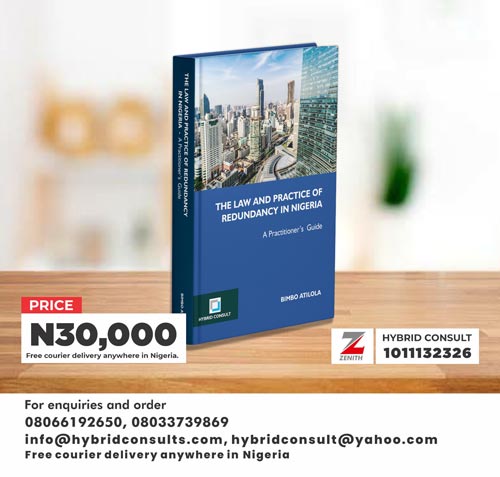 _______________________________________________________________________