

The National Industrial Court has held that Mikano International impliedly confirmed the appointment of its employee, Mr. Oluwaseun, after retaining him in employment for six months beyond his probationary period without formally confirming his appointment, extending his probation or terminating his employment.

The court consequently declared that the termination of Oluwaseun’s employment was unlawful to the extent that the company failed to comply with the contractual notice requirements applicable to a confirmed employee.
Delivering judgment, the presiding judge, Hon. Justice (Dr.) Isaac Essien, held that an employer could not continue to retain an employee after the expiration of probation, pay the employee full salary and entitlements, and subsequently rely on the absence of a formal confirmation letter to deny the employee the benefits attached to confirmed employment.
Justice Essien held that Mikano International’s conduct amounted to an implied and tacit confirmation of Oluwaseun’s appointment, notwithstanding the company’s insistence that confirmation could only be communicated in writing.
The court ordered Mikano International to pay the claimant ₦2 million as the outstanding balance of his salary in lieu of notice, ₦5 million as general damages and ₦1 million as costs, bringing the total monetary award to ₦8 million.
The dispute arose from the company’s decision to terminate Oluwaseun’s employment after he had completed his contractual probationary period and continued working for an additional six months.
According to the claimant, following the expiration of his probation, Mikano International retained him in service and continued paying his full salary and other employment entitlements without issuing any communication confirming his appointment, extending his probation or terminating his employment.
He maintained that he continued discharging his duties throughout the additional six-month period without interruption or any indication that his employment remained subject to probation.
However, the company subsequently issued him a letter of cessation of employment without complying with the notice requirements applicable to confirmed employees under his contract of employment.
Dissatisfied with the termination, Oluwaseun approached the National Industrial Court, challenging the company’s decision to treat him as a probationary employee despite retaining him beyond the stipulated probationary period.
He contended that the company’s actions after the expiration of his probation amounted to confirmation of his appointment by conduct and entitled him to the contractual benefits of a confirmed employee.
In its defence, Mikano International denied that the expiration of probation automatically resulted in confirmation of employment.
The company argued that confirmation depended on satisfactory performance evaluation and the achievement of agreed performance targets.
It also relied on provisions of its Employee Handbook requiring that confirmation of appointment be communicated formally in writing.
On that basis, Mikano International maintained that Oluwaseun remained a probationary employee and was entitled to only two weeks’ salary in lieu of notice upon termination.
The company consequently urged the court to dismiss the suit in its entirety.
However, counsel to the claimant, C. T. Ajah, Esq., challenged the company’s position, arguing that an employer could not indefinitely treat an employee as being on probation after the expiration of the agreed period without taking the necessary contractual steps.
Ajah submitted that Mikano International’s decision to retain his client in employment, continue paying his full salary and entitlements, and permit him to discharge his responsibilities for another six months amounted to implied confirmation.
He further argued that the company was estopped by its conduct from subsequently treating Oluwaseun as a probationary employee.
Counsel maintained that the company’s failure to issue a formal confirmation letter could not defeat the legal consequences of its conduct after the probationary period had expired.
In determining the dispute, Justice Essien examined the claimant’s terms of employment alongside the provisions of Mikano International’s Employee Handbook.
The judge considered whether the company could rely on the absence of written confirmation to maintain that Oluwaseun remained on probation despite having retained him beyond the stipulated period.
Justice Essien held that the company’s continued retention of the claimant, payment of his full salary and entitlements, and failure to comply with the prescribed procedures for dealing with probationary employees established an implied and tacit confirmation of his appointment.
The court observed that Mikano International failed to demonstrate that it had conducted the required performance evaluation, extended the claimant’s probationary period or terminated his employment within the period contemplated by its contractual documents.
The judge held that the company could not rely on its own failure to issue a written confirmation letter to deny the claimant the rights and benefits of a confirmed employee.
According to the court, the employer’s conduct after the expiration of probation was relevant in determining the claimant’s employment status, particularly where the company continued to accept his services without taking steps to preserve or extend the probationary arrangement.
Justice Essien therefore rejected the company’s contention that the claimant remained a probationary employee merely because no formal confirmation letter had been issued.
Having found that Oluwaseun’s appointment had been impliedly confirmed, the court proceeded to determine the appropriate notice entitlement upon termination.
Justice Essien examined the claimant’s offer of appointment, which provided that a confirmed employee was entitled to three months’ written notice or three months’ salary in lieu of notice upon termination.
The court observed that Mikano International had paid the claimant only one month’s salary in lieu of notice.
It held that the payment fell short of the three-month requirement applicable to his confirmed employment status.
Consequently, Justice Essien declared the termination unlawful to the extent of the company’s failure to comply with the applicable contractual notice provisions.
The judge ordered Mikano International to pay Oluwaseun an additional ₦2 million, representing the outstanding two months’ salary in lieu of notice.
The court also considered the circumstances surrounding the cessation of the claimant’s employment and the consequences of the company’s conduct.
Justice Essien awarded ₦5 million in general damages for the abrupt cessation of Oluwaseun’s employment, including the humiliation and psychological trauma arising from the company’s actions.
In addition, the court awarded ₦1 million as costs, bringing the total amount payable by Mikano International to ₦8 million.
The judgment establishes that, in the circumstances of the case, an employer’s conduct after the expiration of an employee’s probationary period may amount to confirmation of appointment even where the employer has not issued a formal confirmation letter.
It also underscores the importance of employers complying with their contractual procedures for performance assessment, extension of probation, confirmation and termination of employment.
The court’s decision makes clear that where an employer retains an employee beyond the prescribed probationary period without formally extending it or taking other steps required by the contract, the employer may be prevented from subsequently denying the employee the benefits of confirmed employment.
Justice Essien’s ruling further distinguishes an employer’s power to terminate employment from its obligation to comply with the contractual notice provisions governing that termination.
[A MUST HAVE] Evidence Act Demystified With Recent And Contemporary Cases And Materials
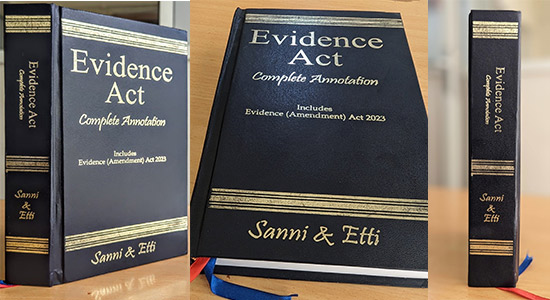
Available now for NGN 40,000 at ASC Publications, 10, Boyle Street, Onikan, Lagos. Beside High Court, TBS. Email publications@ayindesanni.com or WhatsApp +2347056667384. Purchase Link: https://paystack.com/buy/evidence-act-complete-annotation
______________________________________________________________________ “Enhance Legal Practice With Authoritative Reports” — Alexander Payne Offers Comprehensive Law Reports, Spanning Over A Century Of Nigerian Jurisprudence Interested buyers are encouraged to place their orders and enquiries via:
0704 444 4777, 0704 444 4999, 0818 199 9888
Website: www.alexandernigeria.com
“A Comprehensive Guide To Evidence Law” — Releases Second Edition In Three Volumes, Covering 4,051 Cases
For enquiries and orders, contact: 08035526491 Email: jerryamadisilk@gmail.com
 Prof. Jerry Amadi’s Evidence Law, Second Edition (2026), contains 3,314 pages in three volumes, covering the Evidence Act 2011, its 2023 amendment, and 4,051 Nigerian and English cases.