Nigeria and the United Kingdom have signed three landmark agreements that will, for the first time, allow Britain to deport failed asylum seekers, visa overstayers, and convicted criminals to Nigeria using UK-issued identification letters — removing one of the major administrative hurdles that had previously slowed the return of undocumented Nigerians from the UK.

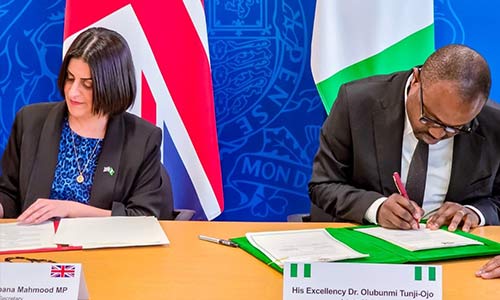
The agreements were signed by Nigeria’s Minister of Interior, Olubunmi Tunji-Ojo, and UK Home Secretary Shabana Mahmood during President Bola Tinubu’s state visit to the United Kingdom, with two signed on Wednesday evening and the third on Thursday.
The deal is being described as the most comprehensive migration agreement the UK has reached with any country, with Mahmood herself acknowledging that Nigeria is the first nation to conclude such a far-reaching arrangement with Britain.
The three agreements signed by both countries are a Memorandum of Understanding on Migration Partnership, a Statement of Intent on Cooperation on Organised Immigration Crime and Border Security, and a Statement of Intent on the expansion of business visas for UK companies operating in Nigeria.
The most consequential aspect of the deal is the migration partnership agreement, which provides the UK with broad flexibility to return Nigerians who have no legal right to remain in Britain.
Under the agreement, the Nigerian government will, for the first time, accept UK-issued letters as an alternative identification certificate for individuals who do not possess valid passports. Previously, Nigeria used emergency travel documents as supplementary identification for undocumented travellers, but the acceptance of UK-issued letters significantly streamlines the deportation process.
According to UK media reports, there are currently 961 Nigerian failed asylum seekers in the UK who have exhausted their rights of appeal, as well as 1,110 foreign national offenders from Nigeria whom the Home Office is waiting to deport. Both groups are now expected to be removed more quickly under the new framework.
The deal also covers visa overstayers, giving Britain wide flexibility in returning Nigerians who remain in the country beyond their authorized stay.
The start date and duration of the agreement were not specified. It is also unclear whether there will be any financial incentives attached to the arrangement or whether the deportees will include other nationalities or be restricted to Nigerians.
In 2022, the UK had struck a similar but more controversial deal with Rwanda, agreeing to pay at least £370 million to the East African nation as part of a plan to relocate asylum seekers there. That deal was later scrapped after British Prime Minister Keir Starmer declared it “dead.”
Tackling Organised Immigration Crime
The second agreement establishes a framework for joint operations and intelligence sharing between Nigeria and the UK targeting criminal gangs that abuse visa routes.
The Home Office said the deal was prompted by a string of high-profile cases involving fake job sponsorships, sham marriages, and forged financial or employment records used to gain entry into the UK.
Under the agreement, Nigeria is also set to review its domestic laws to tackle immigration crime and ensure the toughest possible sentences are handed down to offenders.
A new partnership targeting online scammers involved in romance fraud, investment scams, and cryptocurrency schemes will also be established, delivering what the Home Office described as stronger protections for the UK public.
The agreement introduces a “fusion cell” model that will bring together public-sector bodies, banks, technology firms, and communications companies to rapidly share intelligence on criminal tactics so swift action can be taken against organised immigration crime networks operating across both countries.
UK Border Security and Asylum Minister Alex Norris described Nigeria as a key partner in tackling illegal migration, noting that it is the UK’s largest African visa market.
“We owe everyone across the system fairness. Anyone who abuses our systems, breaks our laws or tries to cheat their way into Britain will be stopped and removed,” Norris stated.
The third agreement focuses on expanding business visa arrangements for UK companies operating in Nigeria, a move aimed at stimulating trade and economic cooperation between both countries.
UK Trade Envoy to Nigeria, Florence Eshalomi, described the agreement as a significant step toward strengthening trade ties and supporting economic growth in Nigeria, Africa’s largest economy.
Interior Minister Tunji-Ojo said the business visa expansion aligns with ongoing reforms aimed at using visa policies as a tool to stimulate economic growth and investment. He stressed that Nigeria’s ambition of building a trillion-dollar economy requires the removal of barriers that hinder trade and economic cooperation, including challenges linked to irregular migration.
“I want to assure you on behalf of Mr President and the great people of Nigeria that we are open to endless possibilities of growth and socio-economic development,” Tunji-Ojo stated.
Tunji-Ojo said the agreements reflect Nigeria’s commitment to building a migration system that is transparent, orderly, and consistent with both national interests and international obligations.
“This partnership is a testament to our shared determination to build a migration system that is safe, orderly and mutually beneficial,” the minister said.
He expressed confidence that the new framework would deliver measurable results within a year and could serve as a model for similar bilateral agreements with other countries.
The minister also framed the deal as a demonstration of Nigeria’s willingness to be a responsible international partner. “We are totally committed to being a responsible country in fulfilling our core obligations. And for us to sustain that relationship, we must remember: ‘He who comes to equity must come with clean hands.’ So, we need to be as open and as fair as possible,” he stated.
Tunji-Ojo reiterated Nigeria’s resolve to protect its citizens while ensuring that individuals who abuse legal migration pathways or engage in criminal activities are held accountable. He also highlighted President Tinubu’s commitment to strengthening international cooperation in areas that support national development and security.
Home Secretary Mahmood described Nigeria as holding a special place in the UK’s bilateral relations, noting that while Britain engages in migration discussions with several countries, Nigeria stands out as the first to reach such a comprehensive agreement.
“We have a shared vision for the work our countries can do together and we really appreciate this partnership,” Mahmood said.
The agreements are expected to have far-reaching implications for Nigerians in the UK, particularly those without valid immigration status. The acceptance of UK-issued letters as identification removes what had been one of the most significant bureaucratic obstacles to deportation, as many individuals flagged for removal could not be returned because they lacked valid Nigerian passports and Nigeria had been slow to issue emergency travel documents.
The deal also sends a strong signal to Nigerians considering irregular migration to the UK, as the enhanced cooperation on border security and organised immigration crime means that fraudulent visa applications, sham marriages, and fake sponsorship arrangements will face increased scrutiny and prosecution in both countries.
For the UK, the agreement addresses a longstanding political challenge. Nigerian nationals represent one of the largest groups of individuals subject to deportation proceedings, and the inability to return them efficiently had been a source of frustration for successive British governments.
The business visa expansion, however, offers a counterbalance, creating legitimate pathways for Nigerian professionals and businesses to access the UK market, potentially reducing the incentive for irregular migration by expanding legal channels for economic engagement.

 ARTIFICIAL INTELLIGENCE FOR LAWYERS: A COMPREHENSIVE GUIDE
Reimagine your practice with the power of AI “...this is the only Nigerian book I know of on the topic.” — Ohio Books Ltd
Authored by Ben Ijeoma Adigwe, Esq., ACIArb (UK), LL.M, Dip. in Artificial Intelligence, Director, Delta State Ministry of Justice, Asaba, Nigeria.
Bonus:
Get a FREE eBook titled “How to Use the AI in Legalpedia and Law Pavilion” with every purchase.
ARTIFICIAL INTELLIGENCE FOR LAWYERS: A COMPREHENSIVE GUIDE
Reimagine your practice with the power of AI “...this is the only Nigerian book I know of on the topic.” — Ohio Books Ltd
Authored by Ben Ijeoma Adigwe, Esq., ACIArb (UK), LL.M, Dip. in Artificial Intelligence, Director, Delta State Ministry of Justice, Asaba, Nigeria.
Bonus:
Get a FREE eBook titled “How to Use the AI in Legalpedia and Law Pavilion” with every purchase.
How to Order: 📞 Call, Text, or WhatsApp: 08034917063 | 07055285878 📧 Email: benadigwe1@gmail.com 🌐 Website: www.benadigwe.com
Ebook Version: Access directly online at: https://selar.com/prv626
________________________________________________________________________ The Law And Practice Of Redundancy In Nigeria: A Practitioner’s Guide, Authored By A Labour & Employment Law Expert Bimbo Atilola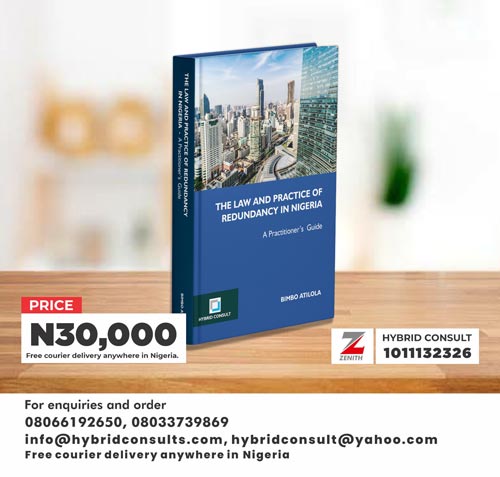 _______________________________________________________________________