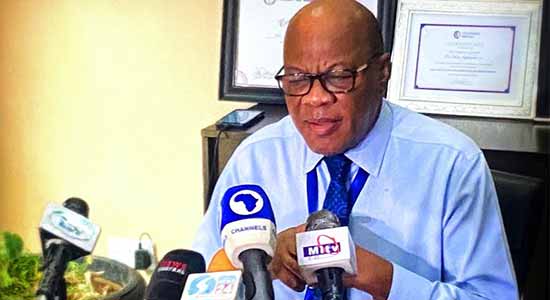
A former President of the Nigerian Bar Association and Senior Advocate of Nigeria, Mr Olisa Agbakoba, has in an interview with Onozure Dania of Punch Newspaper shared his thoughts on the judiciary and some issues around the in-coming government.

On his recent interview where he disagreed with the Supreme Court justices over its judgment on the Lawan v Machina case, of which his position has generated so many debates, he clarified that:
The point I made was that in recent times, the Supreme Court has become a bit unpredictable and a bit too technical, given the fact that the Supreme Court is a policy court. A policy court means that the Supreme Court does not deal with technicalities. So, I was worried and concerned that the lead judgment declined to deal with the case merely because the case was brought by a particular process called originating summons and not a process called writ of summons. That is not how to deal with an issue of high policy on whether a particular person should be the occupant of the senatorial seat. I then made a general point. If you go back to the history of the Supreme Court, there was a time when confidence in the Supreme Court was at the high peak, but now, there have been many judgments.
He summarized his position by asserting that: I think that the Supreme Court can be more policy-driven and deliver judgment that accords more with the man in the molue. If the Supreme Court delivers a judgment and everybody says, ah, is this correct? There is a problem. That was the point I made.
To further clarify his position in a previous interview where he stated, inferentially, that the Supreme Court has become unpredictable with its recent judgment. He was asked if it is not right to say that the courts are unpredictable in this sense. Again, the learned silk gave a rebuttal and maintained that “that was not the point I made”. He went further by stating that:
I wasn’t talking about the particular facts of the case. Apart from Justice (Helen) Ogunwunmiju; she is the only one that went into the case. I applaud her for at least going into the case. The Supreme Court is a policy court, and I don’t think it is at that level that they should be denying the hearing of a case merely because, according to the Supreme Court, the person who brought it did not come by a proper procedure. In any case, the decision of Justice Cletus Nweze was even wrong. It was wrong because the rules allowed for using the procedure that was used. So I’m surprised that they declined and said the facts are controversial and so when facts are controversial, we don’t allow you to come by originating summons, you must come by writ of summons. That was what he said, and I disagree. That’s my point. He could have said, ‘okay, let me now listen to whether in the fact of having come by the wrong procedure, is it even right.’ That would have been the correct approach because the Supreme Court is a policy court.
Giving a case analysis on why the Supreme Court is a policy court and does not rely on technicalities to give judgments; he embarked on an education sojourn in contextualizing between the Naira redesign case and the Lawan v Machina case.
I think we have to understand that the Supreme Court does not deal with technicalities. I will give you an example. I personally believe that the Supreme Court was wrong on the Central Bank of Nigeria case. When the states brought the case against the Federal Government, the proper cause of action was for the Supreme Court to throw it out, but they did not because being a policy court, they realised that the issue of lack of cash was a matter affecting every Nigerian. How would you have felt if you heard that the Supreme Court dismissed the case by the three governors because they sued the wrong party? People will ask if the Federal Government is not the one in charge of the process. Is the CBN not an agency of the Federal Government? So, the Supreme Court invoked its public policy jurisdiction but overlooked the fact that it didn’t have jurisdiction and made the decision. That is correct. So, even though I disagree that they had jurisdiction, I understand why they did it. That is why it’s a policy court. So, back to your question; if you check what I said in the previous interview, and I will encourage people to watch it again, there have been several decisions, not just the one about Ahmad Lawan. There have been a series of cases where I felt, and I feel that the public also feels the same way; if you get public opinion in relation to how the courts are functioning, they will tell you they (Supreme Court) could do better. That is the general feeling. That was the point I made.
Still on the judiciary, he was asked if, like many people had argued; the leadership of the judiciary is appointed by the President or governors as the case may be, the heads of the judiciary may not go against the wish of the executive. However, the learned silk had slightly tilted his position and asserts that:
The CJN is appointed by the National Judicial Council upon the shortlisting of the relevant candidates by the Federal Judicial Service Commission. So, there will be predominantly two names. Usually the most senior will be the lead person to be considered, while the second one is called the reserve candidate. Then, there will be a meeting of the NJC to confirm the appointment of the CJN. The President’s role is merely formal because he will receive a letter from the NJC saying, we have chosen this man as our CJN, and the President endorses it and sends the name to the Senate. So, in real terms, the appointing authority is the NJC under the constitution. But because it is necessary for the three arms of government to have a say, the NJC makes the nomination and no Nigerian president has ever rejected the nomination of the NJC. That’s why I say in real terms, the NJC actually makes the appointment. The President only endorses the name sent to him. So, the NJC and the judiciary are not subject to the control of the President and are therefore free from interference.
To further support his position, he made recourse to the military era where the general notion of the judiciary being kept under the eye of the military, he stated that it was wrong; that the judiciary has always functioned with some level of independence.
Generally speaking, even under the military, the judiciary has been left alone, in fairness to the executive. It is for the judiciary to deliver justice without fear or favour. Sometimes, it is the judges themselves that apply a break. I remember a late judge; I can’t remember his name now. There was a case before him years ago. Do you know what he said? He said no, I will not decide this case because any case against Kabiyesi, and Kabiyesi then was General Ibrahim Babangida. So he likened the President of Nigeria to Kabiyesi and that when Kabiyesi said anything. no one could challenge it. Nobody prevented him from deciding cases, not even IBB. I would say that generally speaking, the executive has not interfered with the judiciary. Rather, it is the judiciary that should be able to take the best possible position and decide cases free of anyone’s control. Now, if we see the judiciary being muzzled by the Federal Government or state government or whatever, then it is the role of the Nigerian Bar Association to protest. So, generally speaking, the Nigerian judiciary has not been interfered with by the executive.
Away from the Judiciary, he was asked what his thoughts were on the CBN’s cashless policy and according to him; he said it was a good policy that was badly implemented:
It’s a good policy, but it has been badly implemented. Too much cash in the system makes monetary policy difficult to control, so, while I agree with the general principle behind the policy, I just don’t understand why it was so badly implemented that the policy now turned around to give Nigerians the challenge of not accessing money in their account. If it was well implemented, it would have been a good policy. Also, the period of currency change was bad. In the United States, their old currency is still being used, since five years ago.
To almost conclude the interview, he was asked to advise the President-elect on how to turn around the fortunes of the country without delay?
So, my expectation is for the next president to recognise the very challenging circumstances that Nigerians are faced with. Unemployment, healthcare, a broken economy, no electricity, high cost of living; those are the things that I hope the President by May 29 can say, I promised Nigerians that they will feel my impact. That’s what I want; I’m not interested in this thing that every quarter we have statistics that our economy has grown by three per cent. Who feels it on the streets all these things they say, so I’m not interested in the statistics economy, I’m interested in the real economy that people, a man on the street can say, yes, I feel good. That would be the success of the president, not to rely on CBN’s reports or that of the National Bureau of Statistics, or to rely on these words of people in the streets who are happy, they can see a difference. That’s what I’m hoping that the next president can achieve so that people can applaud him. I used to always say that the best popularity of the president is to ask him to walk down the road. If he walks down Broad Street (Lagos) and he is hailed, that’s how you know he’s doing the right thing. But if he is bullied, he’s doing the wrong thing because that’s the ultimate. Any president who feels he can walk around Broad Street and behave must be prepared to do the hard work and that is how he will earn that respect.
Dr. Agbakoba further asked that the President obey court’s order and get an Attorney General who can look into court judgment. Also, he recommended that there should be personal punishment for Governmental agencies that incur the loss of a case or even, had by careless incurred a court action. He reemphasis on obedience to court order and alluded to the United States where even former President Donald Trump, who appointed about 60 judges and filed about 60 cases when he lost the election; the many judges he appointed did not agree with him. Court orders were all obeyed.
[A MUST HAVE] Evidence Act Demystified With Recent And Contemporary Cases And Materials

Available now for NGN 40,000 at ASC Publications, 10, Boyle Street, Onikan, Lagos. Beside High Court, TBS. Email publications@ayindesanni.com or WhatsApp +2347056667384. Purchase Link: https://paystack.com/buy/evidence-act-complete-annotation
______________________________________________________________________ “Enhance Legal Practice With Authoritative Reports” — Alexander Payne Offers Comprehensive Law Reports, Spanning Over A Century Of Nigerian Jurisprudence Interested buyers are encouraged to place their orders and enquiries via:
0704 444 4777, 0704 444 4999, 0818 199 9888
Website: www.alexandernigeria.com
Interested buyers are encouraged to place their orders and enquiries via:
0704 444 4777, 0704 444 4999, 0818 199 9888
Website: www.alexandernigeria.com