

The Enugu State High Court has sentenced a security guard, Shuibu Mohammed, to death by hanging for the murder of Njoku Nwabueze, whom he stabbed with a dagger at Soil Plaza, Emene, Enugu, on October 1, 2021.

Justice Kenneth Ikechukwu Okpe, delivering judgment on Wednesday, November 18, 2026, in Charge No. E/66C/2022, held that the prosecution had established all the essential ingredients of murder beyond reasonable doubt.
The court found that Mohammed intentionally stabbed the deceased in a vital part of his body, rejected his denial of involvement in the killing and held that the evidence presented by the prosecution was sufficient to sustain a conviction.
“I hold that the prosecution proved beyond reasonable doubt that the defendant intentionally killed the deceased, Njoku Nwabueze. Accordingly, the defendant, Shuibu Mohammed, is hereby convicted on this charge of murder,” Justice Okpe declared.
The judge consequently sentenced Mohammed to death by hanging, stating, “May God have mercy on his soul.”
The defendant was prosecuted for murder contrary to Section 274(1) of the Criminal Code, Cap. 30, Vol. II, Laws of Enugu State, 2004.
According to the charge, Mohammed murdered Nwabueze on or about October 1, 2021, at Soil Plaza, Emene, Enugu, by stabbing him with a dagger.
The information was filed on April 14, 2022, by Nnaemeka Ngene, then a legal officer in the Enugu State Ministry of Justice, while the prosecution was conducted from the outset by C. N. Avah, a director in the ministry.
Following several adjournments, Mohammed took his plea on April 24, 2024, while the trial commenced on July 17, 2024.
During the proceedings, the prosecution called two police witnesses, Inspectors Amorha Nnaemeka and Chidi Opara, who testified about their investigations into the circumstances surrounding Nwabueze’s death.
The prosecution also tendered photographs of the deceased, statements made by the defendant to the police and a statement by the deceased’s brother, Njoku Onyekachi.
Mohammed was the sole witness for the defence. He denied killing Nwabueze or having any quarrel with him before his death.
In determining whether the prosecution had proved its case, Justice Okpe considered the evidence relating to the death of the victim, the cause of death, the defendant’s alleged confessional statements and the circumstances surrounding his conduct after the incident.
The judge rejected the defence’s argument that the prosecution could not establish the cause of death without tendering an autopsy report.
According to Justice Okpe, medical evidence is not indispensable in every murder trial, particularly where the circumstances surrounding the death clearly establish its cause.
“There are instances where the cause of death is so obvious that the requirement for a medical report to prove the offence of murder will be dispensed with,” the judge held, relying on Oladapo v. State [2020] 7 NWLR (Pt. 1723) 238.
The court also dismissed the defence’s contention that the testimonies of the two police officers amounted to hearsay.
Justice Okpe observed that the officers testified about matters they personally encountered during their investigation, including seeing the lifeless body of the deceased, taking photographs, observing a bleeding injury and subsequently identifying the corpse at the mortuary.
“Contrary to the submission of counsel for the defendant, these are not hearsay evidence. Rather, they are evidence of what PW1 and PW2 saw in the course of their investigation,” the judge held.
On the defendant’s confessional statements, the court found that although the statements were recorded at different locations and on different dates, they were substantially consistent regarding the circumstances of the killing.
Justice Okpe observed that Mohammed had not challenged the voluntariness of the statements during the proceedings.
“At no point, not even in open court, did the defendant raise any issue on the voluntariness of his confessional statements. So, the statements were voluntarily made,” the judge held.
The court further found that the confessions were direct and positive concerning the killing of the deceased.
However, defence counsel, C. C. Azubuike, challenged the admissibility and reliability of the statements, arguing that they were obtained without compliance with Section 17(1), (2), (3) and (4) of the Administration of Criminal Justice Law of Enugu State, 2017.
Azubuike maintained that the statutory provisions required safeguards, including video recording or the presence of a lawyer during the recording of confessional statements.
He relied on Charles v. The State of Lagos (2023) 13 NWLR (Pt. 1901) 213 to support his submission.
Justice Okpe, however, rejected the argument, holding that non-compliance with the relevant provisions of the Administration of Criminal Justice Law would not automatically render a confessional statement inadmissible where there was no allegation of oppression or involuntariness.
The judge relied on Iwah v. State (2026) LPELR-83365 (SC) in resolving the issue.
The court also dismissed the defence’s argument concerning the absence of an illiterate jurat on the statements.
Justice Okpe observed that Mohammed testified in English during the trial without the assistance of an interpreter.
The judge equally rejected the contention that the statements were unsigned, holding that they bore the defendant’s thumbprints, which he did not deny.
Beyond the confessional statements, the court considered circumstantial evidence arising from Mohammed’s conduct following the killing.
Justice Okpe particularly relied on evidence that the defendant disappeared from his duty post after the incident and subsequently concealed himself at Eke Obinagu until he was lured out.
The judge questioned why Mohammed would have gone into hiding if, as he claimed, he neither killed nor fought with the deceased.
“If the defendant did not kill the deceased and did not even fight with him, why did he go into hiding?” Justice Okpe asked.
The court held that the defendant’s conduct, when considered alongside the other evidence, supported the prosecution’s case.
On the issue of intention, Justice Okpe found that the use of a dagger to stab Nwabueze around the heart region demonstrated that Mohammed knew, or ought reasonably to have known, that death or grievous bodily harm was a probable consequence of his actions.
“The defendant intentionally pierced the deceased at his heart region and offered no help and no assistance,” the judge held.
Although Mohammed did not specifically raise the defences of provocation or self-defence, Justice Okpe considered both issues on the court’s own motion because the offence carried a capital punishment.
On provocation, the judge held that even if there had been conduct capable of provoking the defendant, his response was disproportionate.
“His mode of resentment was not proportionate to the provocation occasioned,” Justice Okpe stated.
The court also rejected any possible reliance on self-defence, observing that the deceased was stabbed in the back.
According to the judge, the location of the injury indicated that Nwabueze was no longer attacking Mohammed when the fatal stabbing occurred.
“The evidence showed that the deceased was no longer attacking the defendant when the defendant stabbed him, and, therefore, the defence of self-defence will also not avail the defendant,” Justice Okpe held.
Following the conviction, defence counsel Azubuike pleaded for mercy during his allocutus, informing the court that Mohammed was the breadwinner of his family.
The prosecution also informed the court that the defendant had no previous record of conviction.
However, Justice Okpe observed that Mohammed had shown no remorse throughout the proceedings.
“From the commencement of this trial up to today, when the case came up for judgment, the defendant showed no remorse for his actions. He carried on as if the trial was a waste of his time,” the judge stated.
The court maintained that the punishment prescribed for murder under the applicable law was mandatory and that it had no discretion to substitute a lesser sentence.
Justice Okpe relied on Lucky v. State (2016) LPELR-40541 in holding that, following the defendant’s conviction, the court was bound to impose the prescribed death sentence.
The judge consequently sentenced Mohammed to death by hanging for the murder of Nwabueze.
C. N. Avah appeared for the prosecution, while C. C. Azubuike represented the defendant throughout the proceedings.
[A MUST HAVE] Evidence Act Demystified With Recent And Contemporary Cases And Materials
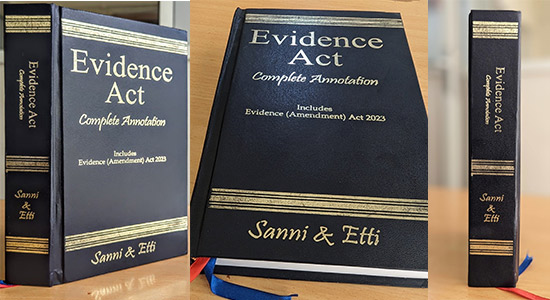
Available now for NGN 40,000 at ASC Publications, 10, Boyle Street, Onikan, Lagos. Beside High Court, TBS. Email publications@ayindesanni.com or WhatsApp +2347056667384. Purchase Link: https://paystack.com/buy/evidence-act-complete-annotation
______________________________________________________________________ “Enhance Legal Practice With Authoritative Reports” — Alexander Payne Offers Comprehensive Law Reports, Spanning Over A Century Of Nigerian Jurisprudence Interested buyers are encouraged to place their orders and enquiries via:
0704 444 4777, 0704 444 4999, 0818 199 9888
Website: www.alexandernigeria.com
“A Comprehensive Guide To Evidence Law” — Releases Second Edition In Three Volumes, Covering 4,051 Cases
For enquiries and orders, contact: 08035526491 Email: jerryamadisilk@gmail.com
 Prof. Jerry Amadi’s Evidence Law, Second Edition (2026), contains 3,314 pages in three volumes, covering the Evidence Act 2011, its 2023 amendment, and 4,051 Nigerian and English cases.