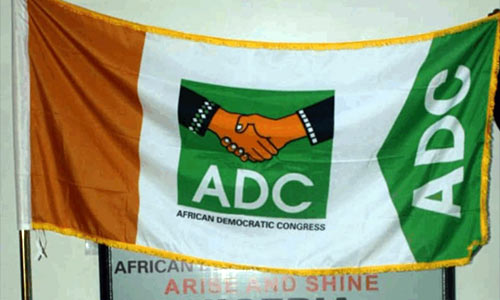
The African Democratic Congress and the Accord Party have vigorously opposed an attempt by the Incorporated Trustees of the National Forum of Former Legislators to amend their originating summons in a Federal High Court suit seeking the deregistration of four political parties — the ADC, Accord Party, Zenith Labour Party, and Action Alliance — for alleged breaches of Section 225 of the 1999 Constitution.

Justice Peter Lifu of the Federal High Court, Abuja, adjourned to April 17, 2026, to deliver a ruling on whether to grant the amendment application, after hearing arguments from all parties at the resumed hearing on Tuesday.
The suit, marked FHC/ABJ/CS/2637/25, has attracted significant attention given its potential to reshape Nigeria’s political landscape ahead of the 2027 general elections — particularly as the ADC has emerged as the primary opposition platform following the defection of nine senators, former Vice President Atiku Abubakar, former Labour Party presidential candidate Peter Obi, and former APC chieftain Rotimi Amaechi.
The former legislators are seeking court orders compelling the Independent National Electoral Commission to deregister political parties that allegedly failed to meet constitutional requirements, including securing at least 25 per cent of votes in any state during presidential elections or winning elective seats at specified levels.
They also seek injunctions restraining INEC from recognising the political activities of the affected parties ahead of the 2027 elections.
The forum argued that allowing such parties to participate in the 2027 polls would overcrowd ballot papers, waste public resources, and undermine electoral integrity.
The suit was instituted against INEC, the Attorney-General of the Federation, and the affected political parties as defendants.
At Tuesday’s hearing, counsel for the former legislators, Yakubu Ruba SAN, urged the court to grant leave to amend the originating summons to formally include additional political parties allegedly in breach of Section 225 of the Constitution.
Ruba argued that bringing the affected parties properly before the court was necessary for any eventual judgment to be enforceable against them. He specifically urged the court to invoke Order 7 Rule 6 of the Federal High Court Civil Procedure Rules in the interest of justice.
The ADC mounted a forceful opposition through its counsel, Shuaibu Eneojo Aruwa SAN, who described the amendment application as incompetent, invalid, and liable to dismissal.
Aruwa drew the court’s attention to what he described as a fundamental inconsistency in the identity of the plaintiff. He pointed out that the initial originating summons filed on December 8, 2025, was in the name “National Forum of Former Legislators,” while a subsequent one filed on January 12, 2026, was in the name “Incorporated Trustees of National Forum of Former Legislators.”
The senior lawyer argued that these were two different legal entities and that the law requires consistency in the identity of parties to a suit.
“The persons who filed the first Originating Summons of December 8, 2025, are quite different from those who filed the second one of January 12, 2026, which they sought to be amended,” Aruwa submitted.
He urged the court to hold that the second originating summons was invalid on this ground alone.
Aruwa further argued that the plaintiffs breached court rules by unilaterally joining additional defendants in the second originating summons without first obtaining the court’s leave, contrary to Order 9 Rule 15 of the Federal High Court rules.
He also submitted that the application ran foul of Section 122 of the Evidence Act and urged the court to take judicial notice of its own records showing the discrepancy in the plaintiff’s name.
The ADC counsel urged the court to dismiss the application with substantial costs.
Counsel for the Accord Party, Musibau Adetunbi SAN — the same Senior Advocate who was involved in the courtroom confrontation with Sowore at the Federal High Court earlier on Tuesday — also faulted the amendment request.
Adetunbi argued that the defect in the plaintiff’s identity was so fundamental that it was incurable, rendering the amendment application liable to dismissal. He urged the court to dismiss the application.
The case raises several important procedural and substantive legal questions.
On the procedural side, the court must determine whether the discrepancy between “National Forum of Former Legislators” and “Incorporated Trustees of National Forum of Former Legislators” is a fundamental defect that invalidates the proceedings, or a mere irregularity that can be cured through amendment.
The court must also decide whether the plaintiffs violated court rules by joining additional defendants without first obtaining leave, and if so, whether the violation is fatal to the application.
On the substantive side, if the amendment is granted and the case proceeds to hearing, the court will need to determine whether the targeted parties have indeed failed to meet the constitutional thresholds set out in Section 225 — and whether INEC is obligated to deregister them as a consequence.
The timing of the suit is politically significant. With the ADC rapidly emerging as the primary opposition vehicle and attracting major political figures ahead of 2027, a successful deregistration would be catastrophic for the opposition’s electoral prospects.
The ADC has registered 652,143 new members as of March 11, 2026, attracted three presidential aspirants in Atiku, Obi, and Amaechi, and received the defection of nine senators — developments that would all be rendered meaningless if the party were deregistered.
Critics of the suit have suggested it may be politically motivated, aimed at weakening the opposition ahead of the 2027 elections by removing key parties from the political landscape. Supporters of the suit argue it is a legitimate effort to enforce constitutional provisions that exist for good reason.
Justice Lifu’s ruling on April 17 will be critical. If the amendment is granted, the case will proceed to substantive hearing. If refused, the suit may collapse on procedural grounds, though the plaintiffs could potentially refile with the correct party name and proper joinder.
The ruling will also signal how the court views the substantive merits of the deregistration argument — providing early indications of whether the suit has any prospect of success on its legal merits.
 ARTIFICIAL INTELLIGENCE FOR LAWYERS: A COMPREHENSIVE GUIDE
Reimagine your practice with the power of AI “...this is the only Nigerian book I know of on the topic.” — Ohio Books Ltd
Authored by Ben Ijeoma Adigwe, Esq., ACIArb (UK), LL.M, Dip. in Artificial Intelligence, Director, Delta State Ministry of Justice, Asaba, Nigeria.
Bonus:
Get a FREE eBook titled “How to Use the AI in Legalpedia and Law Pavilion” with every purchase.
ARTIFICIAL INTELLIGENCE FOR LAWYERS: A COMPREHENSIVE GUIDE
Reimagine your practice with the power of AI “...this is the only Nigerian book I know of on the topic.” — Ohio Books Ltd
Authored by Ben Ijeoma Adigwe, Esq., ACIArb (UK), LL.M, Dip. in Artificial Intelligence, Director, Delta State Ministry of Justice, Asaba, Nigeria.
Bonus:
Get a FREE eBook titled “How to Use the AI in Legalpedia and Law Pavilion” with every purchase.
How to Order: 📞 Call, Text, or WhatsApp: 08034917063 | 07055285878 📧 Email: benadigwe1@gmail.com 🌐 Website: www.benadigwe.com
Ebook Version: Access directly online at: https://selar.com/prv626
________________________________________________________________________ The Law And Practice Of Redundancy In Nigeria: A Practitioner’s Guide, Authored By A Labour & Employment Law Expert Bimbo Atilola _______________________________________________________________________
[A MUST HAVE] Evidence Act Demystified With Recent And Contemporary Cases And Materials
_______________________________________________________________________
[A MUST HAVE] Evidence Act Demystified With Recent And Contemporary Cases And Materials