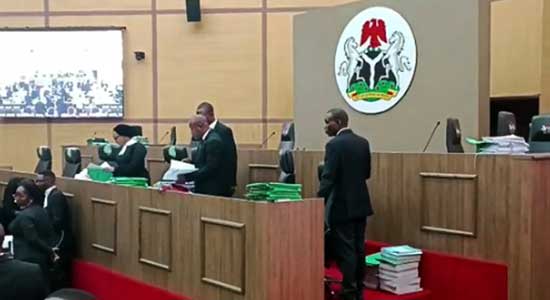
The controversy over the naira redesign policy of the federal government would finally be rested on March 3, when the apex court is expected to deliver judgment in the matter.

A seven-man panel of the apex court presided by Justice John Okoro announced the date for judgment shortly after taking all arguments for and against the policy.
Three states of Kaduna, Kogi and Zamfara had initially sued the federal government over the implementation of the naira policy over the hardship they claimed the policy has brought upon the country.
In addition, they had obtained an interim order of the apex court restraining the federal government from banning the use of the old N200, N500 and N1000 banknotes pending the hearing and determination of their interlocutory applications.
Justice John Okoro who had issued the interim order on February 8, subsequently fixed February 15, for hearing of the interlocutory applications.
However, when the matter came up on February 15, nine other states applied to be joined as interested parties.
The States were Lagos, Katsina, Cross River, Ogun, Ekiti, Ondo, Sokoto, Bayelsa and Edo, although Bayelsa and Edo had sought to be joined as co-defendants alongside the federal government.
Due to the new entrants, hearing could not go on as scheduled and hearing was again adjourned till Wednesday February 22 and President Buhari had held a nationwide broadcast and directed that only the N200 should remain as legal tender till April 10.
At the resumed hearing yesterday, six other states also brought their suits seeking for consolidation with the earlier suit.
The new states included Rivers, Kano, Jigawa, Niger, Nasarawa and Abia, who joined the earlier 10 plaintiffs in asking the apex court to declare as unconstitutional, null and void the cashless policy of the federal government.
AbdulHakeem Mustapha, who argued the case for Kaduna and Kogi, urged the apex court not to hear the case of the federal government due to the contempt proceedings against the first respondent.
On his part, Chief Abiodun Owonikoko, who argued that of Zamfara urged the apex court to set aside the directive of Buhari wherein the president during a media broadcast reiterated the ban on N500 and N1,000 banknotes.
The plaintiffs had argued that the action of the president was in disregard to the interim order of the apex court, coming a day (February 16) after the apex court adjourned for hearing of the matter.
It was their argument that the president’s directive coming when the apex court interim order still subsists leaves Nigerians in a dilemma as to which order to obey.
However, besides Lagos and the new six states, who came up with new suits against the federal government, the other remaining states adopted and aligned themselves with the main suit.
Counsel to Lagos State, Mr. Moyosore Onigbanjo, who noted that his suit bordered on the impact of the policy on governance in the state, also argued that the federal government should not be given audience at all until it complies with the February 8 order of the apex court restraining it from banning the old naira notes from February 10, 2023.
However, in vehement opposition to the plaintiffs’ suit, counsel to the federal government, Chief Kanu Agabi, urged the apex court to dismiss the case on the grounds that it lacked jurisdiction to entertain the matter in the first instance.
According to Agabi the proper place for the plaintiffs to ventilate their grievances was the Federal High Court that is clothed with the necessary jurisdiction.
He said, “if the court holds that all the reliefs of the plaintiff are rooted in Section 20 (3) of the CBN’s Act, then the process cannot be commenced at the Supreme Court at all”.
“They are crying in the wrong place,” the senior lawyer added.
Agabi while further faulting the case of the plaintiffs observed reference was made 32 times about the CBN by the plaintiffs in their originating summons but the plaintiffs did not seem it necessary to bring the CBN before the court.
On Buhari’s directive, Agabi stated that long before the order of February 8 was made, Nigerians were already rejecting the old notes, adding that the president’s directive was to forestall a breakdown of law and order because the president only asked the people to take the old notes to the CBN for deposit.
Similarly, Agabi submitted that the constitution empowers the president to provide basic infrastructure and policies to enhance the welfare and living conditions of the people and the directive was in line with his constitutional powers.
He therefore urged the apex court to dismiss the suits of the 16 states on the grounds of absence of jurisdiction or for being incompetent and lacking in merit.
After listening to all arguments canvassed by parties in the suits, Justice John Okoro announced that judgment in all the suits would be delivered on Friday March 3, 2023.
[A MUST HAVE] Evidence Act Demystified With Recent And Contemporary Cases And Materials

Available now for NGN 40,000 at ASC Publications, 10, Boyle Street, Onikan, Lagos. Beside High Court, TBS. Email publications@ayindesanni.com or WhatsApp +2347056667384. Purchase Link: https://paystack.com/buy/evidence-act-complete-annotation
______________________________________________________________________ “Enhance Legal Practice With Authoritative Reports” — Alexander Payne Offers Comprehensive Law Reports, Spanning Over A Century Of Nigerian Jurisprudence Interested buyers are encouraged to place their orders and enquiries via:
0704 444 4777, 0704 444 4999, 0818 199 9888
Website: www.alexandernigeria.com
Interested buyers are encouraged to place their orders and enquiries via:
0704 444 4777, 0704 444 4999, 0818 199 9888
Website: www.alexandernigeria.com