A lawyer, Ejime Okolie, has dragged the Independent National Electoral Commission (INEC) and 19 political parties before the Federal High Court, Abuja, over imposition of outrageous expression of interest and nomination fees.

In the suit marked: FHC/ABJ/CS/04/2026, Okolie, who filed the action for himself and on behalf of millions of Nigerian citizens desirous of participating in the electoral process, listed 19 political parties including the All Progressives Congress (APC), Peoples Democratic Party (PDP), African Democratic Congress (ADC), the Attorney General of the Federation and INEC respondents.
He is asking the court to direct INEC to issue binding guidelines that will regulate reasonable maximum thresholds for the fees.
He also sought an order restraining the parties from fixing or enforcing any expression of interest (EOI) or nomination fees for the primaries of 2027 general elections that have the effect of excluding qualified Nigerian citizens from contesting in the polls.
Besides, he sought an order that the reliefs granted herein shall operate prospectively, for the protection of constitutional rights ahead of the elections.
The legal practitioner urged the court to declare that the fixation, imposition and enforcement of exorbitant fees for nomination forms by the parties prior to 2023 general elections, as a condition to contest in the primaries, excluded many qualified Nigerian citizens, including himself, from the contest.
Okolie said the act violated his fundamental rights to freedom of association guaranteed under Section 40 of the 1999 Constitution (as amended).
He, therefore, urged the court to declare that the imposition of financial barriers which disproportionately exclude ordinary Nigerian citizens from political participation amounts to discrimination contrary to Section 42 of the constitution.
In his eleven grounds of argument, the plaintiff claimed that the suit is brought in the public interest to protect the constitutional rights of Nigerians to political participation.
He said his net income for the year 2025 was less than N2, 400,000.00 (two million, four hundred thousand naira) and that many professionals and youth earn even less.
He said that before the primaries for the 2023 general elections, political parties fixed non-refundable EOI and nomination fees ranging from millions to tens of millions of naira.
Citing instances, Okolie said the APC fixed its presidential form at N100 million, governorship at N50 million, Senate, N20 million; House of Representatives, N10 million, and state’s assembly, N2 million, per aspirant.
He said the PDP fixed its presidential EOI at N5 million and nomination form at N35 million; governorship at N1 million and nomination form, N20 million; Senate at N500,000 and nomination form, N3 million; House of Representatives at 500,000 and nomination form, N2 million, while state’s assembly was at N100,000 and nomination form, N50Q, 000, respectively.
He said other parties like All Progressives Grand Alliance (APGA), Social Democratic Party (SDP) and others also had fees ranging in millions of naira for EOI and nomination.
According to him, these fees have no statutory backing from INEC which regulates elections and sets campaign finance limits through the Electoral Act, 2022.
He argued that Sections 65, 106, 131 and 177 of the constitution prescribe qualifications for elective offices and do not include financial capacity.
He further argued that political parties are created and regulated under Sections 222 to 229 of the constitution and cannot operate outside constitutional limits.
Although none of the political parties had filed their defence, INEC, in its preliminary objection filed on January 28, urged the court to dismiss the suit.
According to the commission, this honourable court lacks jurisdiction to hear and determine this suit as presently constituted and the same should be dismissed ‘in limine.’
INEC’s lead counsel, Sulayman Ibrahim, SAN, argued that Okolie lacked the locus standi (legal right) to institute the suit.
The lawyer argued that the subject matter of the suit which is regulation of the sale of EOI forms and nomination fees are internal affairs of the political parties and a no-go area for the courts.
“This honourable court lacks the requisite jurisdiction to hear and determine this suit,” he submitted.
But Okolie, while responding to INEC’s argument on points of law, stated that the objection is misconceived, constitutionally narrow and seeks to resurrect doctrines that had been consistently rejected in public interest and fundamental rights litigation.
On whether he lacks locus standi in a fundamental rights enforcement action, the lawyer said INEC’s position is legally obsolete.
According to him, locus standi is deliberately relaxed under the fundamental Rights (Enforcement Procedure) Rules 2009.
“The Preamble, Paragraph 3(e)of the Fundamental Right (Enforcement Procedure) Rules mandates courts to ‘Encourage and welcome public interest litigation in the enforcement of fundamental rights,” he argued.
He said the provision constitutionally overrides the restrictive approach urged by the commission.
On whether the fixing of exorbitant EOI and nomination fees is an internal affair of political parties, Okolie argued that internal affairs doctrine is not absolute.
According to him, while political parties enjoy internal autonomy, such autonomy ends where constitutional rights begin, citing a previous case by the Supreme Court.
On whether the court lacks the jurisdiction to hear the suit, the lawyer argued that jurisdiction is triggered by the claim, and not the defence.
He described INEC’s objection as technically driven, substantively hollow and inconsistent with modern constitutional jurisprudence, urging the court to dismiss the objection and hear his substantive fundamental rights application on the merits.
Meanwhile Justice Binta Nyako has fixed February 12 for hearing

 ARTIFICIAL INTELLIGENCE FOR LAWYERS: A COMPREHENSIVE GUIDE
Reimagine your practice with the power of AI “...this is the only Nigerian book I know of on the topic.” — Ohio Books Ltd
Authored by Ben Ijeoma Adigwe, Esq., ACIArb (UK), LL.M, Dip. in Artificial Intelligence, Director, Delta State Ministry of Justice, Asaba, Nigeria.
Bonus:
Get a FREE eBook titled “How to Use the AI in Legalpedia and Law Pavilion” with every purchase.
ARTIFICIAL INTELLIGENCE FOR LAWYERS: A COMPREHENSIVE GUIDE
Reimagine your practice with the power of AI “...this is the only Nigerian book I know of on the topic.” — Ohio Books Ltd
Authored by Ben Ijeoma Adigwe, Esq., ACIArb (UK), LL.M, Dip. in Artificial Intelligence, Director, Delta State Ministry of Justice, Asaba, Nigeria.
Bonus:
Get a FREE eBook titled “How to Use the AI in Legalpedia and Law Pavilion” with every purchase.
How to Order: 📞 Call, Text, or WhatsApp: 08034917063 | 07055285878 📧 Email: benadigwe1@gmail.com 🌐 Website: www.benadigwe.com
Ebook Version: Access directly online at: https://selar.com/prv626
________________________________________________________________________ The Law And Practice Of Redundancy In Nigeria: A Practitioner’s Guide, Authored By A Labour & Employment Law Expert Bimbo Atilola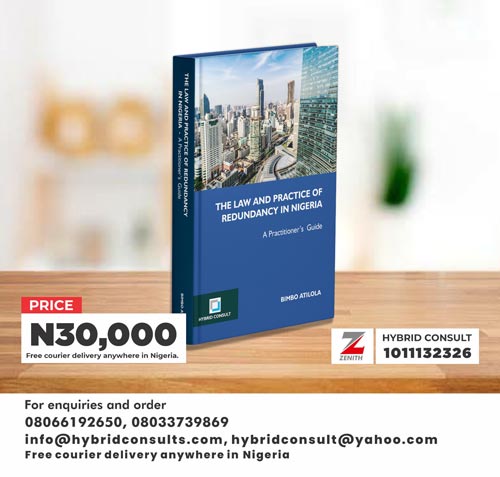 _______________________________________________________________________
"You Don't Need To Be Rich, You Just Need To Start" — Victoria Ezeigwe, Esq Launches Investment Handbook For Nigerians Starting With ₦5,000
_______________________________________________________________________
"You Don't Need To Be Rich, You Just Need To Start" — Victoria Ezeigwe, Esq Launches Investment Handbook For Nigerians Starting With ₦5,000

Get your copy today and take the first step toward financial growth:👉 https://selar.co/4f16676016
_______________________________________________________________________