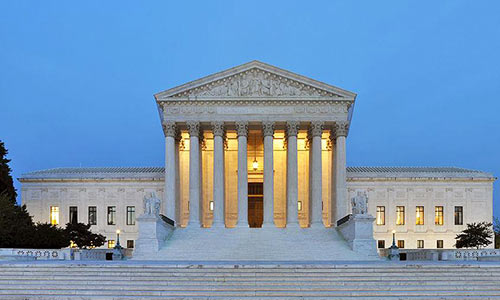
Tackling one of President Donald Trump’s most provocative policies, members of the Supreme Court expressed skepticism Wednesday about the lawfulness of his proposal to limit the constitutional guarantee of birthright citizenship for people born on U.S. soil.

Announced on the first day of Trump’s second term in office as part of his hard-line immigration policy, the executive order at issue would limit birthright citizenship to people who have at least one parent who is a U.S. citizen or a permanent resident.
As a result, babies born to temporary visitors who entered the country legally or to people who entered illegally would not be citizens at birth.
Trump attended the oral argument in person, a first for a sitting president, but left before it ended. “We are the only Country in the World STUPID enough to allow ‘Birthright’ Citizenship!” he wrote on Truth Social soon after.
Trump’s executive order upends the traditional understanding of a provision of the Constitution’s 14th Amendment known as the citizenship clause.
“All persons born or naturalized in the United States, and subject to the jurisdiction thereof, are citizens of the United States,” it states.
Amid discussion of how the issue of mass illegal immigration was not anticipated at the time the amendment became law, conservative Chief Justice John Roberts and others pushed back on the government’s new interpretation.
“It’s a new world. It’s the same Constitution,” Roberts told Solicitor General D. John Sauer, arguing on behalf of Trump.
The clause, ratified with the 14th Amendment after the Civil War to provide equal rights to formerly enslaved Black people, has long been assumed by officials at all levels of the government to apply to almost anyone born in the United States, regardless of the legal status of their parents.
The few exceptions understood at the time included children born to diplomats and foreign invaders.
Trump’s executive order was immediately blocked by courts around the country and has never been in effect.
Conservative Justice Neil Gorsuch, addressing Sauer’s reliance on citizenship’s being conditioned on someone’s being a long-term resident of the U.S., pointed out that at the time of the 14th Amendment’s ratification, that would not have turned on whether someone had entered the country legally.
“If somebody showed up here in 1868 and established domicile, that was perfectly fine,” he said. “And so why wouldn’t we, even if we were to apply your own test, come to the conclusion that the fact that someone might be illegal is immaterial?”
Justice Amy Coney Barrett, another conservative, also poked holes in Sauer’s approach, questioning how his assertion that the children of slaves brought to the U.S. unlawfully would be citizens under the 14th Amendment was consistent with the rest of his argument.
“How would that apply to the children of illegally trafficked people today?” she added.
Sauer, referring to the parents, said it would depend on whether “their presence is lawful,” not how they entered the country.
Liberal Justice Elena Kagan suggested Sauer was relying on “pretty obscure sources” to make his arguments.
“The text of the clause, I think, does not support you. I think you’re sort of looking for some more technical, esoteric meaning,” she added.
Even conservative Justice Clarence Thomas, often a reliable vote for Trump, asked Sauer to “be more specific” when he raised the question of how the 14th Amendment was intended to repudiate the notorious 1857 Dred Scott ruling, which said Black slaves were not citizens.
Conservative Justice Samuel Alito emerged as the most sympathetic to Trump, who sat silently in a section of the courtroom reserved for government officials.
Alito suggested it would be reasonable to apply the “subject to the jurisdiction thereof” language to new situations not contemplated at the time it was written.
“What we’re dealing with here is something that was basically unknown at the time when the 14th Amendment was adopted, which is illegal immigration,” he said.
Most legal experts predicted ahead of the argument that Trump would face an uphill battle to win the case, but Cecillia Wang, the American Civil Liberties Union attorney leading the challenge to the executive order, also faced tough questions. Wang is herself the daughter of immigrants and would not have had citizenship at birth had Trump’s interpretation of the law been in effect then.
Several justices pressed Wang about her reliance on the 1898 Supreme Court ruling United States v. Wong Kim Ark, which concluded that a man born in San Francisco to parents who were both from China was a U.S. citizen.
Sauer argued that the case refers only to people “domiciled” in the U.S., which he interpreted as those with permanent residency. Wang, in contrast, argued that the Ark ruling affirmed the broad principle of birthright citizenship and would need to be overturned for her to lose.
Roberts noted that the Ark ruling includes multiple references to the word “domicile,” suggesting that might buttress Sauer’s argument.
“Isn’t it at least something to be concerned about to say that, since it’s discussed 20 different times and has that significant role in the opinion, that you can just dismiss it as irrelevant?” he asked.
Wang responded in part that the word was used because, in Ark’s specific case, his parents were long-term residents of the U.S.
Trump’s executive order, if it were implemented, would affect thousands of babies born every year across the U.S.
One woman, who asked not to be identified to protect her family, was heavily pregnant last year when she heard about the executive order. Originally from Argentina, she now lives in Florida on a student visa and was immediately alarmed about what legal status her child would have.
“My baby was actually going to be one of the first ones impacted. I immediately went into panic mode,” she said in an interview.
Determined to make sure her now-8-month-old son’s citizenship was secured, she started making arrangements to apply for a passport for him before he was even born.
Although her son now has his passport, she said she is deeply sympathetic to other families expecting babies who remain unsure what will happen.
“I know there’s probably a lot of different families and moms, pregnant moms, in my situation that are probably stressed,” she said.,
In addition to probing the language of the 14th Amendment, the justices also questioned whether the executive order falls afoul of a federal immigration law that uses similar language, including “subject to the jurisdiction thereof.” The court could rule that the executive order is unlawful under that law without having to decide the 14th Amendment question and put the onus on Congress to act.
The Supreme Court has a 6-3 conservative majority, which repeatedly ruled in Trump’s favor last year. But the court handed him a major defeat in February when it ruled that his broad use of tariffs was unlawful.
Trump responded to that ruling with harsh criticism of the justices who voted against him in the 6-3 decision, calling them “disloyal to the Constitution.”
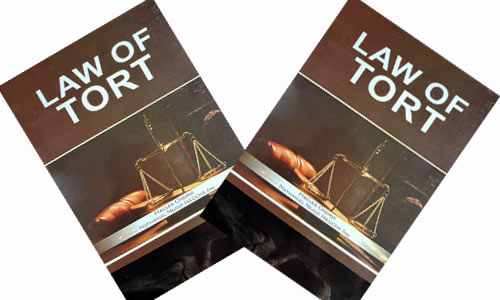 The book, titled The Law of Torts in Nigeria: A Functional Approach, authored by Professor Hagler Sunny Okorie Ph.D and Ikeocha, Nathaniel Ngozi Esq, offers law students, practitioners, and academics a comprehensive guide to understanding and applying tort law in Nigerian courts. Interested buyers can place orders via the following contact numbers: 08028636615, 08037667945, 08032253813, or +234 902 196 2209.
_______________________________________________________________________
The book, titled The Law of Torts in Nigeria: A Functional Approach, authored by Professor Hagler Sunny Okorie Ph.D and Ikeocha, Nathaniel Ngozi Esq, offers law students, practitioners, and academics a comprehensive guide to understanding and applying tort law in Nigerian courts. Interested buyers can place orders via the following contact numbers: 08028636615, 08037667945, 08032253813, or +234 902 196 2209.
_______________________________________________________________________
 ARTIFICIAL INTELLIGENCE FOR LAWYERS: A COMPREHENSIVE GUIDE
Reimagine your practice with the power of AI “...this is the only Nigerian book I know of on the topic.” — Ohio Books Ltd
Authored by Ben Ijeoma Adigwe, Esq., ACIArb (UK), LL.M, Dip. in Artificial Intelligence, Director, Delta State Ministry of Justice, Asaba, Nigeria.
Bonus:
Get a FREE eBook titled “How to Use the AI in Legalpedia and Law Pavilion” with every purchase.
ARTIFICIAL INTELLIGENCE FOR LAWYERS: A COMPREHENSIVE GUIDE
Reimagine your practice with the power of AI “...this is the only Nigerian book I know of on the topic.” — Ohio Books Ltd
Authored by Ben Ijeoma Adigwe, Esq., ACIArb (UK), LL.M, Dip. in Artificial Intelligence, Director, Delta State Ministry of Justice, Asaba, Nigeria.
Bonus:
Get a FREE eBook titled “How to Use the AI in Legalpedia and Law Pavilion” with every purchase.
How to Order: 📞 Call, Text, or WhatsApp: 08034917063 | 07055285878 📧 Email: benadigwe1@gmail.com 🌐 Website: www.benadigwe.com
Ebook Version: Access directly online at: https://selar.com/prv626
________________________________________________________________________ The Law And Practice Of Redundancy In Nigeria: A Practitioner’s Guide, Authored By A Labour & Employment Law Expert Bimbo Atilola _______________________________________________________________________
[A MUST HAVE] Evidence Act Demystified With Recent And Contemporary Cases And Materials
_______________________________________________________________________
[A MUST HAVE] Evidence Act Demystified With Recent And Contemporary Cases And Materials