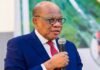
The President of the Dangote Group, Alhaji Aliko Dangote, has hinged Nigeria’s industrialisation challenges on unstable electricity.

Dangote said running a business abroad is 30 per cent cheaper than running the same business in Nigeria and other African countries due to stable electricity supply in developed countries.
Africa’s richest man stated this recently while hosting the Zambian Minister of Energy, Makozo Chikote, at the Dangote refinery in Lekki, Lagos State.
He said the group’s most profitable cement factory is the one in Ethiopia because of its stable power supply.
According to him, he had carried out research before going into industrialisation to ascertain why others who attempted it failed in the past, including his grandfather.
He disclosed finding out that one of the challenges is a lack of electricity.
He explained, “If there’s no power, there won’t be growth. For example, anything I’m going to do abroad will cost me maybe 30 per cent cheaper than here, because abroad is plug-and-play. You just go, no infrastructure construction. You just build a factory, and you connect to the network; that’s all.
“That’s why, if you look at it today, I tell you that our most profitable cement factory is in Ethiopia because there’s no investment in power. They gave us power at the same rate for five years. So, we plan, it’s a one-price electricity continuously.”
In Nigeria, Dangote said the group had to invest a lot in generating electricity for the refinery and other factories, saying this does not happen in developed nations.
Aside from electricity, Dangote also blamed inconsistent government policies for Nigeria’s failure to industrialise.
“One of the problems of industrialisation is inconsistencies in government policies, where, just like a footballer, you’re about to score the goal, and the government will remove the goalpost and point behind you that the goalpost is behind. So, you have to now turn. Once you turn back, you have a lot of challenges to get to that goalpost again,” he stated.
The businessman noted that the best way to reduce the inconsistencies is to explain to the government that when industrialisation happens, the government is a major shareholder, especially with the collection of taxes.
“For example, in our cement, every N1 we turn around, 52 kobo go to the government in various taxes—30 per cent corporate tax, 7.5 per value-added tax, two per cent for education, and one per cent,for health. When money is being made in the company, if you want to take the money, all the shareholders will have to pay the government 10 per cent as withholding tax again. This is for the Federal Government. When you add the state and the local government, everything now is something else,” he stressed.
Dangote maintained that if a business shuts down, one of the major losers is the government, stressing that industrialisation is key to national development.
[A MUST HAVE] Evidence Act Demystified With Recent And Contemporary Cases And Materials

Available now for NGN 40,000 at ASC Publications, 10, Boyle Street, Onikan, Lagos. Beside High Court, TBS. Email publications@ayindesanni.com or WhatsApp +2347056667384. Purchase Link: https://paystack.com/buy/evidence-act-complete-annotation
______________________________________________________________________ “Enhance Legal Practice With Authoritative Reports” — Alexander Payne Offers Comprehensive Law Reports, Spanning Over A Century Of Nigerian Jurisprudence Interested buyers are encouraged to place their orders and enquiries via:
0704 444 4777, 0704 444 4999, 0818 199 9888
Website: www.alexandernigeria.com
Interested buyers are encouraged to place their orders and enquiries via:
0704 444 4777, 0704 444 4999, 0818 199 9888
Website: www.alexandernigeria.com