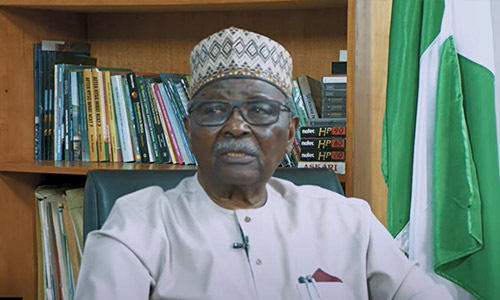
Former Nigerian Head of State General Yakubu Gowon has said he wishes to be remembered as a patriotic leader who deeply loved Nigeria and consistently prayed for its unity and progress.

Speaking in an interview with Arise Television, the 90-year-old elder statesman reflected on his years in office from 1966 to 1975, particularly addressing the causes of the Nigerian Civil War, which broke out in July 1967 and lasted for 30 months.
Gowon revealed that efforts to prevent the conflict failed largely due to irreconcilable differences that surfaced during the January 1967 Aburi summit held in Ghana. He noted that Eastern Region leader, Chukwuemeka Odumegwu Ojukwu, demanded a form of autonomy that the federal government could not agree to.
“The Aburi meeting in Ghana could have prevented the war,” Gowon said. “But there was a fundamental disagreement between Ojukwu and the federal side. He wanted a type of regional autonomy that we just couldn’t accept.”
Further elaborating during the interview, Gowon stated that although both parties engaged in sincere dialogue during the summit, Ojukwu pushed for regional control over military commands, which was a red line for the federal government.
“Although we said that the military would be zoned, he wanted those zones to be commanded by the governor,” Gowon said. “Say you have a military zone in the north, it would be commanded by the governor there, and in the east, by him. And, of course, we did not agree with that.”
Gowon emphasized that the federal delegation did not view the Aburi meeting as a constitutional negotiation or a move toward military devolution.
“We just went there to meet as officers and resolve a problem at home. That was my understanding. But that was not his understanding.”
He also disclosed that upon returning to Nigeria, he fell ill and could not respond promptly to the version of the Aburi Accord that Ojukwu publicly announced. “I was having a serious attack of kind of fever… and I could not make a decision,” he said.
Gowon accused Ojukwu of making premature and unilateral pronouncements about the agreement. “Ojukwu was one who, when he came, he went and made a statement about the Aburi Accord,” he noted.
To clarify matters, Gowon said a follow-up meeting was convened in Benin with all regional governors invited to chart a path forward, but Ojukwu declined to attend. “We met at NIFO in Benin. And he did not turn up,” Gowon said, expressing regret that the absence thwarted a potential resolution.
He insisted that the federal government was willing to work in the “spirit of Aburi” but could never concede control of the armed forces to regional governors or accept any talk of secession.
“The only thing that I added was that no region can secede from the country,” Gowon said.
He also pushed back on widely reported casualty figures from the war, claiming that deaths on the Igbo side were “not in millions.” While the war was poorly documented, historians estimate that at least three million people, mainly Igbos, were killed—many through starvation and indiscriminate violence.
Despite repeated denials of ethnic targeting, numerous documented incidents, including massacres in Asaba, Onitsha, and other southeastern towns, have shaped the prevailing narrative of the war.
Gowon defended his leadership during the war, saying it was never intended to be a fight against the Igbos but a bid to preserve the nation.
“I had a responsibility and duty as a loyal Nigerian to keep the country whole. From the beginning, I ensured that this was not a war against Igbos as such, but one to stop the breaking up of Nigeria,” he said.
He added, “I gave a code of conduct of how the operations were to go. Soldiers on the Nigerian side were to protect the people, especially women and children, and take up arms only against those who had taken arms against them.”
He also claimed that the Biafran leadership blocked all efforts to deliver humanitarian aid. “The other side refused all attempts to send aid into their camp,” he stated.
Earlier this month, Gowon described the civil war period as the most difficult of his life. The war ended in January 1970 with his famous declaration of “no victor, no vanquished” aimed at promoting reconciliation—a goal many argue remains largely unfulfilled.
[A MUST HAVE] Evidence Act Demystified With Recent And Contemporary Cases And Materials

Available now for NGN 40,000 at ASC Publications, 10, Boyle Street, Onikan, Lagos. Beside High Court, TBS. Email publications@ayindesanni.com or WhatsApp +2347056667384. Purchase Link: https://paystack.com/buy/evidence-act-complete-annotation
______________________________________________________________________ “Enhance Legal Practice With Authoritative Reports” — Alexander Payne Offers Comprehensive Law Reports, Spanning Over A Century Of Nigerian Jurisprudence Interested buyers are encouraged to place their orders and enquiries via:
0704 444 4777, 0704 444 4999, 0818 199 9888
Website: www.alexandernigeria.com
Interested buyers are encouraged to place their orders and enquiries via:
0704 444 4777, 0704 444 4999, 0818 199 9888
Website: www.alexandernigeria.com