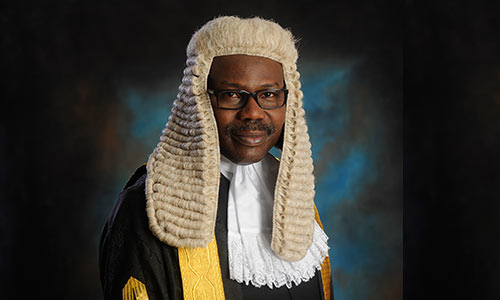
By Muiz Banire, SAN

In my last intervention, I interrogated the challenges confronting dispensation of justice in Nigeria, particularly the disturbing gap between judgments delivered and justice perceived. Today, I take the conversation a step further, perhaps into a more uncomfortable territory, by examining the role of legal practitioners themselves in the steady erosion of the justice system. If the court is the temple of justice, then lawyers are its ministers; and when ministers abandon their sacred calling, the temple itself becomes desecrated. It is a settled principle, both in legal philosophy and professional ethics, that a lawyer is not merely an advocate for his client but a custodian of justice.
This dual responsibility is what distinguishes the legal profession from mere commercial enterprise. It is for this reason that the Rules of Professional Conduct were not fashioned as ornamental guidelines but as a binding ethical compass meant to regulate conduct, preserve dignity, and ensure that the administration of justice remains untainted. Regrettably, what we witness today suggests that these rules, though elaborate on paper, have become increasingly impotent in practice. The first, and perhaps most disturbing manifestation of this decline is the growing complicity of lawyers in acts of corruption within the judiciary. Much has been said about judicial corruption, and rightly so, for judges occupy a sacred pedestal. Although the truth remains that a substantial number of our judges are free of this vice, it would be both dishonest and self-deceptive to isolate even the few judges involved in this nefarious act as the sole culprits.
The uncomfortable truth is that, in many instances, some lawyers are the architects, facilitators, and couriers of these corrupt practices. Lawyers, in many cases, are the unseen hands that initiate and sustain this corrosive chain. Even in situations where judges deliver questionable or “curious” orders, a closer interrogation often reveals that such outcomes are rooted in processes crafted and presented by lawyers themselves. It is equally lawyers who, in such instances, make the dangerous submissions culminating in those judicial conclusions. The court, after all, is largely reactive; it acts on the materials placed before it.
When those materials are tainted, whether through misrepresentation, suppression of facts, or outright falsification, the integrity of the judicial outcome is already compromised ab initio. It is therefore intellectually lazy to heap all blame on the bench while ignoring the pivotal role of the bar.
Closely related to this is the rampant abuse of court process by legal practitioners. The Nigerian judicial system today groans under the weight of frivolous suits, multiplicity of actions, and interlocutory applications designed not to advance the course of justice but to frustrate it. Lawyers file cases they know are untenable, pursue applications that lack merit, and deploy procedural technicalities as weapons of delay. Litigation, in many instances, has become less about the pursuit of justice and more about strategic obstruction. The courts are thus transformed into arenas of endless technical battles, while substantive justice remains perpetually out of reach. It is only at the level of the Supreme Court, particularly with the introduction of more stringent procedural rules, that we begin to see a semblance of deterrence against such abuses. Yet even this is insufficient to stem the tide at the lower courts, where the bulk of litigation occurs and ends in many cases. The consequence is a justice system that is not only slow but, more dangerously, susceptible to manipulation. Perhaps even more alarming is the increasing involvement of some lawyers in outright fraud and criminal conduct. What was once considered unthinkable within the profession is now becoming distressingly common.
Lawyers fabricate documents, falsify court processes, and deliberately mislead the courts. Imagine a factual situation in which a lawyer attaches a purported order of mareva injunction to a counter-affidavit and urges the court to rely on it, while in actual fact, the attached document evidences the refusal of the prayers sought in the said suit. The anecdote is simply that of a lawyer presenting a ruling of a court that clearly refused reliefs as though the court granted them. This is not an isolated incident but part of a broader pattern of ethical decay. That such an attempt nearly succeeded, but for the vigilance of opposing counsel, speaks volumes about how close the system often comes to being subverted. Similarly, the compromise of court registries to underpay filing fees represents another dimension of this malaise. It is not merely a case of individual dishonesty but a systemic breach involving both legal practitioners and court officials.
When officers of the court collude to defraud the very institution they are sworn to serve, the implications extend beyond financial loss; they strike at the very legitimacy of the judicial process. Equally troubling is the emerging trend of lawyers engaging in fraudulent commercial activities under the guise of legal practice. The example of a lawyer who, having sold non-existent land and refused to refund the purchase money, sought refuge under the canopy of fundamental human rights enforcement is both shocking and instructive. It illustrates a profound misunderstanding, or perhaps a willful distortion, of the law. Fundamental rights provisions are designed as shields against state oppression, not as swords for evading personal accountability. That a legal practitioner would attempt to weaponize such provisions for personal gain reflects a troubling erosion of both ethical judgment and professional identity. It is common knowledge that it is not only professional misconduct in such situations to engage in such dubious real estate practices, but outright criminality to swindle an innocent citizen. Notwithstanding the deprecation of this practice in some decisions of the Legal Practitioners Disciplinary Committee, the vice is still on the rise.
The sanction certainly needs to be stiffer than it is presently imposed by the Committee. This brings us to the question of enforcement and accountability. Why are erring lawyers not consistently referred to the Legal Practitioners Disciplinary Committee (LPDC)? Why does misconduct, even when glaring, often go unpunished? The answer lies partly in institutional weakness and partly in collective reluctance. There appears to be an unspoken culture of professional indulgence, where lawyers are hesitant to expose or sanction their own. In many instances, lawyers shy away from filing complaints against their erring and errant colleagues, while judges equally fail to refer such lawyers to the disciplinary committee.
The LPDC itself, while constitutionally empowered, appears overstretched and under-resourced. There is an urgent need to strengthen its capacity, both in terms of personnel and operational efficiency. Disciplinary processes must be swift, transparent, and consequential. Without credible sanctions, ethical rules become mere suggestions, and misconduct becomes normalized. Concomitant with the foregoing is the power of contempt exercisable by the court. Ordinarily, this ought to be another check on the excesses of lawyers and parties. Let me say, without equivocation, that most judges hardly exercise this power, particularly when contempt in the face of the court is committed.
This has further emboldened many lawyers to continue to misbehave. The truth is that it is not accidental that judges are referred to as “My Lords”; it is simply because they possess enormous judicial authority, historically described in terms of life and death over matters brought before them. It is regrettable that in some instances where this power is exercised, the bar association and some lawyers respond with a form of institutional infantilism. Even where a judge exercises the power wrongly, the victim is at liberty to appeal; grandstanding is certainly not an option. At times, it appears that where a lawyer exercises madness, the judge responds in equal measure, suggesting that nobody has monopoly of madness. We must recognize that judges too are human beings.
We must all, at all times, condemn misconduct and deprecate the misbehaviour of our colleagues if this profession must survive. Beyond disciplinary mechanisms, there is a more foundational issue, the quality of legal education in Nigeria. The unchecked proliferation of law faculties, many of which lack adequate infrastructure and qualified personnel, has significantly diluted the quality of entrants into the profession. The situation is further compounded by the emergence of unconventional modes of legal training that prioritize convenience over rigor. When legal training becomes a subject of correspondence, there is a crisis. When schools of agriculture, as well as technology, now produce lawyers, then the profession is imperilled. When the foundation is weak, the structure cannot be strong. This reality lends credence to the growing call for law to be studied as a second degree, ensuring that entrants into the profession possess a certain level of maturity and intellectual grounding. Until such reforms are implemented, there is an urgent need to regulate the number of law faculties and the intake of students. Quantity, in this context, is not a virtue but a liability. The argument often advanced, that Nigeria’s large population justifies a high number of lawyers, fails to withstand scrutiny when juxtaposed with the country’s economic realities. A legal profession that produces more practitioners than it can meaningfully absorb, creates fertile ground for desperation and, by extension, unethical conduct. It is no longer news that some of our colleagues are now Uber drivers, while others operate hair salons or engage in event decoration. While there is dignity in all honest labour, the misalignment between training and opportunity represents a systemic failure that must be addressed. The most tragic dimension of this crisis is its cyclical nature.
Today’s poorly trained and ethically compromised lawyers are tomorrow’s judges. Thus, the very individuals who contribute to the degradation of the system at the bar may eventually ascend to the bench, further entrenching the dysfunction. It is a vicious cycle that, if left unchecked, threatens the very survival of the justice system. The question, therefore, is both urgent and existential: who will save the legal profession? The answer lies not in external intervention but in internal reform. The bar must rediscover its moral compass. Senior members of the profession must lead by example, mentoring younger lawyers not only in legal skills but in ethical responsibility. Professional bodies must move beyond rhetoric to decisive action. If practicable, there may even be a need for designated officials to move around courts, with full institutional awareness, to monitor ethical compliance and report breaches to the disciplinary committee where necessary.
Judges must be more proactive in reporting misconduct. And perhaps most importantly, individual lawyers must recognize that their ultimate duty is not to their clients alone, but to the course of justice itself. In the final analysis, the restoration of integrity in the legal profession is not merely a professional imperative; it is a national necessity. For without a credible justice system, the very fabric of society unravels. As we reflect on these issues, let us remember that there is a progressive loss of confidence in our profession, thus necessitating recourse to alternatives such as brute force and increasing reliance on security agencies. In not too long a distance, we will not only have no jobs to do again, we would have lost the profession itself. Something, indeed, must give way, and that something must be our collective intolerance for misconduct within the legal profession. Only then can we begin the arduous but necessary journey of reclaiming the soul of justice in Nigeria.
 _______________________________________________________________________
[A MUST HAVE] Evidence Act Demystified With Recent And Contemporary Cases And Materials

Available now for NGN 40,000 at ASC Publications, 10, Boyle Street, Onikan, Lagos. Beside High Court, TBS. Email publications@ayindesanni.com or WhatsApp +2347056667384. Purchase Link: https://paystack.com/buy/evidence-act-complete-annotation
______________________________________________________________________ ARTIFICIAL INTELLIGENCE FOR LAWYERS: A COMPREHENSIVE GUIDE
Reimagine your practice with the power of AI “...this is the only Nigerian book I know of on the topic.” — Ohio Books Ltd
Authored by Ben Ijeoma Adigwe, Esq., ACIArb (UK), LL.M, Dip. in Artificial Intelligence, Director, Delta State Ministry of Justice, Asaba, Nigeria.
Bonus:
Get a FREE eBook titled “How to Use the AI in Legalpedia and Law Pavilion” with every purchase.
ARTIFICIAL INTELLIGENCE FOR LAWYERS: A COMPREHENSIVE GUIDE
Reimagine your practice with the power of AI “...this is the only Nigerian book I know of on the topic.” — Ohio Books Ltd
Authored by Ben Ijeoma Adigwe, Esq., ACIArb (UK), LL.M, Dip. in Artificial Intelligence, Director, Delta State Ministry of Justice, Asaba, Nigeria.
Bonus:
Get a FREE eBook titled “How to Use the AI in Legalpedia and Law Pavilion” with every purchase.
How to Order: 📞 Call, Text, or WhatsApp: 08034917063 | 07055285878 📧 Email: benadigwe1@gmail.com 🌐 Website: www.benadigwe.com
Ebook Version: Access directly online at: https://selar.com/prv626
______________________________________________________________________ “Bridging Theory And Courtroom Practice” — Hagler Sunny Okorie, Nathaniel Ngozi Ikeocha Unveil ‘Functional’ Tort Law Book For Nigerian Legal System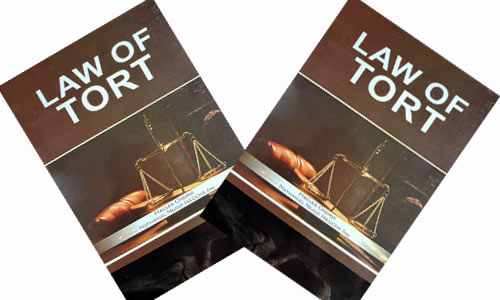 The book, titled The Law of Torts in Nigeria: A Functional Approach, authored by Professor Hagler Sunny Okorie Ph.D and Ikeocha, Nathaniel Ngozi Esq, offers law students, practitioners, and academics a comprehensive guide to understanding and applying tort law in Nigerian courts. Interested buyers can place orders via the following contact numbers: 08028636615, 08037667945, 08032253813, or +234 902 196 2209.
______________________________________________________________________
“Enhance Legal Practice With Authoritative Reports” — Alexander Payne Offers Comprehensive Law Reports, Spanning Over A Century Of Nigerian Jurisprudence
The book, titled The Law of Torts in Nigeria: A Functional Approach, authored by Professor Hagler Sunny Okorie Ph.D and Ikeocha, Nathaniel Ngozi Esq, offers law students, practitioners, and academics a comprehensive guide to understanding and applying tort law in Nigerian courts. Interested buyers can place orders via the following contact numbers: 08028636615, 08037667945, 08032253813, or +234 902 196 2209.
______________________________________________________________________
“Enhance Legal Practice With Authoritative Reports” — Alexander Payne Offers Comprehensive Law Reports, Spanning Over A Century Of Nigerian Jurisprudence
 Interested buyers are encouraged to place their orders and enquiries via:
0704 444 4777, 0704 444 4999, 0818 199 9888
Website: www.alexandernigeria.com
Interested buyers are encouraged to place their orders and enquiries via:
0704 444 4777, 0704 444 4999, 0818 199 9888
Website: www.alexandernigeria.com