In a major blow to President Donald Trump, the United States Supreme Court on Friday ruled that he exceeded his authority when imposing sweeping tariffs using a law reserved for a national emergency.

The justices, divided 6-3, held that Trump’s aggressive approach to tariffs on products entering the United States from across the world was not permitted under a 1977 law called the International Emergency Economic Powers Act (IEEPA).
It is a rare setback for the administration at the Supreme Court, which has a 6-3 conservative majority, since Trump began his second term in January.
Justice Brett Kavanaugh, joined by Justices Clarence Thomas and Samuel Alito, dissented from the majority ruling.
The decision does not affect all of Trump’s tariffs, leaving in place ones he imposed on steel and aluminum using different laws, for example.
But it upends his tariffs in two categories:
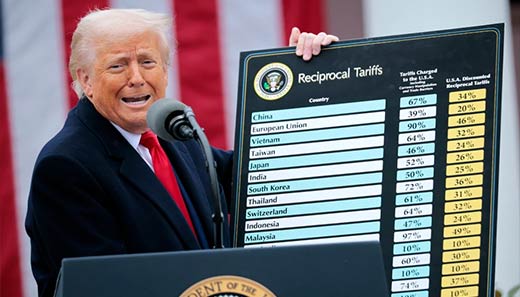
Reciprocal Tariffs: Country-by-country tariffs ranging from 34% for China to a 10% baseline for the rest of the world.
Drug-Related Tariffs: A 25% tariff Trump imposed on some goods from Canada, China and Mexico for what the administration said was their failure to curb the flow of fentanyl.
Trump could seek to reimpose the tariffs using other laws.
The Constitution states that the power to set tariffs is assigned to Congress. But Trump used IEEPA, which does not specifically mention tariffs but allows the president to “regulate” imports and exports when he deems there to be an emergency due to an “unusual and extraordinary threat” to the nation.
Before Trump, no president had ever used that law to tariff imports.
Lower courts ruled against the Trump administration in two related cases that were consolidated, with both sides asking the Supreme Court to issue a definitive ruling.
During arguments last year, Chief Justice John Roberts, one of the court’s conservatives, noted that “the imposition of taxes on Americans” has always “been the core power of Congress.”
“The statute doesn’t use the word tariff,” Roberts said.
Liberal Justice Elena Kagan told the administration’s lawyer: “It has a lot of actions that can be taken under this statute. It just doesn’t have the one you want.”
The high-stakes case put the spotlight on a court that was skeptical of President Joe Biden’s unilateral use of executive power, including his attempt to forgive billions of dollars in student loan debt.
The court blocked that proposal, citing what has been called the “major questions doctrine,” which holds that Congress must explicitly authorize policies that have a major nationwide impact.
Multiple businesses sued over the tariffs, including V.O.S. Selections Inc., a wine and spirits importer, Plastic Services and Products, a pipe and fittings company, and two companies that sell educational toys.
A coalition of states led by Oregon also sued.
As of the middle of December, IEEPA tariffs had raised about $130 billion, according to the latest data available from U.S. Customs and Border Protection.
Trump has touted much higher numbers, up to $3 trillion, taking into account trade deals his administration has negotiated.
Analysts say the ruling could save consumers billions and boost the global economy by removing the sweeping tariffs that had been imposed on trading partners worldwide.
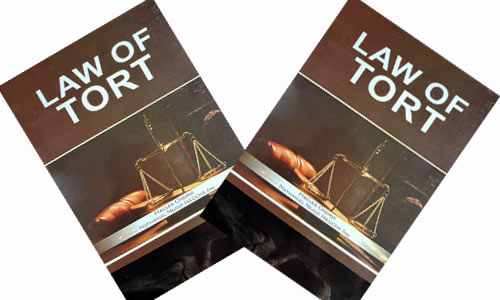 The book, titled The Law of Torts in Nigeria: A Functional Approach, authored by Professor Hagler Sunny Okorie Ph.D and Ikeocha, Nathaniel Ngozi Esq, offers law students, practitioners, and academics a comprehensive guide to understanding and applying tort law in Nigerian courts. Interested buyers can place orders via the following contact numbers: 08028636615, 08037667945, 08032253813, or +234 902 196 2209.
______________________________________________________________________
[A MUST HAVE] Evidence Act Demystified With Recent And Contemporary Cases And Materials
The book, titled The Law of Torts in Nigeria: A Functional Approach, authored by Professor Hagler Sunny Okorie Ph.D and Ikeocha, Nathaniel Ngozi Esq, offers law students, practitioners, and academics a comprehensive guide to understanding and applying tort law in Nigerian courts. Interested buyers can place orders via the following contact numbers: 08028636615, 08037667945, 08032253813, or +234 902 196 2209.
______________________________________________________________________
[A MUST HAVE] Evidence Act Demystified With Recent And Contemporary Cases And Materials

 ARTIFICIAL INTELLIGENCE FOR LAWYERS: A COMPREHENSIVE GUIDE
Reimagine your practice with the power of AI “...this is the only Nigerian book I know of on the topic.” — Ohio Books Ltd
Authored by Ben Ijeoma Adigwe, Esq., ACIArb (UK), LL.M, Dip. in Artificial Intelligence, Director, Delta State Ministry of Justice, Asaba, Nigeria.
Bonus:
Get a FREE eBook titled “How to Use the AI in Legalpedia and Law Pavilion” with every purchase.
ARTIFICIAL INTELLIGENCE FOR LAWYERS: A COMPREHENSIVE GUIDE
Reimagine your practice with the power of AI “...this is the only Nigerian book I know of on the topic.” — Ohio Books Ltd
Authored by Ben Ijeoma Adigwe, Esq., ACIArb (UK), LL.M, Dip. in Artificial Intelligence, Director, Delta State Ministry of Justice, Asaba, Nigeria.
Bonus:
Get a FREE eBook titled “How to Use the AI in Legalpedia and Law Pavilion” with every purchase.
How to Order: 📞 Call, Text, or WhatsApp: 08034917063 | 07055285878 📧 Email: benadigwe1@gmail.com 🌐 Website: www.benadigwe.com
Ebook Version: Access directly online at: https://selar.com/prv626
________________________________________________________________________ “Enhance Legal Practice With Authoritative Reports” — Alexander Payne Offers Comprehensive Law Reports, Spanning Over A Century Of Nigerian Jurisprudence Interested buyers are encouraged to place their orders and enquiries via:
0704 444 4777, 0704 444 4999, 0818 199 9888
Website: www.alexandernigeria.com
Interested buyers are encouraged to place their orders and enquiries via:
0704 444 4777, 0704 444 4999, 0818 199 9888
Website: www.alexandernigeria.com