

President Bola Tinubu has transmitted the National Mental Health Amendment Bill, 2026, to the Senate, seeking to decriminalise attempted suicide and replace criminal punishment with support, care and rehabilitation, particularly for persons experiencing mental health challenges.

The proposed legislation is aimed at addressing provisions of Nigerian law that criminalise attempted suicide, with a focus on ensuring that individuals experiencing psychological distress receive appropriate medical and mental health assistance rather than prosecution.
The President of the Senate, Godswill Akpabio, announced the transmission of the bill during plenary on Tuesday, November 17, 2026, describing the proposed amendment as a timely intervention to address what he considered an insensitive aspect of the law.
Akpabio welcomed the President’s decision, maintaining that persons experiencing mental health difficulties required understanding, treatment and support rather than criminal sanctions.
He explained that the proposed amendment would remove criminal penalties associated with attempted suicide, particularly in circumstances involving individuals whose mental health conditions affected their ability to understand their actions.
“I want to thank the President for supporting the decriminalisation of attempted suicide because making it a criminal offence for people who are mentally disturbed would be insensitive,” Akpabio said.
“People who are mentally disturbed require our support.”
The Senate President also used the occasion to clarify earlier remarks he had made concerning attempted suicide, which had attracted criticism on social media.
According to him, his previous comments were specifically directed at persons who were mentally sound and were not intended to apply to individuals experiencing mental illness.
He maintained that some social media reports of his remarks failed to reflect the distinction he had made between the two categories.
“When I made my earlier submission, I clearly stated that I was referring to mentally sound people, not those who were mentally disturbed. Unfortunately, social media reports did not capture that distinction,” he explained.
“Nevertheless, this is a welcome development.”
The proposed amendment comes against the background of existing Nigerian laws under which attempted suicide remains a criminal offence in some jurisdictions.
Mental health advocates have long criticised the criminalisation of attempted suicide, arguing that it discourages individuals experiencing psychological distress from seeking professional assistance and exposes vulnerable persons to prosecution instead of appropriate treatment.
The proposed legislation seeks to address these concerns by shifting the legal response to attempted suicide away from criminal punishment towards care, counselling and rehabilitation.
If passed into law, the amendment would provide a framework for treating survivors of attempted suicide as persons requiring assistance rather than automatically subjecting them to criminal sanctions.
The proposed change would also reflect the increasing emphasis on healthcare-based responses to mental health challenges, particularly where individuals experiencing psychological distress may require medical intervention and sustained support.
Akpabio maintained that the legislative intervention was necessary to ensure that the law recognised the circumstances of persons experiencing mental health difficulties.
He welcomed the President’s support for the proposed reform and urged lawmakers to give the bill the attention required for its consideration.
Following the announcement, the Senate President referred the National Mental Health Amendment Bill, 2026, to the Senate Committee on Rules and Business for further legislative action.
He urged the committee to ensure that the bill received consideration as soon as practicable.
[A MUST HAVE] Evidence Act Demystified With Recent And Contemporary Cases And Materials
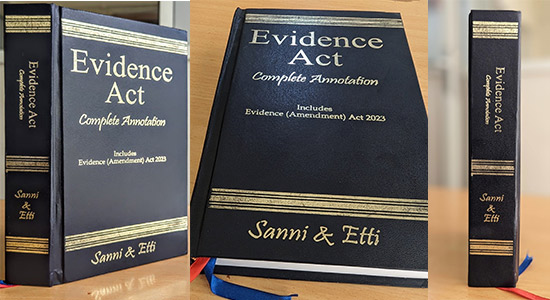
Available now for NGN 40,000 at ASC Publications, 10, Boyle Street, Onikan, Lagos. Beside High Court, TBS. Email publications@ayindesanni.com or WhatsApp +2347056667384. Purchase Link: https://paystack.com/buy/evidence-act-complete-annotation
______________________________________________________________________ “Enhance Legal Practice With Authoritative Reports” — Alexander Payne Offers Comprehensive Law Reports, Spanning Over A Century Of Nigerian Jurisprudence Interested buyers are encouraged to place their orders and enquiries via:
0704 444 4777, 0704 444 4999, 0818 199 9888
Website: www.alexandernigeria.com
“A Comprehensive Guide To Evidence Law” — Releases Second Edition In Three Volumes, Covering 4,051 Cases
For enquiries and orders, contact: 08035526491 Email: jerryamadisilk@gmail.com
 Prof. Jerry Amadi’s Evidence Law, Second Edition (2026), contains 3,314 pages in three volumes, covering the Evidence Act 2011, its 2023 amendment, and 4,051 Nigerian and English cases.