Across every major city in Nigeria, a quiet but devastating housing crisis is unfolding one driven not by conflict or natural disaster but by relentless, arbitrary rent increases that are forcing families to relocate, downgrade their living conditions, sink into debt, or face homelessness entirely.

From Lagos to Abuja, Port Harcourt to Kano, Enugu to Kaduna, Ibadan to Akure, the story is the same: rents that have doubled or tripled within two to three years, landlords who issue quit notices via WhatsApp, agents who inflate prices and pile on fees, and ordinary Nigerians who can no longer afford the basic human need of shelter.
The crisis is unfolding against the backdrop of a national housing deficit estimated at 14.9 million units, with experts warning that Nigeria must build approximately 550,000 housing units annually for the next decade to close the gap at a cost that could exceed N59 trillion.
In Nigeria’s commercial capital, the housing nightmare is most acute. A two-bedroom flat in Egbeda that cost N750,000 four years ago now goes for N1.8 million — the increase communicated to the tenant, Adaobi, via a casual WhatsApp message from the agent on a Tuesday morning: “Your rent is now N1.8 million. If you can’t pay, vacate before month end.”
“I read it three times. I thought maybe it was a mistake. How do you jump from N950,000 to N1.8 million just like that?” she said.
For Ekene Nwonye, a 29-year-old graphic designer in Yaba earning N220,000 monthly with rent of N900,000, life has been reduced to survival arithmetic. “I don’t plan anymore. I eat late. I save nothing,” he said. He now shares an apartment with three other adults. “We are all educated people. But we live like students because rent won’t let us breathe.”
In Ajao Estate, Madam Maureen Okafor watched her rent leap from N1.4 million to N4.5 million in three years — a more than threefold increase for a building over 50 years old with no improvements. Five of her neighbours were evicted during the same period.
A 67-year-old retired civil servant in Ajegunle, Mr. Samuel Okere, is preparing to leave Lagos entirely after his rent was increased from N400,000 to N900,000. “I cannot fight. My pension cannot fight,” he said.
At the centre of the crisis in every city are estate agents who operate with little regulation. Tenants describe a pattern: agents encourage landlords to raise rents sharply, citing inflation or “market value,” then add multiple fees agreement, caution, commission sometimes totalling 20 to 30 per cent of annual rent.
“Agents now tell you, ‘If you don’t take it, five people are waiting,'” said Bose, a single mother in Ikorodu. “Sometimes they are lying. But fear makes you agree.”
A growing practice identified by tenants is the insistence on one-year fixed-term tenancies, which allow landlords to charge a fresh 10 per cent legal fee every year of renewal — treating each renewal as a brand-new contract.
Abuja’s rental market has experienced 40-60 per cent rent increases across various neighbourhoods. The original master plan designed the city for 3.1 million people; current estimates put the population above 4 million.
A one-room self-contained apartment in Gwarimpa that cost N400,000-N600,000 now costs N1.5-N2 million. In Kubwa, David Emmanuel, a salesman, watched his rent climb from N400,000 to N2.5 million over five years, with the agent threatening eviction if the new amount was not paid.
Married couples are leaving families behind in other cities and sharing accommodation with colleagues to conserve funds. A bank staff member was forced from a N10 million apartment in Maitama to a N3.5 million duplex in F01 after his employer deemed the rent unreasonable.
In Port Harcourt, a two-bedroom flat in Abuloma that cost N550,000 before the current administration has skyrocketed to N1 million — a near-100 per cent increase. One-room apartments in Mile 3 Diobu have gone from N96,000 to N180,000 per year, while two-bedroom flats have jumped from N800,000 to N1.2 million.
Human rights activist Prince Wiro confirmed that many families have relocated to villages and outskirts because they cannot cope. “Most of the persons meeting up with the payments are big businessmen and women, as well as alleged internet fraudsters,” he said.
In the South-East, residents across Awka, Umuahia, Enugu, Owerri, and Onitsha point to internet fraudsters — “Yahoo Boys” — as a major driver of rent inflation.
A house agent in Umuahia named Blessing confirmed: “These Yahoo Boys fleeing from Anambra and Enugu states are the cause. Landlords prefer giving out their houses to them because they pay ‘sharp-sharp.’ They don’t negotiate rent. As the landlord is mentioning the amount, they are paying immediately.”
In Awka, civil servant Augustine Okeke watched his rent jump from N150,000 to N700,000, forcing him to relocate to rural Nibo where he pays N300,000 but spends N2,500 daily on transportation to work. In Enugu, three-bedroom flats in medium-class areas cost N700,000 and above, exclusive of agent and legal fees that can reach N200,000-N300,000.
In Kaduna, two-bedroom apartments in Malali and Kawo now cost N800,000 to N1 million. Residents complain that agents convince landlords of old buildings to match the rents of new ones, and that agents bring prospective tenants to inspect occupied apartments without notice.
In Kano, tenant Abdul Waheed saw his rent jump from N260,000 to N420,000 without any renovation. “If you can’t pay, move out,” the landlord told him.
In Akure, broadcast engineer Musa Dauda, earning N80,000 monthly with a wife, two children, and two dependants, was told his rent had increased from N165,000 to N265,000 with immediate effect. Private school teacher Mrs. Ibidakun Helen, earning N50,000 monthly, described the increases as “arbitrary and unjustified.”
In Ibadan, what used to be modest accommodation at N250,000 has skyrocketed to over N1 million within a few years. Tenants describe multiple inspection fees, exorbitant agency charges, “caution fees” with no legal basis, and artificial inflation of property values.
The legal framework to protect tenants exists largely on paper. Lagos has tenancy laws on notice periods and arbitrary increases, but enforcement is weak. “Going to court is expensive and slow. Most tenants choose peace over justice because they still need somewhere to sleep,” a Lagos legal practitioner observed.
The Lagos State Real Estate Regulatory Authority head, Barakat Odunuga-Bakare, stated that unreasonable rent increases can be challenged in court, but acknowledged the law is being reviewed.
Enugu State has taken more concrete action. Following a suit by human rights lawyer Alex Amujiogu seeking a mandamus to compel the state assembly to regulate rents, the Enugu House of Assembly initiated the “Landlord and Tenant (Amendment) Bill, 2025,” which mandates agent certification, caps agency fees at 10 per cent, and abolishes caution fees. The bill has passed reading stages and is at committee level.
Ebonyi State has a similar executive bill before its assembly.
Multiple structural factors drive the crisis. Nigeria’s housing deficit stands at 14.9 million units, with approximately 15.2 million existing homes classified as substandard. Lagos alone has a shortfall of 3.4 million units.
Building material costs have surged a 50kg bag of cement that cost N6,000-N7,500 now exceeds N10,000. Steel, timber, paint, and tiles have doubled in price. Labour costs have also surged as skilled artisans command higher wages.
Nigeria’s mortgage-to-GDP ratio sits below 1 per cent, compared to 80 per cent in the UK or 30 per cent in South Africa. Mortgage loans come with interest rates as high as 25 per cent, with 20-30 per cent equity contribution requirements.
The Land Use Act creates cumbersome processes for obtaining Certificates of Occupancy, discouraging institutional investment. Nigeria’s urbanization rate of approximately 4.1 per cent annually one of the world’s fastest creates permanent demand pressure.
Only 32.5 per cent of urban Nigerians own their homes, while over 49 per cent live in rented accommodation, leaving millions vulnerable to rent hikes and evictions.
In Lagos and Abuja, landlords increasingly demand two years’ rent upfront. A three-bedroom apartment at N4 million per year requires N8 million at once, plus 10 per cent agency fee and agreement charges forcing tenants to seek high-interest personal loans just to secure shelter.
Stakeholders recommend mass affordable housing schemes delivering hundreds of thousands of units annually, “social housing” models with government providing free land and infrastructure, strengthening mortgage institutions, expanding the National Housing Fund, using local building materials to reduce costs by up to 30 per cent, reforming land administration laws, and slum upgrading programmes rather than demolitions.
The crisis is no longer just about supply but affordability. Unless Nigeria scales up housing delivery through technology-driven construction, reforms land and mortgage systems, and improves real disposable incomes, the gap will continue to widen — leaving millions more Nigerians priced out of decent shelter and trapped in a cycle of housing poverty that threatens social stability and economic productivity nationwide.
As one resident put it: “The question is no longer where to live, but whether we can afford to live at all.”
 Interested buyers are encouraged to place their orders and enquiries via:
0704 444 4777, 0704 444 4999, 0818 199 9888
Website: www.alexandernigeria.com
Interested buyers are encouraged to place their orders and enquiries via:
0704 444 4777, 0704 444 4999, 0818 199 9888
Website: www.alexandernigeria.com
 Reimagine your practice with the power of AI “...this is the only Nigerian book I know of on the topic.” — Ohio Books Ltd
Authored by Ben Ijeoma Adigwe, Esq., ACIArb (UK), LL.M, Dip. in Artificial Intelligence, Director, Delta State Ministry of Justice, Asaba, Nigeria.
Bonus:
Get a FREE eBook titled “How to Use the AI in Legalpedia and Law Pavilion” with every purchase.
Reimagine your practice with the power of AI “...this is the only Nigerian book I know of on the topic.” — Ohio Books Ltd
Authored by Ben Ijeoma Adigwe, Esq., ACIArb (UK), LL.M, Dip. in Artificial Intelligence, Director, Delta State Ministry of Justice, Asaba, Nigeria.
Bonus:
Get a FREE eBook titled “How to Use the AI in Legalpedia and Law Pavilion” with every purchase.
How to Order: 📞 Call, Text, or WhatsApp: 08034917063 | 07055285878 📧 Email: benadigwe1@gmail.com 🌐 Website: www.benadigwe.com
Ebook Version: Access directly online at: https://selar.com/prv626
_______________________________________________________________________ [A MUST HAVE] Evidence Act Demystified With Recent And Contemporary Cases And Materials
 ______________________________________________________________________
“Bridging Theory And Courtroom Practice” — Hagler Sunny Okorie, Nathaniel Ngozi Ikeocha Unveil ‘Functional’ Tort Law Book For Nigerian Legal System
______________________________________________________________________
“Bridging Theory And Courtroom Practice” — Hagler Sunny Okorie, Nathaniel Ngozi Ikeocha Unveil ‘Functional’ Tort Law Book For Nigerian Legal System
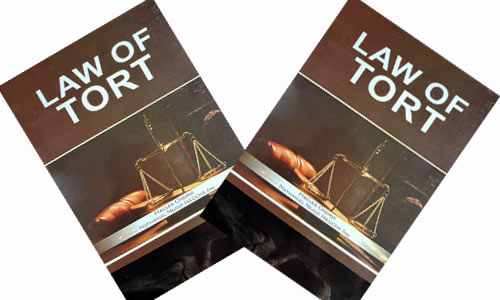 The book, titled The Law of Torts in Nigeria: A Functional Approach, authored by Professor Hagler Sunny Okorie Ph.D and Ikeocha, Nathaniel Ngozi Esq, offers law students, practitioners, and academics a comprehensive guide to understanding and applying tort law in Nigerian courts. Interested buyers can place orders via the following contact numbers: 08028636615, 08037667945, 08032253813, or +234 902 196 2209.