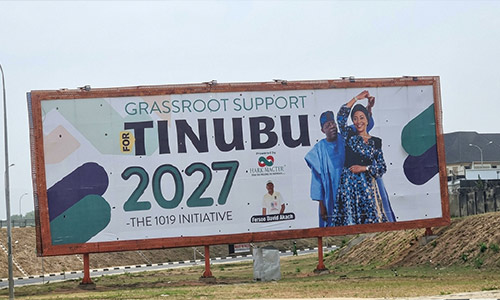
Political parties and candidates are pushing back against rising campaign advertising and billboard permit fees imposed by state signage agencies ahead of the 2027 general elections, with critics arguing that the charges could substantially increase the cost of political participation and limit candidates’ access to public advertising spaces.

The controversy cuts across states governed by different political parties. A report on the growing dispute identified Abia, Enugu, Kogi, Anambra and Imo among states where campaign advertising regulations have attracted concern, although detailed fee schedules in the material reviewed were provided principally for Abia, Enugu and Imo.
In Abia State, the State Structures for Signage and Advertising Agency, ABSSAA, announced in July that presidential candidates seeking to use approved outdoor advertising spaces during the 2027 election period would pay ₦200 million. Governorship candidates are to pay ₦150 million, senatorial candidates ₦100 million, House of Representatives candidates ₦50 million, and State House of Assembly candidates ₦20 million. The agency said the rates apply across political parties.
The size of the presidential charge has generated particular debate because of its potential relationship with the campaign expenditure limits contained in the Electoral Act 2026.
Section 92 of the Act fixes the maximum election expenditure of a presidential candidate at ₦10 billion, a governorship candidate at ₦3 billion, a senatorial candidate at ₦500 million, a House of Representatives candidate at ₦250 million, and a State House of Assembly candidate at ₦100 million.
On a purely hypothetical nationwide calculation, if each of the 36 states and the Federal Capital Territory imposed the same ₦200 million presidential advertising permit charged in Abia, a candidate would face ₦7.4 billion in such permit charges across the 37 jurisdictions. That would amount to 74 per cent of the statutory ₦10 billion presidential expenditure ceiling if the charges were ultimately treated as part of the candidate’s election expenses.
Whether state advertising permit fees are legally to be counted in precisely that manner remains part of the dispute. State agencies defend the levies as administrative or municipal charges for regulating outdoor advertising, public safety, visual pollution and the use of public spaces, while critics contend that their scale could collide with campaign-finance limits and restrict political participation.
In Enugu State, the Enugu State Structures for Signage and Advertisement Agency, ENSSAA, has fixed a ₦150 million mandatory advertising permit for political parties and candidates participating in the 2026 and 2027 elections.
The permit extends beyond conventional billboards to visual campaign activities including banners, branded vehicles, T-shirts, caps, handbills, buntings, street campaigns and rallies. ENSSAA says the framework is intended to regulate outdoor advertising, maintain environmental aesthetics and ensure orderly campaign activities.
Opposition parties in Enugu have challenged the fee. The Secretary of the Nigerian Democratic Congress in the state, Dr. Chukwuebuka Okafor, called for the Inter-Party Advisory Council to intervene, arguing that the question should be treated as a national electoral issue rather than merely a dispute between political parties.
The PDP governorship candidate, Chief Uche Nnaji, through his campaign spokesman, Chief Chukwunweike Okeke, also opposed the policy and said the party had approached the Federal High Court in Abuja to challenge it. The PDP’s position is that the fee could impede freedom of political expression and make it harder for opposition parties to promote their candidates. Those assertions are the party’s legal and political position and remain subject to judicial determination.
The ruling APC in Enugu has rejected suggestions that the fee is designed to suppress opposition parties. Its state publicity secretary, Chief Uchenna Obute, said the APC was itself complying with the requirement and argued that government was not preventing anybody from campaigning but requiring parties to pay the applicable advertising fee.
In Imo State, candidates seeking outdoor campaign visibility are also required to obtain approval from the Imo State Signage and Advertisement Agency, IMSAA.
According to the reported schedule, senatorial candidates are required to pay ₦5 million into the state Treasury Single Account, alongside an application fee of ₦250,000 and a ₦500,000 site inspection fee before erecting billboards.
House of Representatives candidates are required to pay ₦3 million into the TSA in addition to application and inspection charges, while State House of Assembly candidates are to pay ₦1.5 million into the TSA and another ₦200,000 in application and inspection charges.
Charles Okafor Nkenna, Media Coordinator of the Action People’s Party for Ideato Federal Constituency, said his party would comply despite considering the charges high, while Imo ADC Publicity Secretary Chief MacDonald Amadi argued that the rates would make democratic participation more expensive.
In Abia, opposition parties have similarly criticised the ABSSAA rates. The ADC questioned their compatibility with statutory campaign spending limits, while the PDP alleged that the policy amounted to political extortion intended to disadvantage rivals. The APC in Abia also called for the withdrawal of the charges and asked INEC to take notice of the policy. These are allegations and legal positions advanced by the parties; they have not been established by a court.
ABSSAA has defended its role. The agency says its responsibilities extend beyond raising revenue to regulating outdoor advertising and protecting the appearance of the state, and it has warned that campaign billboards erected without compliance could be removed or their approvals revoked.
The controversy is also generating constitutional arguments. Critics have invoked Sections 39 and 40 of the 1999 Constitution, which protect freedom of expression and association, to argue that prohibitively expensive advertising requirements could restrict political communication. State agencies, on the other hand, rely on their regulatory responsibilities over outdoor advertising, physical planning and the use of public spaces.
There is also an Electoral Act issue requiring an important clarification. The source material refers to Section 95 in discussing the prohibition against using state apparatus to favour or disadvantage a candidate. However, a review of the official Electoral Act 2026 shows that the relevant provision is Section 99(2), which states that “State apparatus including the media shall not be employed to the advantage or disadvantage of any political party or candidate at any election.” Section 95, by contrast, deals principally with security for political rallies and processions.
Critics want INEC to clarify how state administrative charges interact with national campaign expenditure rules, while some have also called for legislative intervention to expressly regulate the scale of state levies on political advertising. Others argue that the courts may ultimately have to determine where the states’ authority to regulate outdoor advertising ends and federal electoral safeguards begin.
[A MUST HAVE] Evidence Act Demystified With Recent And Contemporary Cases And Materials

Available now for NGN 40,000 at ASC Publications, 10, Boyle Street, Onikan, Lagos. Beside High Court, TBS. Email publications@ayindesanni.com or WhatsApp +2347056667384. Purchase Link: https://paystack.com/buy/evidence-act-complete-annotation
______________________________________________________________________ “Enhance Legal Practice With Authoritative Reports” — Alexander Payne Offers Comprehensive Law Reports, Spanning Over A Century Of Nigerian Jurisprudence Interested buyers are encouraged to place their orders and enquiries via:
0704 444 4777, 0704 444 4999, 0818 199 9888
Website: www.alexandernigeria.com
Interested buyers are encouraged to place their orders and enquiries via:
0704 444 4777, 0704 444 4999, 0818 199 9888
Website: www.alexandernigeria.com