No fewer than 8,300 inmates have been pardoned or had their sentences reduced at different custodial centres across the country between January 2022 and March 2026, as federal and state authorities step up efforts to address overcrowding in correctional facilities.

Pardons are usually granted after being recommended by a judicial or advisory body, often referred to as a Prerogative of Mercy Committee.
The figures were gathered from media reports as well as the websites of the Nigerian Correctional Service and various state governments, compiled by our correspondent on Friday.
A breakdown showed that 707 inmates benefited from pardons or sentence adjustments in 2022. The number rose sharply to 4,678 in 2023 before dropping to 1,843 in 2024. In 2025, over 850 inmates were pardoned, while more than 240 received similar relief in 2026.
The actual figures could be higher, as the numbers reported reflect what is currently available to our correspondent.
The surge in 2023 was largely driven by a major nationwide intervention in November that year, when more than 4,000 inmates were granted relief after fines imposed by courts were settled through an FG-backed initiative supported by private sector contributions.
Despite these measures, overcrowding remains a major concern. More than 50,000 inmates are still awaiting trial nationwide, many facing serious charges such as armed robbery, murder and culpable homicide. Such cases often involve prolonged investigations and extended court proceedings, contributing to delays in the justice system.
Beyond pardons, the Federal Government is pursuing longer-term reforms aimed at easing pressure on correctional centres.
It recently unveiled plans to transform custodial facilities into agricultural and production hubs through public-private partnerships, in a shift towards rehabilitation and reintegration.
The Minister of Interior, Olubunmi Tunji-Ojo, represented by the Permanent Secretary in the ministry, Magdalene Ajani, said at a stakeholders’ roundtable in Abuja that the initiative was intended to reposition correctional centres as institutions focused on skills acquisition and productivity, rather than mere detention.
According to him, expanding agricultural and vocational programmes would equip inmates with practical skills, improve their chances of reintegration, and contribute to reducing repeat offences and long-term congestion in the system.
“Correctional centres are no longer just places of custody; they are platforms for transformation, rehabilitation and a new lease of life,” he said.

 ARTIFICIAL INTELLIGENCE FOR LAWYERS: A COMPREHENSIVE GUIDE
Reimagine your practice with the power of AI “...this is the only Nigerian book I know of on the topic.” — Ohio Books Ltd
Authored by Ben Ijeoma Adigwe, Esq., ACIArb (UK), LL.M, Dip. in Artificial Intelligence, Director, Delta State Ministry of Justice, Asaba, Nigeria.
Bonus:
Get a FREE eBook titled “How to Use the AI in Legalpedia and Law Pavilion” with every purchase.
ARTIFICIAL INTELLIGENCE FOR LAWYERS: A COMPREHENSIVE GUIDE
Reimagine your practice with the power of AI “...this is the only Nigerian book I know of on the topic.” — Ohio Books Ltd
Authored by Ben Ijeoma Adigwe, Esq., ACIArb (UK), LL.M, Dip. in Artificial Intelligence, Director, Delta State Ministry of Justice, Asaba, Nigeria.
Bonus:
Get a FREE eBook titled “How to Use the AI in Legalpedia and Law Pavilion” with every purchase.
How to Order: 📞 Call, Text, or WhatsApp: 08034917063 | 07055285878 📧 Email: benadigwe1@gmail.com 🌐 Website: www.benadigwe.com
Ebook Version: Access directly online at: https://selar.com/prv626
________________________________________________________________________ The Law And Practice Of Redundancy In Nigeria: A Practitioner’s Guide, Authored By A Labour & Employment Law Expert Bimbo Atilola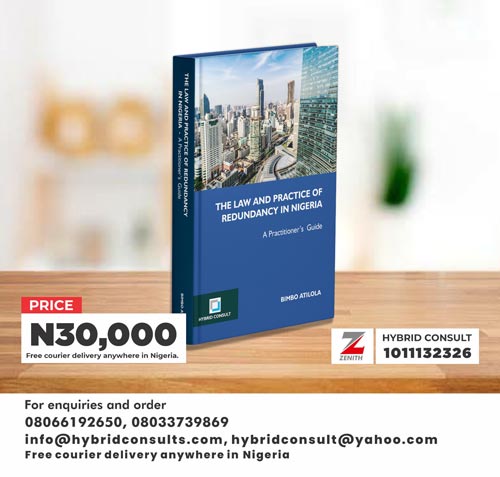 _______________________________________________________________________