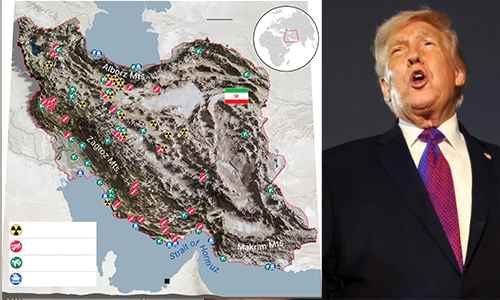
President Donald Trump has issued his most direct and dangerous ultimatum of the conflict, warning Iran that the United States will “hit and obliterate” its power plants, starting with the biggest, unless the Strait of Hormuz is fully reopened without threat within 48 hours — a threat that prompted Iran to warn it would target all energy infrastructure, desalination plants, and information technology systems linked to the US and Israel across the entire Middle East in retaliation.

The ultimatum came on the same night that an Iranian ballistic missile breached Israeli defences and struck the strategically critical city of Dimona — home to Israel’s nuclear programme — wounding over 50 people, and as Israel announced a fresh “wave of strikes” on government infrastructure in Tehran, where residents reported “extremely terrifying explosions” across the capital.
The war, now entering its fourth week, has killed over 1,400 people in Iran including a 20-day-old infant, sent oil prices surging toward $110 per barrel with experts predicting $150 within days, wiped $53 billion off the value of the world’s biggest airlines, and created a global energy crisis that has forced countries from Sri Lanka to the United Kingdom to take emergency economic measures.
In a dramatic all-caps post on Truth Social on Saturday night, Trump explicitly named civilian infrastructure as a target for the first time in the conflict.
“If Iran doesn’t FULLY OPEN, WITHOUT THREAT, the Strait of Hormuz, within 48 HOURS from this exact point in time, the United States of America will hit and obliterate their various POWER PLANTS, STARTING WITH THE BIGGEST ONE FIRST!” Trump wrote.
Iran’s largest nuclear power facility is the Bushehr Nuclear Power Plant, located along the Persian Gulf — the country’s only operational nuclear power station. Other major plants include the Damavand plant near Tehran with 2,868 megawatts capacity, the Kerman plant in southeastern Iran with 1,910 MW, and the Ramin steam power plant in Khuzestan province with 1,890 MW.
Any strike on the Bushehr facility would carry serious environmental and geopolitical risks given its nuclear nature.
The ultimatum came just one day after Trump had suggested the US could soon begin “winding down” military operations, writing that the US was “getting very close to meeting our objectives.” The dramatic reversal underscored what analysts described as a pattern of contradictory signals from the administration.
Iran’s response was swift and defiant. Ebrahim Zolfaghari, spokesperson for Iran’s Khatam al-Anbiya central command, warned that if the US attacks energy infrastructure, all energy, information technology, and desalination infrastructure belonging to the US and its allies in the region would be targeted.
“If the enemy attacks fuel and energy infrastructure, all energy, information technology, and desalination infrastructure belonging to the US and the regime in the region will be targeted,” the statement read.
The Fars news agency noted that the late chief of the Iranian Supreme National Security Council had previously warned that “the entire region will be blacked out within half an hour” if Iran’s electricity grid was targeted — a threat that encompasses the Gulf states’ critical water desalination systems, without which millions of people in Saudi Arabia, the UAE, Qatar, Kuwait, and Bahrain would face humanitarian catastrophe.
Iranian spokesperson Esmaeil Baghaei told Sky News it was “pointless” to expect restraint from Iran while the country was being constantly bombarded.
In a significant escalation, an Iranian ballistic missile breached Israeli air defences and struck the city of Dimona in the Negev Desert — home to Israel’s nuclear programme.
The Israeli ambulance service reported that 88 people were transferred to hospital in nearby Arad, with 10 in serious condition, 13 in moderate condition, and 48 with light injuries. In Dimona itself, 39 wounded were referred to hospital, including a 12-year-old boy in very serious condition with shrapnel injuries.
Iran said the attack was in retaliation for strikes on its Natanz nuclear facility. The IRGC claimed it targeted military installations in Arad, Dimona, Eilat, Beersheba, and Kiryat Gat, as well as the Ali Al Salem base in Kuwait and Al Minhad and Al Dhafra bases in the UAE.
Israel’s Home Front Command responded by closing schools and banning gatherings of more than 50 people across the country’s south until Tuesday. The Education Ministry announced no classes nationwide on Monday.
Israeli peace activist Yariv Oppenheimer demanded the government be held accountable, saying authorities were not telling the public how interceptors failed or how many Iranian missiles hit their targets.
Israel announced it had “just begun a wave of strikes” on government infrastructure in Tehran following the Iranian missile attacks. Residents reported “extremely terrifying explosions” in the east and west of the capital, including the eastern suburbs of Pardis and the nearby city of Damavand.
The Iranian military said it intercepted and downed a US-Israeli armed drone over Tehran before it could carry out combat operations, bringing the total number of enemy drones destroyed since the war began to 127.
Since the conflict began on February 28, more than 200 Iranian cities have been struck by American and Israeli air strikes. Over 1,400 people have been killed, with many more wounded.
Targets have included not just military installations but residential areas, schools, hospitals, and Red Crescent buildings. The most haunting image of the day was the funeral of Mohammad Ali Kayalha, a 20-day-old infant from Qazvin killed alongside his mother and brother in a strike on the Majidieh residential area of Tehran. At least 204 children have been killed in Iran since the war began.
Iran’s internet blackout has entered its fourth week, stretching past 500 hours, with authorities maintaining near-total shutdown of international connectivity. Cyber-watchdog NetBlocks called for the blockade to be lifted, saying many families are unable to contact loved ones.
In a separate post, Trump claimed the US had “blown Iran off the map” and crushed its military power “weeks ahead of schedule.”
“Their leadership is gone, their navy and air force are dead, they have absolutely no defense, and they want to make a deal. I don’t! We are weeks ahead of schedule,” Trump wrote.
However, Defence Secretary Pete Hegseth confirmed that more than 7,000 targets have been hit, while the administration simultaneously announced the deployment of three additional warships and roughly 2,500 Marines to the region — raising the total US personnel supporting the conflict to approximately 50,000.
The contradiction between claims of imminent victory and continued military buildup has left analysts uncertain about the war’s trajectory.
Paolo Von Schirach, president of the Global Policy Institute, told Al Jazeera: “We have been bombing Iran now for several weeks — successfully, I would say, but not to the point of forcing the Iranians into submission.”
He noted that the US and Israel claim to have hit more than 8,000 targets but questioned how many high-value targets remain. Using Iraq as reference, he estimated the US might need as many as half a million troops if Trump “wants to take over Iran.”
The war’s economic impact continues to mount across the globe.
Brent crude futures stand at approximately $110 per barrel, with Iranian energy strategist Mahdi Arabsadegh predicting prices will hit $150 per barrel if the conflict continues another 10 days. He noted that Iran’s closure of the strait has prevented the passage of 21 million barrels of oil per day since the war began.
The world’s 20 largest publicly listed airlines have lost approximately $53 billion in value since the war started, according to the Financial Times. Jet fuel, which accounts for a third of airlines’ costs, has doubled, raising the possibility of significant increases in airline ticket prices.
Sri Lanka has raised fuel prices for the second time in two weeks, with regular petrol rising to 398 rupees per litre from 317 rupees, while introducing a shorter work week to conserve fuel reserves. President Dissanayake told officials the country must prepare for a prolonged conflict.
Bank of England Governor Andrew Bailey warned that reopening the strait is the “best thing to do” to prevent interest rate increases in the UK, as the war threatens to push up household energy costs and food prices.
The Trump administration made the unusual decision to ease some sanctions on Iranian oil, allowing previously restricted shipments already at sea to enter global markets. Treasury Secretary Scott Bessent said this would bring “approximately 140 million barrels of oil to global markets,” though analysts note that represents only a few days’ worth of global demand.
The conflict continues to widen across the region.
Saudi Arabia intercepted three ballistic missiles launched toward Riyadh, with one striking an uninhabited area. Nearly 60 drones were fired at the kingdom in 24 hours, all intercepted, with most targeting the Eastern Province where the majority of energy facilities are located.
The UAE said its air defences were responding to incoming missile and drone threats. An explosion was reported near a tanker off Sharjah.
The Islamic Resistance in Iraq claimed 21 attacks against US bases within 24 hours using dozens of drones and rockets. Explosions were heard west of Baghdad after air defences intercepted two drones near a US logistics camp near the airport.
Israel expanded its ground offensive in southern Lebanon, with heavy fighting around the strategic towns of Khiam and Taybeh. Hezbollah claimed at least 12 attacks on Israeli positions overnight.
The UAE dismantled a Hezbollah-linked “terrorist network” operating under fictitious commercial cover, while Kuwait uncovered a separate Hezbollah group planning attacks.
Cyprus is reconsidering the presence of UK military bases on the island after Hezbollah drones launched from Lebanon targeted it, prompting a diplomatic scramble from London.
Only about 90 ships have crossed the Strait of Hormuz since the war began, compared to hundreds daily under normal conditions. Iran’s representative to the International Maritime Organization said foreign vessels can still pass with coordination from the Iranian government, but the strait is closed to Iran’s “enemies.”
US Central Command Chief Admiral Brad Cooper said forces are targeting underground missile facilities and radar systems along the Iranian coast using heavy bunker-busting bombs to degrade Iran’s ability to threaten shipping.
Japan’s Foreign Minister said Tokyo could consider deploying military minesweepers to the strait if a ceasefire is reached, but ruled out sending combat troops despite pressure from Trump.
European nations, Japan, and Canada have offered to help secure passage through the strait, though Trump has complained allies are “dragging their feet.”
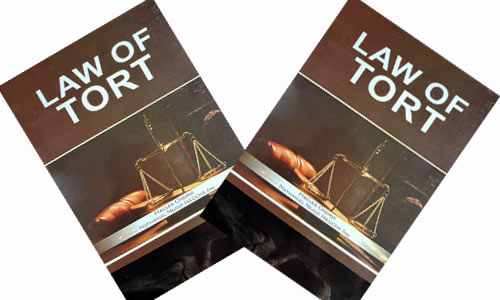 The book, titled The Law of Torts in Nigeria: A Functional Approach, authored by Professor Hagler Sunny Okorie Ph.D and Ikeocha, Nathaniel Ngozi Esq, offers law students, practitioners, and academics a comprehensive guide to understanding and applying tort law in Nigerian courts. Interested buyers can place orders via the following contact numbers: 08028636615, 08037667945, 08032253813, or +234 902 196 2209.
______________________________________________________________________
[A MUST HAVE] Evidence Act Demystified With Recent And Contemporary Cases And Materials
The book, titled The Law of Torts in Nigeria: A Functional Approach, authored by Professor Hagler Sunny Okorie Ph.D and Ikeocha, Nathaniel Ngozi Esq, offers law students, practitioners, and academics a comprehensive guide to understanding and applying tort law in Nigerian courts. Interested buyers can place orders via the following contact numbers: 08028636615, 08037667945, 08032253813, or +234 902 196 2209.
______________________________________________________________________
[A MUST HAVE] Evidence Act Demystified With Recent And Contemporary Cases And Materials

 ARTIFICIAL INTELLIGENCE FOR LAWYERS: A COMPREHENSIVE GUIDE
Reimagine your practice with the power of AI “...this is the only Nigerian book I know of on the topic.” — Ohio Books Ltd
Authored by Ben Ijeoma Adigwe, Esq., ACIArb (UK), LL.M, Dip. in Artificial Intelligence, Director, Delta State Ministry of Justice, Asaba, Nigeria.
Bonus:
Get a FREE eBook titled “How to Use the AI in Legalpedia and Law Pavilion” with every purchase.
ARTIFICIAL INTELLIGENCE FOR LAWYERS: A COMPREHENSIVE GUIDE
Reimagine your practice with the power of AI “...this is the only Nigerian book I know of on the topic.” — Ohio Books Ltd
Authored by Ben Ijeoma Adigwe, Esq., ACIArb (UK), LL.M, Dip. in Artificial Intelligence, Director, Delta State Ministry of Justice, Asaba, Nigeria.
Bonus:
Get a FREE eBook titled “How to Use the AI in Legalpedia and Law Pavilion” with every purchase.
How to Order: 📞 Call, Text, or WhatsApp: 08034917063 | 07055285878 📧 Email: benadigwe1@gmail.com 🌐 Website: www.benadigwe.com
Ebook Version: Access directly online at: https://selar.com/prv626
________________________________________________________________________ “Enhance Legal Practice With Authoritative Reports” — Alexander Payne Offers Comprehensive Law Reports, Spanning Over A Century Of Nigerian Jurisprudence Interested buyers are encouraged to place their orders and enquiries via:
0704 444 4777, 0704 444 4999, 0818 199 9888
Website: www.alexandernigeria.com
Interested buyers are encouraged to place their orders and enquiries via:
0704 444 4777, 0704 444 4999, 0818 199 9888
Website: www.alexandernigeria.com