The Federal High Court sitting in Abuja, in a judgment delivered on Thursday, April 2, 2026, by Honourable Justice B.F.M. Nyako, has declared that the Nigeria Police Force has no statutory powers to approach Magistrate Courts to obtain orders freezing or placing post-no-debit restrictions on citizens’ bank accounts.

The ruling was handed down in Suit No. FHC/ABJ/CS/842/2025 between Chukwu Lincoln Ofodile (Plaintiff) and the Inspector General of Police, the Assistant Inspector General of Police (INTERPOL), the Deputy Commissioner of Police Investigation (INTERPOL), Union Bank PLC, First City Monument Bank Limited, Access Bank PLC, and First Bank of Nigeria PLC (Defendants).
The case arose after the 1st to 3rd Defendants officers of the Nigeria Police Force obtained an order from a Magistrate Court in the course of an investigation, directing the Plaintiff’s bank accounts be placed on post-no-debit. The 4th to 7th Defendants, all commercial banks, acted on the order and restricted the Plaintiff’s accounts. The Plaintiff challenged the process as fundamentally defective, unconstitutional, and without legal basis.
Justice Nyako held that the starting point in any matter of this nature is the question of jurisdiction, describing it as the lifeblood of adjudication. The Court noted that where jurisdiction is absent, the entire proceedings no matter how well conducted would collapse, citing the Supreme Court decision in Madukolu v. Nkemdilim (1962) 1 ALL NLR 587.
The Court then examined the combined provisions of Sections 34 and 36 of the Economic and Financial Crimes Commission (Establishment) Act 2004 and Sections 7 and 23 of the Money Laundering (Prevention and Prohibition) Act 2022 and arrived at a decisive conclusion: the power to grant orders for the freezing or restriction of bank accounts is vested exclusively in the Federal High Court or a High Court of a State.
Justice Nyako stated plainly that no executive agency of government with prosecutorial powers has the authority to place a Post No Debit on any bank account without a valid court order from a court of competent jurisdiction obtained within a reasonable time. The rationale, the Court explained, is to prevent law enforcement agencies from the unlawful exercise of powers that could lead to confusion and anarchy.
The Court further held that the statutory provisions on the subject are clear, unambiguous, and admit of no alternative interpretation. Where the law prescribes a particular mode or forum for the doing of an act, that procedure must be followed strictly, referencing the case of A.G. Abia State v. A.G. Federation (2002) 6 NWLR (Pt. 763) 264.
The Court ruled that Lower Courts, including Magistrate, Area, and Customary Courts, do not have jurisdiction to issue Post No Debit Orders, citing Section 34 and 46 of the EFCC Act and Section 76 of the Terrorism (Prevention and Prohibition) Act 2015. The Court referenced its own earlier decision in Aiman vs. Mahfauz vs. Fidelity Bank PLC, FHC/L/CS/07/2025 (unreported) in support of this position.
Justice Nyako declared that the recourse by the 1st to 3rd Defendants to a Magistrate Court was a clear departure from the law and therefore a nullity.
The Court agreed with the Plaintiff that the restriction of his accounts without affording him an opportunity to be heard was a clear infraction of his right to fair hearing guaranteed under Section 36(1) of the 1999 Constitution. The continuous denial of access to his funds without a valid court order was also held to constitute an interference with his right to property under Section 44(1) of the Constitution.
The Defendants had raised a preliminary objection arguing that the suit constituted an abuse of court process, on the ground that the Plaintiff had earlier instituted a similar suit (Suit No. FHC/ABJ/CS/181/2025). After careful consideration, Justice Nyako held that she was not satisfied the Defendants had established that the present action was identical in subject matter and reliefs to the earlier suit so as to warrant a finding of abuse. The objection was accordingly dismissed.
Consequent upon the foregoing findings, the Court made the following orders:
The order of the Magistrate Court placing the Plaintiff’s accounts on post no debit was declared null and void and of no effect whatsoever. The post-no-debit restriction placed on the Plaintiff’s accounts pursuant to the said order was set aside. The Defendants were ordered to forthwith remove the restriction placed on the Plaintiff’s accounts.
This judgment reinforces the established legal position that only the Federal High Court, High Court of a State, or High Court of the Federal Capital Territory possesses the jurisdiction to make orders freezing or restricting bank accounts in connection with financial crime investigations. It serves as a stern warning to law enforcement agencies against circumventing proper legal channels and to commercial banks against complying with orders issued by courts lacking the requisite jurisdiction.
Federal High Court Voids Police-Backed Magistrate Order, Lifts Post-No-Debit Restrictions TheNigeriaLawyerClick here to download the judgment
Suit No.: FHC/ABJ/CS/842/2025
Judge: Hon. Justice B.F.M. Nyako
Date of Judgment: April 2, 2026
Counsel for Plaintiff: Sir N.S.L. Okoro
 Interested buyers are encouraged to place their orders and enquiries via:
0704 444 4777, 0704 444 4999, 0818 199 9888
Website: www.alexandernigeria.com
Interested buyers are encouraged to place their orders and enquiries via:
0704 444 4777, 0704 444 4999, 0818 199 9888
Website: www.alexandernigeria.com
 Reimagine your practice with the power of AI “...this is the only Nigerian book I know of on the topic.” — Ohio Books Ltd
Authored by Ben Ijeoma Adigwe, Esq., ACIArb (UK), LL.M, Dip. in Artificial Intelligence, Director, Delta State Ministry of Justice, Asaba, Nigeria.
Bonus:
Get a FREE eBook titled “How to Use the AI in Legalpedia and Law Pavilion” with every purchase.
Reimagine your practice with the power of AI “...this is the only Nigerian book I know of on the topic.” — Ohio Books Ltd
Authored by Ben Ijeoma Adigwe, Esq., ACIArb (UK), LL.M, Dip. in Artificial Intelligence, Director, Delta State Ministry of Justice, Asaba, Nigeria.
Bonus:
Get a FREE eBook titled “How to Use the AI in Legalpedia and Law Pavilion” with every purchase.
How to Order: 📞 Call, Text, or WhatsApp: 08034917063 | 07055285878 📧 Email: benadigwe1@gmail.com 🌐 Website: www.benadigwe.com
Ebook Version: Access directly online at: https://selar.com/prv626
_______________________________________________________________________ [A MUST HAVE] Evidence Act Demystified With Recent And Contemporary Cases And Materials
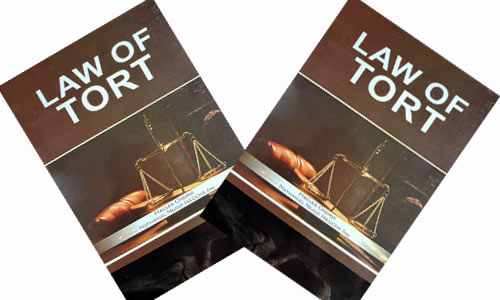 The book, titled The Law of Torts in Nigeria: A Functional Approach, authored by Professor Hagler Sunny Okorie Ph.D and Ikeocha, Nathaniel Ngozi Esq, offers law students, practitioners, and academics a comprehensive guide to understanding and applying tort law in Nigerian courts. Interested buyers can place orders via the following contact numbers: 08028636615, 08037667945, 08032253813, or +234 902 196 2209.