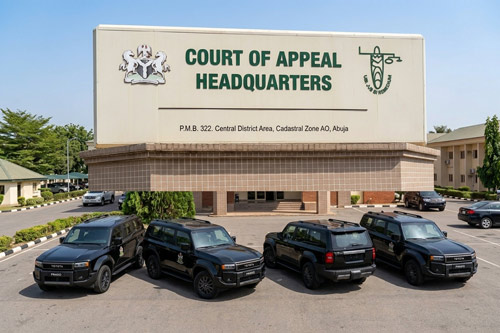
An investigation into the Court of Appeal’s nearly ₦4.8 billion vehicle procurement has raised questions over the bidding process, the representation of multiple companies by the same individuals, the exclusion of a participating bidder, changes in vehicle specifications and an alleged request for payment of almost ₦3.9 billion on the same day a major contract was awarded.

The investigation, published by Secrets Reporters on November 11, 2026, and subsequently examined by Law & Society Magazine on November 13, 2026, questioned whether the procurement process complied with applicable laws, ensured fair competition and provided adequate documentation for the delivery and payment of official vehicles.
According to the reports, the Court of Appeal’s 2025 vehicle procurement involved contracts covering three lots with a combined value of ₦4,770,131,999.94.
The largest contract, valued at ₦3,896,874,999.94, was reportedly awarded to Hazdokas West Africa Limited for the supply of 25 Toyota Land Cruiser Prado vehicles.
The publications raised concerns about the circumstances surrounding the award, particularly the participation of companies represented by the same individuals, the eligibility of bidders, the exclusion of a company from the technical shortlist and the timing of a payment request submitted by the successful contractor.
One of the central issues identified in the investigation concerned the attendance register for the technical bid opening held on May 20, 2025, at the Court of Appeal Training Room in Abuja.
According to Secrets Reporters, a man identified as Yahaya Hussaini signed the attendance register as the representative of three separate companies: HDM Global Limited, Hazdokas Limited and May Eagle Motors.
Another individual, Michael Eze, was reportedly listed as the representative of both Kefiano Motors and EPI Mgt Ltd.
The investigation questioned whether the involvement of the same representatives in the bidding process indicated genuinely independent competition among the participating companies.
It also raised concerns about whether the procurement arrangement created the appearance of competition without the corresponding independence expected among bidders.
Secrets Reporters further cited sources within the Court of Appeal who alleged that some of the participating companies were connected to the same interests and that firms associated with officials involved in the court’s procurement structure participated in the exercise.
However, Law & Society Magazine cautioned that such allegations required investigation and independent confirmation.
The magazine observed that the representation of several companies by one individual did not, by itself, establish common ownership, collusion or procurement fraud.
Nevertheless, it maintained that the circumstances warranted scrutiny to determine whether the companies participated independently and whether the procurement process met the required standards of transparency and competition.
The investigation also questioned the exclusion of Kojo Motors Limited from the list of companies permitted to proceed beyond the technical evaluation stage.
According to Secrets Reporters, the Federal Judiciary Tenders Board issued a technical evaluation notice on May 23, 2025, shortlisting two companies for each lot.
Kojo Motors Limited, which reportedly participated in the bid opening, was not included among the shortlisted companies.
The publication alleged that the company received no formal communication explaining why it was excluded and that its request for clarification was not answered.
Law & Society Magazine examined the development against the provisions of the Public Procurement Act, 2007.
It cited Section 23(7) of the Act, which requires procuring entities to promptly inform applicants whether they have been pre-qualified.
The magazine also referred to Section 23(9), which provides that unsuccessful applicants who request explanations should be informed of the grounds for their disqualification.
It further cited Section 24 of the Act, which establishes open competitive bidding as the general method of public procurement, subject to exceptions permitted by law.
According to the magazine, where a procuring entity adopts a selective or restricted bidding process, the decision must be properly justified and documented.
It acknowledged, however, that the use of a limited invitation process does not automatically establish a violation of procurement law.
Beyond the questions surrounding the bidding process, the investigation raised concerns about the timing of the award and subsequent payment request for the 25 Toyota Land Cruiser Prado vehicles.
Secrets Reporters reported that the Federal Judiciary Tenders Board approved the award of the ₦3,896,874,999.94 contract to Hazdokas West Africa Limited on June 27, 2025.
According to the investigation, the award letter provided that the vehicles should be delivered within four weeks from the signing of the contract agreement.
However, the company allegedly submitted a request for payment of the entire contract sum on the same day the award was approved.
The payment request reportedly stated that all 25 vehicles had already been supplied.
This development prompted questions about how the vehicles could have been reported as delivered and payment requested on the date of the award, despite the delivery period provided in the contract.
Law & Society Magazine described the timing as an issue requiring a clear explanation from the court and the contractor.
The magazine, however, cautioned that the dates alone did not establish that the vehicles were never delivered or that payment was improperly made.
It observed that determining what actually occurred would require an examination of the signed contract agreement, delivery notes, inspection and acceptance certificates, payment vouchers, relevant bank records and a physical inventory of the vehicles.
Nevertheless, the magazine maintained that the discrepancy was “too substantial to be dismissed as a clerical discrepancy”.
The reports did not establish whether the ₦3.897 billion payment request was approved or whether the contractor actually received the money.
Another allegation concerned the preparation of delivery and store receipts.
Secrets Reporters alleged that some documents relating to the receipt and delivery of the vehicles were prepared in the names of Court of Appeal employees who were unaware that they had been identified as recipients or signatories.
If established, Law & Society Magazine observed, the allegation would raise questions about the authenticity of the court’s delivery and inventory records, as well as the effectiveness of its internal controls.
The magazine consequently called for the relevant documents to be examined to establish whether the vehicles were delivered, inspected and properly recorded in the court’s inventory.
The investigation also identified an apparent change in the specifications of the vehicles covered by the major contract.
According to Secrets Reporters, the Federal Judiciary Tenders Board’s technical evaluation notice described the vehicles under Lot 1C as 2024-model Toyota Land Cruiser Prados.
However, the subsequent award letter reportedly specified 2025-model Toyota Prado VX vehicles.
The publication stated that the documents it reviewed did not provide an explanation for the change.
Law & Society Magazine called for the original specifications, the contractor’s financial bid, the technical evaluation report and any approval authorising the variation to be made available for examination.
The magazine also raised questions about the price of the vehicles.
Based on the reported contract sum of ₦3,896,874,999.94 for 25 vehicles, the average cost was approximately ₦155.87 million per vehicle.
It cautioned that the figure did not automatically establish overpricing, as a proper assessment would require consideration of vehicle specifications, taxes, delivery costs, accessories, warranty arrangements and other relevant expenses.
Nevertheless, it maintained that the court should disclose the market assessment and pricing considerations used to establish that the award represented value for public money.
Questions were also raised about the officials responsible for managing the procurement exercise.
Secrets Reporters alleged that a retired former head of the Court of Appeal’s Procurement Department continued to oversee procurement activities under a contract appointment, despite not belonging to the professional procurement cadre.
The publication cited a circular issued by the Office of the Secretary to the Government of the Federation on June 14, 2017, with reference number 59780/S.I/T.I/117.
According to the investigation, the circular prohibits officers who are not members of the procurement cadre from performing procurement functions where career procurement officers are available.
Law & Society Magazine also referred to a 2025 communication from the Bureau of Public Procurement reiterating the directive to federal accounting officers.
The reports consequently raised questions about whether the appointment and continued involvement of the retired official complied with the applicable administrative and procurement requirements.
The investigation further identified alleged discrepancies in the corporate records of some companies participating in the procurement exercise.
These reportedly included inactive company status flags, expired compliance documents and differences in the names appearing in various procurement and corporate records.
Law & Society Magazine called for the allegations to be checked against certified records maintained by the Corporate Affairs Commission.
It cautioned that an inactive registry flag, expired document or variation in a company’s name was not, without further evidence, sufficient to establish fraud.
The magazine maintained that the relevant records should be independently examined before conclusions were drawn about the eligibility of any participating company.
The procurement exercise took place during the tenure of the President of the Court of Appeal, Justice Monica Dongban-Mensem, who assumed office in June 2020.
However, Law & Society Magazine stressed that the fact that the procurement occurred during her tenure did not establish that she personally directed, approved, knew of or participated in any alleged irregularity.
According to Secrets Reporters, efforts were made to obtain responses from the President of the Court of Appeal and the Federal Judiciary Tenders Board before the investigation was published.
The publication stated that no response was received before publication.
Among the issues identified as requiring clarification were the identity of those who approved the list of invited bidders, the reasons one individual represented three companies, and the circumstances surrounding the exclusion of Kojo Motors Limited from the technical shortlist.
The publications also sought explanations concerning the verification of bidders’ eligibility documents, the change in the specifications of the Toyota Prado vehicles and the dates on which the vehicles were actually delivered, inspected and accepted.
Another outstanding question concerned whether the ₦3.897 billion payment request was approved and whether any payment was subsequently made.
Law & Society Magazine also requested clarification concerning Lot 1B, which reportedly appeared in the original procurement documentation but was not covered by the two contract awards detailed in the investigation.
The magazine maintained that a complete examination of the procurement exercise would require access to the relevant bidding, evaluation, award, delivery and payment records.
It consequently called on the appropriate oversight institutions to examine the allegations where they were supported by the underlying documents.
Among the institutions identified were the National Assembly’s relevant oversight committees, the Bureau of Public Procurement and the appropriate anti-corruption authorities.
The magazine emphasised that any examination should provide the Court of Appeal officials and companies named in the reports with an opportunity to respond.
It also stressed the importance of distinguishing possible administrative irregularities from evidence capable of establishing criminal wrongdoing.
According to the magazine, the central issue was not whether judicial institutions were entitled to procure official vehicles but whether the procurement was conducted transparently, lawfully and in a manner that ensured value for public funds.
“The issue is not whether judges and judicial institutions may procure official vehicles,” the magazine stated.
“It is whether almost ₦4.8 billion in public funds was committed through a process that complied with procurement law, delivered value for money and produced reliable evidence of delivery and payment. The court owes the public clear answers, supported by records.”
The allegations concerning the Court of Appeal’s procurement process have not been independently established in the material provided, and no finding of procurement fraud or criminal misconduct has been reported.
[A MUST HAVE] Evidence Act Demystified With Recent And Contemporary Cases And Materials

Available now for NGN 40,000 at ASC Publications, 10, Boyle Street, Onikan, Lagos. Beside High Court, TBS. Email publications@ayindesanni.com or WhatsApp +2347056667384. Purchase Link: https://paystack.com/buy/evidence-act-complete-annotation
______________________________________________________________________ “Enhance Legal Practice With Authoritative Reports” — Alexander Payne Offers Comprehensive Law Reports, Spanning Over A Century Of Nigerian Jurisprudence Interested buyers are encouraged to place their orders and enquiries via:
0704 444 4777, 0704 444 4999, 0818 199 9888
Website: www.alexandernigeria.com
“A Comprehensive Guide To Evidence Law” — Releases Second Edition In Three Volumes, Covering 4,051 Cases
For enquiries and orders, contact: 08035526491 Email: jerryamadisilk@gmail.com
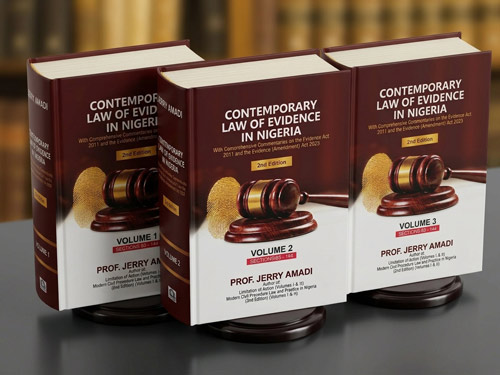 Prof. Jerry Amadi’s Evidence Law, Second Edition (2026), contains 3,314 pages in three volumes, covering the Evidence Act 2011, its 2023 amendment, and 4,051 Nigerian and English cases.