Kano State Governor Abba Kabir Yusuf has reassured his supporters that he will continue wearing the iconic Kwankwasiyya red cap despite his defection to the All Progressives Congress, even as the movement he left behind confirmed that its leader, former Governor Rabiu Musa Kwankwaso, is in active discussions with the African Democratic Congress and the National Democratic Congress about potentially merging into a single opposition platform ahead of the 2027 elections.

The two developments underscore the complex and evolving political dynamics in Kano State, where the governor who rode to power on the Kwankwasiyya wave now finds himself in the APC while his political godfather explores deeper alliances with opposition forces that could challenge the very party Yusuf has joined.
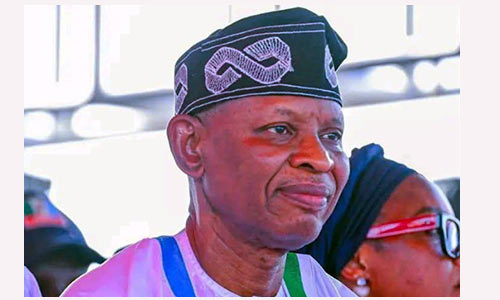
Speculation had been growing in Kano over Governor Yusuf’s refusal to drop the Kwankwasiyya red cap — the movement’s most recognisable symbol — since his defection to the APC. The red cap has been the defining emblem of the Kwankwasiyya political movement for over a decade, synonymous with Kwankwaso’s political identity and his mass following in Kano and across northern Nigeria.
The speculation intensified when Yusuf was seen in Yola, Adamawa State, wearing a dark blue cap carrying President Tinubu’s insignia — prompting some of his supporters to ask whether they could now abandon the red cap.
However, the governor’s spokesperson, Sanusi Bature Dawakin Tofa, moved to quash the speculation, stating that no order had been given to drop the cap.
“There has been no directive to remove the red cap yet. This was a special outing in Yola, Adamawa State, where dignitaries dressed in uniform. Let’s be patient; everything has its time,” Dawakin Tofa posted on his Facebook handle on Tuesday.
The phrase “it is not yet time” suggests the governor recognises that the cap may eventually have to go, but is delaying the symbolic break to manage his political base in Kano, where the Kwankwasiyya movement retains deep cultural and emotional significance.
Many Kwankwasiyya followers and even some of the governor’s own supporters have been urging Yusuf to remove the cap, drawing parallels with his predecessor, Abdullahi Ganduje, who dropped the Kwankwasiyya red cap in 2018 when he formally parted ways with Kwankwaso.
Ganduje’s removal of the cap was seen as a definitive statement of political independence from Kwankwaso, and many believe Yusuf must eventually make a similar symbolic gesture to demonstrate his full allegiance to the APC and President Tinubu.
However, political analysts note that the red cap has evolved beyond factional politics and has become a broader cultural emblem in Kano. For Yusuf, dropping it carries the risk of alienating the large base of Kwankwasiyya supporters who voted him into office in 2023 but may not have followed him to the APC.
While his protégé navigates the politics of the red cap inside the APC, Kwankwaso himself is positioning for a potentially transformative opposition realignment.
The Kwankwasiyya Movement’s Spokesperson II, Mansur Kurugu, confirmed that Kwankwaso is in active talks with the ADC and the NDC, with discussions that may eventually lead to the alignment of the platforms into a single opposition force.
“It is true that Kwankwaso is in talks with ADC and NDC, and we are optimistic that the leaders will end up adopting one of the parties before the 2027 elections,” Kurugu told reporters on Monday.
He identified the key participants in the discussions: “The likes of Seriake Dickson, Peter Obi, and Seyi Makinde are all part of the talks, and they have progressed significantly.”
Kurugu explained that at the conclusion of the discussions, the leaders would adopt either the ADC, NDC, or even the NNPP as their final platform — indicating that all three parties remain in play as potential vehicles for a merged opposition.
The merger talks were given visible form at Kwankwaso’s Kano residence during the Sallah celebrations on Sunday, when the NNPP leader hosted a high-profile gathering of opposition figures from across party lines.
The visitors included former Labour Party presidential candidate Peter Obi, now a member of the ADC; Oyo State Governor Seyi Makinde of the PDP; and former Bayelsa State Governor Senator Seriake Dickson of the NDC.
Obi told the gathering he was there to pay Sallah homage to “our leader,” while calling for the revival of Kano’s industrial base, specifically mentioning the Bompai and Sharada industrial areas and legacy institutions like the Bank of the North.
“We want to change Kano. We want to build a new Kano. What we want to do is to make sure that we bring back the power of Kano,” Obi stated.
The simultaneous developments — Yusuf clinging to the Kwankwasiyya cap inside the APC while Kwankwaso explores merger with the ADC and NDC — create a fascinating political tension.
If Kwankwaso ultimately joins or aligns with the ADC, it would bring his formidable Kano political machine into the opposition’s orbit, potentially creating a serious challenge to the APC in one of Nigeria’s most electorally significant states. The NNPP polled over 1.4 million presidential votes in 2023, with the bulk coming from Kano and the northwest.
For Governor Yusuf, the red cap represents a connection to the political base that elected him. Dropping it too soon risks losing those supporters to whatever platform Kwankwaso ultimately adopts. Retaining it too long risks antagonising his new APC allies who expect full loyalty.
The governor’s aide’s careful wording “everything has its time” suggests this is a calculated political strategy rather than mere sentimentality, with Yusuf likely waiting to see how the opposition realignment develops before making his final symbolic break with the movement that created him.
The merger talks between Kwankwaso, the ADC, and the NDC are expected to intensify in the coming weeks as the party primary window of April 23 to May 30 approaches. The choice of final platform — whether ADC, NDC, or NNPP will have significant implications for candidate selection, party structures, and the distribution of tickets.
For Kano State specifically, the question of whether Kwankwaso’s Kwankwasiyya movement finds a home in the opposition and challenges Yusuf’s APC in 2027 could determine the political future of one of Nigeria’s most populous and politically influential states.
And the red cap that simple piece of headwear that has defined Kano politics for over a decade — remains, for now, firmly on the governor’s head.

 ARTIFICIAL INTELLIGENCE FOR LAWYERS: A COMPREHENSIVE GUIDE
Reimagine your practice with the power of AI “...this is the only Nigerian book I know of on the topic.” — Ohio Books Ltd
Authored by Ben Ijeoma Adigwe, Esq., ACIArb (UK), LL.M, Dip. in Artificial Intelligence, Director, Delta State Ministry of Justice, Asaba, Nigeria.
Bonus:
Get a FREE eBook titled “How to Use the AI in Legalpedia and Law Pavilion” with every purchase.
ARTIFICIAL INTELLIGENCE FOR LAWYERS: A COMPREHENSIVE GUIDE
Reimagine your practice with the power of AI “...this is the only Nigerian book I know of on the topic.” — Ohio Books Ltd
Authored by Ben Ijeoma Adigwe, Esq., ACIArb (UK), LL.M, Dip. in Artificial Intelligence, Director, Delta State Ministry of Justice, Asaba, Nigeria.
Bonus:
Get a FREE eBook titled “How to Use the AI in Legalpedia and Law Pavilion” with every purchase.
How to Order: 📞 Call, Text, or WhatsApp: 08034917063 | 07055285878 📧 Email: benadigwe1@gmail.com 🌐 Website: www.benadigwe.com
Ebook Version: Access directly online at: https://selar.com/prv626
________________________________________________________________________ The Law And Practice Of Redundancy In Nigeria: A Practitioner’s Guide, Authored By A Labour & Employment Law Expert Bimbo Atilola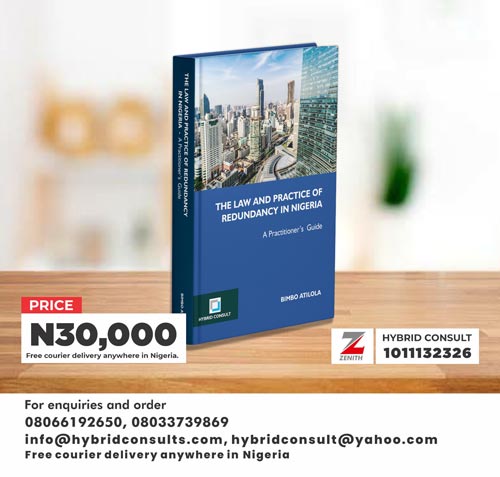 _______________________________________________________________________