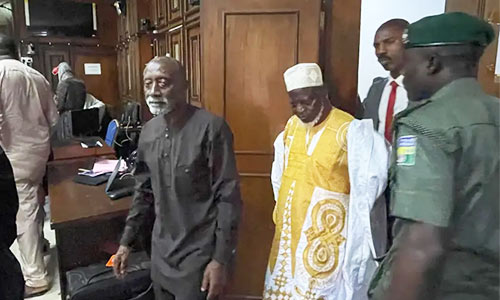
A Federal High Court in Abuja heard on Tuesday that none of the six men being prosecuted over their alleged complicity in the plot to overthrow the President Bola Tinubu-led administration was coerced or induced to volunteer statements to investigators.

An officer of the Nigerian Army Corps of Military Police, who said he was part of the investigators, told the court that members of the Special Investigative Panel (SIP) and the Military Police team that took statements from the defendants complied with relevant standard operating procedures and best investigative practices as stipulated by the Administration of Criminal Justice Act (ACJA).
The military personnel spoke while testifying as the first prosecution witness (PW1) in the trial-within-trial being conducted to ascertain the voluntariness or otherwise of the statements made to investigators by the defendants.
The defence team had objected to the admissibility of the defendants’ statements and the audio visual recordings of their interview sessions when the prosecuting lawyer, Rotimi Oyedepo (SAN) applied to tender them in evidence during the substantive trial on Monday.
The defence’s objection informed the decision by the trial judge, Justice Joyce Abdulmalik to order the conduct of the trial-within-trial to ascertain the voluntariness or otherwise of the statements.
On Tuesday the prosecution tendered the statements of the six defendants, which they were said to have made before the SIP and the Military Police investigating team.
The statements by the first to fifth defendants were admitted as Exhibits series A to series E, while that made by the sixth defendant to the Military Police team was admitted as Exhibit F.
The prosecution also tendered a black external hard drive and a flash drive said to contain audio visual recordings of the defendants’ extra- statements, alongside the certificates of identification.
Defence lawyers raised no objections to their admissibility during the trial-within-trial, following which the court admitted the devices as Exhibits G, G1, H and H1.
Led in evidence by Oyedepo, the prosecution tendered the military personnel, who is the fourth prosecution witness in the main trial, said consistently maintained that none of the defendants was denied access to legal representation as claimed by their lawyers.
The witness also stated that all defendants were informed of their rights, including the right to remain silent and the right to engage counsel of their choice.
In relation to the first defendant, retired Major General Mohammed Ibrahim Gana, the witness described him as a highly respected senior military officer who remained calm throughout the interrogation process.
The military personnel said the defendant was placed in a properly ventilated room, cautioned about his rights and informed that any statement made could later be tendered in court as his own side of the story.
He added that the video recordings showed no sign of coercion, intimidation or inducement and argued that the similarity between the oral and written statements reinforced the claim that they were voluntarily made.
On the defence team’s claim that the defendants’ written statements did not correspond exactly with the recorded interviews, the witness explained that written accounts could not be word-for-word reproductions of oral interviews because as human beings, they are not computers.
He also maintained that the military investigation team employed modern investigative techniques and had no reason to force suspects into making statements.
The witness gave similar testimony regarding the second defendant, Captain Erasmus Ochegobia Victor (retired), stating that the senior military officer voluntarily elected to reduce his oral statement into writing after speaking in the recorded interview.
He denied allegations that the defendant was coerced into pleading for clemency and insisted that all statements were made freely in the interest of justice.
As it relates to the third defendant, Inspector Ahmed Ibrahim, the witness dismissed claims of torture and coercion, stating that the video recordings showed the defendant in a calm and relaxed posture throughout the interview process.
He also rejected suggestions that the defendant may have been restrained outside the camera frame, arguing that the duration and nature of the video showed no signs of tension or force.
On the defendant, Umoru Zekeri, the military personnel said he was expressed about the defence’s claim of involuntariness in the statements he made.
The witness insisted that Zekeri freely narrated events and locations allegedly known only to him in relation to the alleged coup plot.
The witness equally told the court that the fifth defendant, Bukar Kashim Goni willingly gave his account after being informed of his rights and choosing to tell his own side of the story.
As it relates to the sixth defendant, Sheikh Sani Abdulkadir, the witness said an interpreter was provided after the defendant said he could neither speak nor write in English language fluently.
The witness added that the Abdulkadir’s statements were translated between the Hausa language and the English language in line with fair hearing requirements before they were read back to him for confirmation.
While being cross-examined by lawyers to the defendants, the witness admitted that he was not a member of the Special Investigative Panel but stated that he participated intermittently in the investigation process.
He also acknowledged that the video recordings shown in court related only to statements made before the Military Police and not those taken before the SIP.
The witness admitted that some video recordings and written statements were made on different dates.
He however, insisted that the sequence did not affect their voluntariness so long as they were freely made.
The witness further confirmed that none of the statements tendered before the court bore endorsements by legal practitioners and that no lawyers, civil society representatives or Justices of the Peace were present during the recordings.
The witness said all defendants were informed of their rights to legal representation but did not request lawyers during the interrogation sessions.
He admitted that some defendants were not shown, in the audio visual recordings, physically writing their statements.
The witness said explained that oral accounts were later reduced into writing and endorsed by the suspects after being read back to them.
Lawyers to the defendants spoke about alleged discrepancies relating to dates of recordings, the absence of lawyers during interrogations, lack of video footage showing actual writing of statements and the non-appearance of cautionary words in some exhibits.
In response, the witness insisted that the investigation process was transparent and conducted in line with military procedures and constitutional safeguards.
Further proceedings in the trial-within-trial resume at 12 noon on Wednesday.
[A MUST HAVE] Evidence Act Demystified With Recent And Contemporary Cases And Materials

Available now for NGN 40,000 at ASC Publications, 10, Boyle Street, Onikan, Lagos. Beside High Court, TBS. Email publications@ayindesanni.com or WhatsApp +2347056667384. Purchase Link: https://paystack.com/buy/evidence-act-complete-annotation
______________________________________________________________________ “Enhance Legal Practice With Authoritative Reports” — Alexander Payne Offers Comprehensive Law Reports, Spanning Over A Century Of Nigerian Jurisprudence Interested buyers are encouraged to place their orders and enquiries via:
0704 444 4777, 0704 444 4999, 0818 199 9888
Website: www.alexandernigeria.com
Interested buyers are encouraged to place their orders and enquiries via:
0704 444 4777, 0704 444 4999, 0818 199 9888
Website: www.alexandernigeria.com