The trial of the Chief Executive Officer of Loft & Keys Limited, Mr Austin Albert, and his co-defendant, Mr Jinadu Musbau Olalekan, before the Federal High Court in Lagos has suffered another setback following the disclosure that a private legal practitioner who appeared to prosecute the defendants had not obtained the necessary authorisation from the Attorney-General of the Federation (AGF).

The development raised questions about the legal authority of the private prosecutor, particularly after the police had earlier withdrawn the amended criminal charge against the defendants and a representative of the AGF had informed the court that the Federal Government was taking over the prosecution.
At the resumed proceedings, Mr R.A. Atuwayin announced his appearance for the prosecution but reportedly acknowledged that he had yet to obtain the AGF’s fiat authorising him to conduct the criminal proceedings.
The disclosure prompted objections and concerns from the defence, which questioned the legal basis for the continued prosecution of the defendants in the absence of the required authorisation.
The controversy followed an earlier development at the October 5, 2026, sitting, when the police prosecutor, Inspector G.T. Nev, informed the court that the police were withdrawing the amended charge marked FHC/LAG/CR/388/2026.
Following the announcement, Mrs Aderonke Imana appeared on behalf of the Attorney-General of the Federation and informed the court that the Federal Government was taking over the prosecution of the case.
However, Imana disclosed that she had not received the case file from the police, a development that necessitated an adjournment.
At the subsequent sitting, Atuwayin appeared as a private prosecutor, raising fresh questions about the transition of prosecutorial responsibility from the police to the office of the AGF.
The defence expressed concern that the private lawyer had appeared to conduct the prosecution without establishing that he had received the authorisation required to do so.
The issue brought into focus the constitutional and statutory provisions governing the institution and conduct of criminal proceedings in federal courts.
Section 174(1) of the Constitution of the Federal Republic of Nigeria, 1999, as amended, empowers the Attorney-General of the Federation to institute, take over and discontinue criminal proceedings in respect of offences created by or under an Act of the National Assembly.
Similarly, Section 106 of the Administration of Criminal Justice Act (ACJA), 2015, governs the categories of persons authorised to conduct criminal prosecutions, including private legal practitioners acting under the appropriate authority.
The defence questioned whether the private prosecutor could validly proceed with the case without demonstrating that he had obtained the AGF’s fiat, particularly after the Federal Government had indicated its intention to assume responsibility for the prosecution.
The issue also raised questions about the procedural status of the criminal charge following its earlier withdrawal by the police and the subsequent involvement of different prosecuting counsel.
Beyond the question of prosecutorial authority, the defence challenged the circumstances surrounding the investigation and institution of the criminal proceedings against Albert.
According to the defence, the businessman was never invited by the police to respond to the allegations before the charge was filed against him.
His lawyers alleged that he was not afforded an opportunity to make a statement, present documents relevant to the allegations or call witnesses during the investigation.
The defence maintained that the alleged omissions raised concerns about the fairness of the investigative process and the circumstances under which the defendants were brought before the court.
Relying on Sections 36(1) and 36(5) of the Constitution, the defence raised questions concerning the constitutional guarantees of fair hearing and the presumption of innocence.
Section 36(1) provides for fair hearing in the determination of civil rights and obligations, while Section 36(5) guarantees the presumption of innocence for persons charged with criminal offences until proved guilty.
The defence argued that the manner in which the case was initiated called for scrutiny, particularly in view of the alleged failure to provide Albert with an opportunity to respond to the accusations during the police investigation.
Citing previous judicial decisions, the defence further maintained that criminal proceedings should not be used as instruments for settling private disputes or exerting undue pressure on individuals.
The lawyers questioned the continued prosecution of the defendants following the police’s withdrawal of the amended charge and the reported absence of established authorisation for the private prosecutor.
At the proceedings, senior advocate Ebun-Olu Adegboruwa, SAN, appeared for Austin Albert, while Mallam Adio represented the second defendant, Jinadu Musbau Olalekan.
Mr Oluniyi Adedeji appeared for the nominal complainant, Ms Jane Kimemia, while Ms Ogechi Abu represented the International Federation of Women Lawyers (FIDA).
The proceedings were presided over by Justice Ibrahim Ahmad Kala of the Federal High Court, Lagos.
Following the developments, Justice Kala adjourned the matter until January 13, 2027, for further proceedings.
[A MUST HAVE] Evidence Act Demystified With Recent And Contemporary Cases And Materials

Available now for NGN 40,000 at ASC Publications, 10, Boyle Street, Onikan, Lagos. Beside High Court, TBS. Email publications@ayindesanni.com or WhatsApp +2347056667384. Purchase Link: https://paystack.com/buy/evidence-act-complete-annotation
______________________________________________________________________ “Enhance Legal Practice With Authoritative Reports” — Alexander Payne Offers Comprehensive Law Reports, Spanning Over A Century Of Nigerian Jurisprudence Interested buyers are encouraged to place their orders and enquiries via:
0704 444 4777, 0704 444 4999, 0818 199 9888
Website: www.alexandernigeria.com
“A Comprehensive Guide To Evidence Law” — Releases Second Edition In Three Volumes, Covering 4,051 Cases
For enquiries and orders, contact: 08035526491 Email: jerryamadisilk@gmail.com
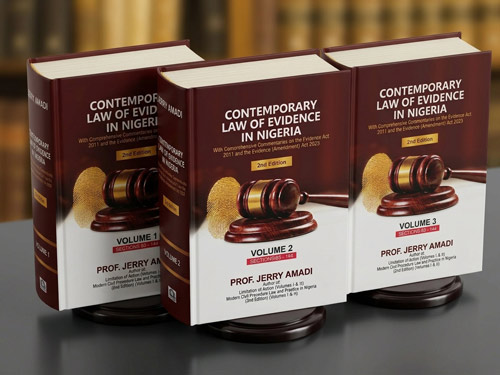 Prof. Jerry Amadi’s Evidence Law, Second Edition (2026), contains 3,314 pages in three volumes, covering the Evidence Act 2011, its 2023 amendment, and 4,051 Nigerian and English cases.