The Federal High Court in Abuja has declared that it is unlawful to use the Nigeria Police Force for loan recovery, describing such actions as an abuse of power and a violation of fundamental rights.

Justice Mohammed Umar issued the ruling in a case involving the arrest and detention of a woman, Helen Shalamba, over a loan and relationship dispute with her former lover, Ogashuwa Okuba.
Ms Shalamba was arrested after Mr Okuba petitioned the police, alleging that she owed him $2,000 and had defrauded him. She was detained on 15 May and released on bail the following day.
Delivering judgment, Justice Umar held that the dispute between the parties was purely civil, with no element of criminality, and that the police acted outside their statutory powers by intervening. He stressed that deploying the police to enforce a civil debt violates constitutional guarantees under Sections 34 and 36 of the Criminal Code.
“The affidavit in support illustrated that the dispute between the applicant and the sixth respondent was purely civil, without any element of criminality,” the judge ruled.
Justice Umar awarded N2 million in damages to Ms Shalamba for unlawful arrest, detention, and infringement of her rights. He further ordered Access Bank and Stanbic IBTC Bank to lift the post-no-debit restrictions placed on her accounts, noting that the restrictions were imposed following a petition and police request.
Although the banks argued that they acted based on a valid court order from a Karu Magistrates Court dated 19 March, the judge declared the order null and void, stating that the sixth respondent improperly used the police to enforce a civil obligation.
The Nigeria Police Force, the Inspector General of Police, senior officers of the Force Criminal Investigation Department, and Mr Okuba did not file any response to the suit.
According to court filings, Ms Shalamba visited Access Bank on 15 May to complain about restrictions on her account when she was arrested. She said she was shown a petition alleging fraud, despite a deputy commissioner of police in the Gender Unit advising that the matter be resolved amicably.
Her lawyer, Ibrahim Alhassan, filed the fundamental rights suit on 12 May under sections 35, 41, 43, and 46 of the Constitution and the African Charter on Human and Peoples’ Rights. Seventeen reliefs were sought, including declarations on the unlawfulness of her arrest, detention, and account restrictions.
The court held that while the banks were right to obey a court order until set aside, the use of the police to compel repayment of a private loan was improper and violated the applicant’s rights.
The judge ruled that Ms Shalamba’s rights to liberty, fair hearing, movement, and property were violated, stating that her arrest and detention without a valid court order were unlawful.
In her affidavit, Ms Shalamba said she met Mr Okuba in 2019, began a relationship in 2020, and borrowed $2,000 from him in 2022 while relocating her boutique. She ended the relationship in 2023 after discovering he was married. She alleged that Mr Okuba then began threatening her life and vowed to disgrace her if she refused to marry him.
The decision reinforces the long-standing judicial principle that police officers have no authority to intervene in or enforce civil debt disputes.
 Reimagine your practice with the power of AI “...this is the only Nigerian book I know of on the topic.” — Ohio Books Ltd
Authored by Ben Ijeoma Adigwe, Esq., ACIArb (UK), LL.M, Dip. in Artificial Intelligence, Director, Delta State Ministry of Justice, Asaba, Nigeria.
Bonus:
Get a FREE eBook titled “How to Use the AI in Legalpedia and Law Pavilion” with every purchase.
Reimagine your practice with the power of AI “...this is the only Nigerian book I know of on the topic.” — Ohio Books Ltd
Authored by Ben Ijeoma Adigwe, Esq., ACIArb (UK), LL.M, Dip. in Artificial Intelligence, Director, Delta State Ministry of Justice, Asaba, Nigeria.
Bonus:
Get a FREE eBook titled “How to Use the AI in Legalpedia and Law Pavilion” with every purchase.
How to Order: 📞 Call, Text, or WhatsApp: 08034917063 | 07055285878 📧 Email: benadigwe1@gmail.com 🌐 Website: www.benadigwe.com
Ebook Version: Access directly online at: https://selar.com/prv626
_______________________________________________________________________ [A MUST HAVE] Evidence Act Demystified With Recent And Contemporary Cases And Materials
 ______________________________________________________________________
“Bridging Theory And Courtroom Practice” — Hagler Sunny Okorie, Nathaniel Ngozi Ikeocha Unveil ‘Functional’ Tort Law Book For Nigerian Legal System
______________________________________________________________________
“Bridging Theory And Courtroom Practice” — Hagler Sunny Okorie, Nathaniel Ngozi Ikeocha Unveil ‘Functional’ Tort Law Book For Nigerian Legal System
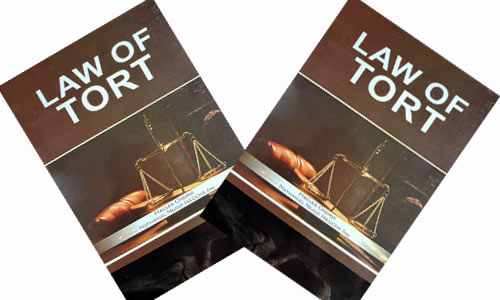 The book, titled The Law of Torts in Nigeria: A Functional Approach, authored by Professor Hagler Sunny Okorie Ph.D and Ikeocha, Nathaniel Ngozi Esq, offers law students, practitioners, and academics a comprehensive guide to understanding and applying tort law in Nigerian courts. Interested buyers can place orders via the following contact numbers: 08028636615, 08037667945, 08032253813, or +234 902 196 2209.