*Calls Out Baseless Corruption Allegations Against Courts

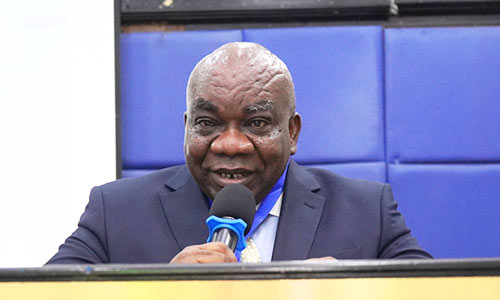
Justice Emmanuel Akomaye Agim of the Supreme Court of Nigeria has delivered a stinging rebuke to legal practitioners, declaring that lawyers bear primary responsibility for most weaknesses in the country’s justice delivery system, including conflicting judgments, delayed trials, and abuse of court processes.
Speaking at the Akaraiwe & Associates 5th Annual Lecture in Enugu on Thursday, Justice Agim pushed back against the growing tendency of legal practitioners to publicly blame courts exclusively for failures in the administration of justice.
“Experience through the cases show that the practices of legal practitioners are in most situations the primary causes of most of these weaknesses because they start the processes that create each weakness,” Justice Agim stated.
The Supreme Court Justice framed his address as a reminder of the shared obligations of the Bench and Bar in ensuring the effective functioning of Nigeria’s legal system.
“The now common tendency of legal practitioners to lead or instigate the public blame of the courts alone for any real or perceived problem in administration of law and justice and the functioning of the legal system suggests that they do not regard their duty or role to support or work with the courts to administer law and justice,” Justice Agim said.
He described courts and legal practitioners as “midwives of our legal system and the custodians of the rule of law,” emphasising that both bear primary responsibility for driving the legal system and ensuring the complete rule of law.
Justice Agim was particularly critical of the role lawyers play in creating conflicting judgments — a persistent source of public criticism of the judiciary.
He explained that conflicting judgments often arise because legal practitioners raise issues already settled by judicial precedents without reference to those precedents, or argue contrary to settled case law.
“This results in judgments that conflict with existing judicial precedent and settled case law,” Justice Agim said.
He cited the Supreme Court’s decision in Chief Jude Okeke V APGA & Ors where the court adjudged the practice of a legal practitioner filing a suit to litigate issues already settled by case law as “unethical,” while the trial judge who admitted and tried such a case engaged in “judicial misconduct.”
“The legal practitioner that filed the Suit No. JDU/022/2021 in contravention of settled law and Section 287(1) of the 1999 Constitution engaged in unethical practice,” Justice Agim quoted from the judgment.
On the crisis of delayed justice, Justice Agim provided stark figures: cases can take up to 8 months to be assigned by Chief Judges, hang in trial courts for 10 years, spend 5-10 years in the Court of Appeal, and another 10 years in the Supreme Court — a total of 15 to 25 years before final determination.
He listed lawyer practices that cause delays: deliberate stalling tactics, use of preliminary objections as roadblocks, frequent adjournment requests, piece-meal litigation, interlocutory appeals aimed at frustrating proceedings, frivolous suits, and encouraging disobedience of court orders.
Justice Agim cited Geepee Industries Nigeria Limited V The MV “Kota Manis” where the Supreme Court noted that a claim filed in 2013 when the exchange rate was N161 to one US dollar remained unresolved 12 years later with the exchange rate at N1,600.
“This massive devaluation of the amount claimed for due to the failure to try and determine the merit of the claim for 12 years has rendered the pursuit of justice in this case illusory and meaningless,” the court held.
Justice Agim reserved sharp criticism for lawyers who publicly allege judicial corruption without evidence.
“Several Nigerian lawyers have spoken in IBA conferences, many local conferences, local and social media making general assertions condemning the Nigerian courts as corrupt. This has largely encouraged the public perception of the courts as corrupt,” he said.
He rejected the 2017 National Bureau of Statistics/UNODC survey that ranked the judiciary as the second most corrupt public institution in Nigeria as “speculative, subjective and baseless.”
“As it is there is very little or scanty evidence-based fact of corruption by judges. So the widely held belief that courts in Nigeria are generally corrupt is based on rumors, unverifiable assumptions, speculations and deliberate falsehood,” Justice Agim stated.
The Supreme Court Justice criticised the practice of lawyers holding press conferences immediately after judgments to condemn decisions they have not yet read.
“Many resort to social media and mainstream media condemning court judgments they have not read in very abusive, condescending and derogatory terms,” he said.
He referenced a case where a “very highly respected senior counsel” allegedly instigated lawyers to condemn a judgment unfavourable to their client, and another instance where a senior counsel described a Supreme Court judgment as “silly” in the presence of the President, members of the Federal Executive Council, and members of the diplomatic corps — without stating any reason.
Justice Agim also addressed the global calumny against the Supreme Court following its judgment in Sunday Jackson V The State, where critics alleged the court upheld the death sentence of a Christian farmer who defended himself against a Muslim Fulani herdsman.
He explained that the court’s majority decision of 4-1 — with three Christians on the panel — found that the appellant’s evidence failed to establish self-defence because after successfully disarming his attacker, he did not retreat but instead stabbed the now-unarmed assailant three times on the throat.
“The stabs on the assailant clearly amount to reprisal or revenge attacks and not acts of self-defence,” Justice Agim stated.
Justice Agim recalled statements by then-NBA President Yakubu Maikyau (SAN) who condemned lawyers appearing on television to castigate Supreme Court judgments.
“When I read the heart-rending statements by Professor Farooq Kperogi over the judgement of the Supreme Court in the case involving Bashir Machina and Ahmed Lawan, I was burning with rage against Kperogi, only to hear like a whisper in my ear, while I sat alone lamenting that, ‘you people started it, you Senior Advocates of Nigeria,'” Maikyau was quoted as saying.
Justice Agim outlined the dual nature of judicial independence — external and internal.
External independence requires that judicial officers are subject only to the Constitution and laws, free from interference by the executive, litigants, legal practitioners, friends, family members, and heads of courts.
“The common assumption is that interference and control by litigants and legal practitioners is fast emerging as the most serious threat to a judicial officer’s external decisional independence,” he warned.
Internal independence, he explained, requires judicial officers to have a settled mindset and personal commitment to contribute to the country’s development, rather than viewing the office “purely as an employment opportunity, a means of self-aggrandizement or amassing wealth.”
Justice Agim did not argue that courts should be immune from criticism. Instead, he called for responsible engagement.
“Comments on court judgments should be made only after reading the judgments with the motive of making contributions to the advancement of the rule of law and better functioning of the legal system and not to scandalize or calumniate the judges or blackmail the judiciary,” he said.
He urged lawyers with evidence of judicial corruption to use the NJC’s established processes rather than resort to media propaganda.
“Calumniating judges and instigating the public against them through media propaganda of baseless allegations of corruption creates the bigger problem of loss of public trust and confidence in the courts,” Justice Agim stated.
Justice Agim’s speech represents a significant intervention from the highest court in the land, directly challenging the legal profession to examine its own practices rather than reflexively blaming the judiciary for systemic failures.
His detailed cataloguing of lawyer practices that undermine justice delivery — and the Supreme Court precedents condemning such practices — suggests the court is prepared to take a harder line on professional misconduct.
For the Nigerian Bar Association and senior members of the profession, the speech poses uncomfortable questions about self-regulation and the culture of accountability within the legal profession.
The timing of the address — amid ongoing debates about judicial corruption and the integrity of election-related judgments — makes it a pointed reminder that the courts expect lawyers to share responsibility for public confidence in the justice system.
 Reimagine your practice with the power of AI “...this is the only Nigerian book I know of on the topic.” — Ohio Books Ltd
Authored by Ben Ijeoma Adigwe, Esq., ACIArb (UK), LL.M, Dip. in Artificial Intelligence, Director, Delta State Ministry of Justice, Asaba, Nigeria.
Bonus:
Get a FREE eBook titled “How to Use the AI in Legalpedia and Law Pavilion” with every purchase.
Reimagine your practice with the power of AI “...this is the only Nigerian book I know of on the topic.” — Ohio Books Ltd
Authored by Ben Ijeoma Adigwe, Esq., ACIArb (UK), LL.M, Dip. in Artificial Intelligence, Director, Delta State Ministry of Justice, Asaba, Nigeria.
Bonus:
Get a FREE eBook titled “How to Use the AI in Legalpedia and Law Pavilion” with every purchase.
How to Order: 📞 Call, Text, or WhatsApp: 08034917063 | 07055285878 📧 Email: benadigwe1@gmail.com 🌐 Website: www.benadigwe.com
Ebook Version: Access directly online at: https://selar.com/prv626
_______________________________________________________________________ [A MUST HAVE] Evidence Act Demystified With Recent And Contemporary Cases And Materials
 _______________________________________________________________________